Missing Persons, Forced Labor, and Human Trafficking: Harsh Realities
'Universal Jurisdiction' Criminal Prosecution of North Korea... Is It Feasible?
"Need to Draw International Attention and Raise Awareness"
The United Nations Office of the High Commissioner for Human Rights (OHCHR) has released a report on North Korea's human rights situation for the first time in two years, holding the North Korean regime accountable for human rights violations. In particular, it proposed a measure for member states to criminally prosecute perpetrators of crimes within North Korea through 'universal jurisdiction.' However, the feasibility and effectiveness of this approach remain uncertain.
According to the Ministry of Foreign Affairs on the 25th, OHCHR recently published the "Report on Accountability for Human Rights in North Korea" and submitted it to the 52nd session of the UN Human Rights Council, held in Geneva, Switzerland, from the 27th of this month to early April.
The Report on Accountability for Human Rights in North Korea was first prepared following the adoption of the North Korea human rights resolution at the 49th session of the UN Human Rights Council in 2019, and this is the third report following the 2021 edition. This report was based on the activities of the North Korea Human Rights Accountability Team, composed of the Seoul UN Human Rights Office and OHCHR, over the past two years.
Disappearances, Forced Labor, Human Trafficking... North Korea, the Worst Human Rights Violator
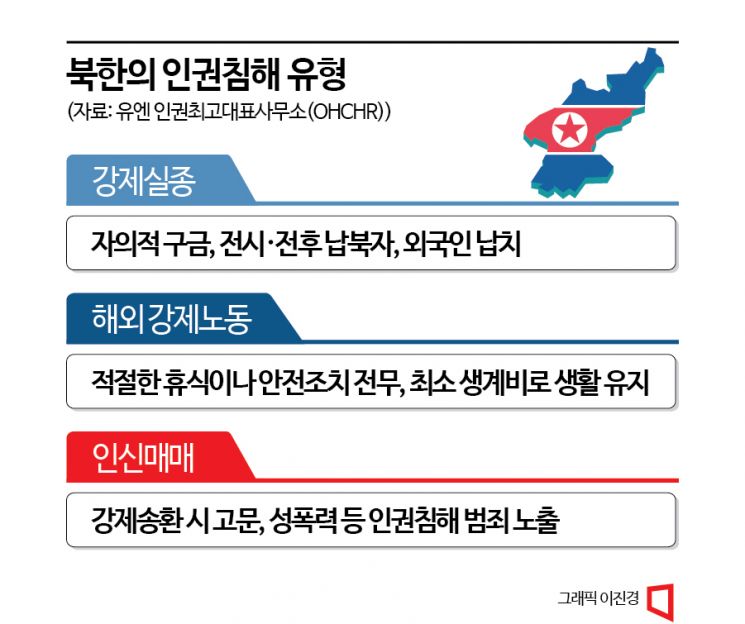
The report categorized the types of human rights violations by the North Korean regime into three: ▲ enforced disappearances ▲ forced labor overseas ▲ human trafficking.
'Enforced disappearances' include not only arbitrary detention and enforced disappearances within North Korea but also the abduction of people during and after wartime and foreign nationals. The report criticized the systematic enforced disappearances and inhumane crimes, mentioning prisoners of war and foreigners abducted to North Korea from the Korean War until the 1980s. It also pointed out that not only the victims but their families have had to live in prolonged suffering.
Regarding 'forced labor overseas,' the report pointed out that North Korea forces numerous workers to work abroad under coercion. An investigation team interviewed 18 overseas dispatched workers and found that they endured intense labor under government control, working long hours without adequate rest or necessary safety measures. Workers in poor working conditions were surviving on minimum living expenses.
'Human trafficking' has been a consistent issue raised by the international community. The investigation team contacted women who were sold to neighboring countries for employment or marriage and found that the victims feared forced repatriation to North Korea if their origin was discovered. There were concerns that if these women were taken back to North Korea, they would be exposed to crimes such as detention, torture, and sexual violence.
Creative Strategy... "Prosecute North Korean Criminals through Universal Jurisdiction"
The report acknowledged the existence of serious human rights violations by North Korea that may constitute crimes against humanity and other international crimes, urging immediate measures to stop them. It called on member states of the Human Rights Council to take additional actions to hold perpetrators accountable, recommending direct investigations of suspects accused of human rights violations in North Korea whenever possible.
To this end, it proposed a "novel and creative strategy," namely, for each member state to exercise 'universal jurisdiction.' Universal jurisdiction is the concept that a state has the obligation to punish perpetrators even if the offender is not its national and the crime occurred abroad. This applies to all countries, including South Korea, that follow the principle of universality.
For example, Argentine judicial authorities investigated the Myanmar government's genocide against the Rohingya in 2021 based on the principle of universality. The German court sentenced a former Syrian intelligence officer involved in torturing and killing anti-government protesters during the Syrian civil war. In this way, most countries punish perpetrators of war crimes, human trafficking, terrorism, and other serious anti-human rights crimes.
The report mentioned that "South Korea may prosecute perpetrators of human rights violations in North Korea by utilizing universal jurisdiction." It also emphasized the need for measures to hold "criminal responsibility" through the International Criminal Court (ICC) or the establishment of special tribunals. Elizabeth Salm?n, the UN Special Rapporteur on human rights in North Korea, also argued for criminal prosecution of North Korea's human rights violations at the UN General Assembly Third Committee meeting in October last year.
'Feasibility' Uncertain... "Maintaining International Attention is Also Important"
However, whether criminal responsibility can actually be imposed on North Korea remains uncertain. North Korea has strongly opposed human rights criticisms. Whenever the South Korean government condemns it, North Korean propaganda media often respond by claiming that "unlike the Democratic People's Republic of Korea, which respects women, discrimination and oppression are rampant in the South." Especially when accountability is demanded, North Korea interprets it as an "insult to the supreme dignity," invoking national sovereignty.
Practically, the ICC can only investigate and prosecute parties to the Rome Statute since 2002, and North Korea, not being a party, cannot be subject to investigation. Although the UN Security Council could exceptionally investigate non-party states, this is nearly impossible given that China and Russia, both permanent members with veto power, frequently block resolutions. Sanctions resolutions that arise whenever North Korea launches intercontinental ballistic missiles (ICBMs) have all been vetoed.
Regarding universal jurisdiction, apart from the victim states such as South Korea, the United States, and Japan, it is generally expected that few member states would bear the burden of criminal prosecution. There are clear practical limitations in securing suspects and collecting evidence. While OHCHR acknowledges the low likelihood of holding North Korea accountable, it repeatedly emphasized that each country must consider solutions and prosecution of perpetrators.
An official from the Ministry of Foreign Affairs criticized, "It is deplorable that the North Korean regime neglects the human rights and livelihoods of its people while focusing solely on nuclear and missile development." Regarding this report, the official said, "The record itself is important, but it is even more important in maintaining international attention and raising awareness." The government pledged to continue efforts to inform the international community about the dire human rights situation in North Korea.
© The Asia Business Daily(www.asiae.co.kr). All rights reserved.



















