Casualty and Bereaved Family Support Excludes Caregiving Costs
"A Disaster Caused by Social Calamity... The State Must Step In"
Survivors of the Itaewon disaster and their families are experiencing financial difficulties due to caregiving costs. Although the government created the 'Itaewon Accident Medical Expense Support Guidelines' to assist the victims and bereaved families, caregiving expenses were excluded, creating a blind spot. There are calls for the need to develop a plan to comprehensively expand the medical expense support guidelines.
On the 24th, the 10·29 Itaewon Disaster Bereaved Families Association and the Citizens' Countermeasure Meeting issued a statement urging measures to support caregiving costs. They expressed their difficulties, saying, "There is no mention of caregiving expenses in the 'Itaewon Accident Medical Expense Support Guidelines,' causing survivors and their families who have been battling illness for a long time to suffer."
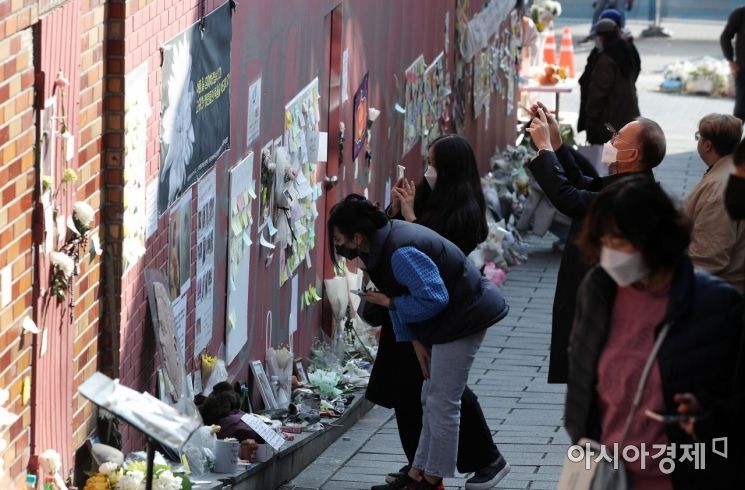 On the 17th, visitors continued to pay their respects at the Itaewon disaster site in Yongsan-gu, Seoul. Photo by Hyunmin Kim kimhyun81@
The issue with the Itaewon Accident Medical Expense Support Guidelines surfaced recently as cases of Itaewon survivors struggling financially due to expensive caregiving costs became known.
According to Yong Hye-in, a member of the Basic Income Party, A, a person in their 20s who suffered brain damage due to cardiac arrest during the disaster, has been unconscious for about four months, and A's family has not received caregiving cost support. A's caregiving expenses amount to about 5 million won per month, and due to the heavy burden, A's mother has even quit her job to provide care, resulting in 'caregiving unemployment,' leading to financial hardship.
However, the government maintains that caregiving costs are not covered by health insurance under the medical system, making support difficult. Currently, caregiving costs are considered one of the three major non-reimbursable expenses along with selective treatment fees and premium hospital room charges. Previously, the Central Disaster and Safety Countermeasures Headquarters provided support to the Itaewon bereaved families under the Itaewon Accident Medical Expense Support Guidelines, but economic burdens related to caregiving costs were not included.
In this regard, there are calls to comprehensively expand the medical expense support guidelines. On the 22nd, Representative Yong stated on her Facebook, "The Itaewon disaster was a social disaster caused by insufficient disaster prevention and preparedness by the government and local governments," and argued that retroactive application of caregiving cost support is necessary.
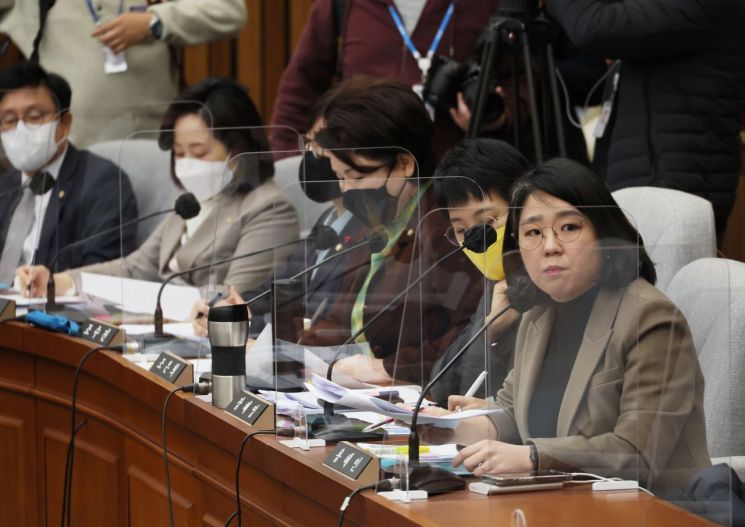 Yong Hye-in, a member of the Basic Income Party, is questioning at the '1st Hearing of the Special Committee on the Itaewon Disaster National Investigation' held at the National Assembly on January 4. Photo by Yonhap News Agency
Representative Yong pointed out, "The hospital diagnosis clearly states that caregiving is necessary, and local governments have long sent official letters requesting caregiving cost support to the Office for Government Policy Coordination, the Ministry of the Interior and Safety, and the Ministry of Health and Welfare," adding, "The Yoon Seok-yeol administration keeps repeating that caregiving costs are not covered under the 'Itaewon Accident Medical Expense Support Guidelines' and that support is 'not possible.'"
She continued, "Families of survivors who lost their daily lives with their loved ones due to the state are still isolated amid the government's ongoing irresponsibility and neglect," urging, "The state, which failed to protect its citizens in the face of the disaster, must now fulfill its responsibilities."
Shin Hyun-young, a member of the Democratic Party of Korea, also advocated for simplifying the medical expense application process and comprehensively expanding the support period and target scope. Representative Shin emphasized, "The government must actively communicate with the victims to establish an advanced disaster response system centered on the victims, including simplifying the medical expense application process, comprehensively expanding the support period and target scope, introducing a primary care physician system and cohort construction for the victims, and expanding caregiving cost support."
© The Asia Business Daily(www.asiae.co.kr). All rights reserved.


















