A Village of 6,000 Residents, Nagicho
Local Government Provides Unprecedented Childcare Support for 20 Years Amid Extinction Fears
[Asia Economy Reporter Jeon Jinyoung] In Japan, where the total fertility rate has become a social issue alongside South Korea at 1.33, a local government has attracted attention for raising the birth rate to 2.95. This local government has even reduced the number of local assembly members to secure the budget and employed retired elderly people to create childcare hubs, setting a standard for low birthrate and aging population countermeasures within Japan.
According to the Nihon Keizai Shimbun (Nikkei) on the 24th, the total fertility rate of Nagi-cho (奈義町) village in Okayama Prefecture, Japan, recorded 2.95, ranking first among all municipalities in Japan. Earlier, on the 19th, Japanese Prime Minister Fumio Kishida, who has been dedicating efforts to low birthrate countermeasures, personally visited and inspected Nagi-cho village. Within Japan, it is literally called the "miracle village."
Low Birthrate Measures Started from Concerns over Local Government Extinction
The background behind the small Nagi-cho village, with a population of just over 6,000, being able to raise the birthrate this much was the voluntary movement of residents worried about the extinction of their local government.
Until the early 2000s, Nagi-cho village experienced severe rural depopulation, with the population continuously decreasing and the birthrate plummeting to around 1.4. In 2002, a residents' referendum was held on merging with surrounding municipalities, which further heightened the sense of crisis over the extinction of the local government. The people of Nagi-cho opposed the merger and decided to remain an independent village, but as a result, central government support was reduced. Drastic measures were needed to save the village.
Accordingly, local residents and officials united to explore various ways to increase the village population. After long discussions, attracting new child-rearing generations emerged as the only solution.
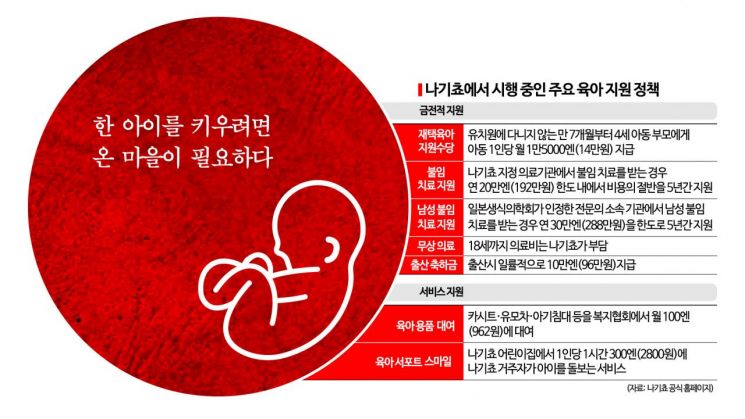
Since 2005, Nagi-cho village has pushed forward strong childcare support measures for nearly 20 years. The village first reduced the number of local government officials and assembly members by 20-30% compared to before, creating more than 100 million yen (approximately 960 million KRW) annually in childcare support funds. Through this, they were able to establish about 20 comprehensive childcare support items, ranging from childbirth to childcare and educational support.
Comprehensive Support Policies from Childbirth and Infertility to Childcare
Nagi-cho village strengthened support for infertility treatment first. When receiving infertility treatment at designated medical institutions, half of the treatment cost is supported up to 200,000 yen (1.92 million KRW) annually for five years. For male infertility, treatment costs are supported up to 300,000 yen (2.88 million KRW) annually within the same period. Upon childbirth, a lump-sum congratulatory payment of 100,000 yen (960,000 KRW) is given.
They also worked on providing services and infrastructure for childcare support. Car seats, strollers, and baby cribs for children can be rented from the Social Welfare Council for 100 yen per month. Additionally, the village runs the "Childcare Support Smile" program, where village residents look after children for 300 yen (2,800 KRW) per hour per child at local daycare centers.
For parents with children aged from 7 months to 4 years who do not attend daycare, a home childcare support allowance of 15,000 yen (140,000 KRW) per child per month is provided, and the village covers all medical expenses until the child reaches adulthood at 18 years old.
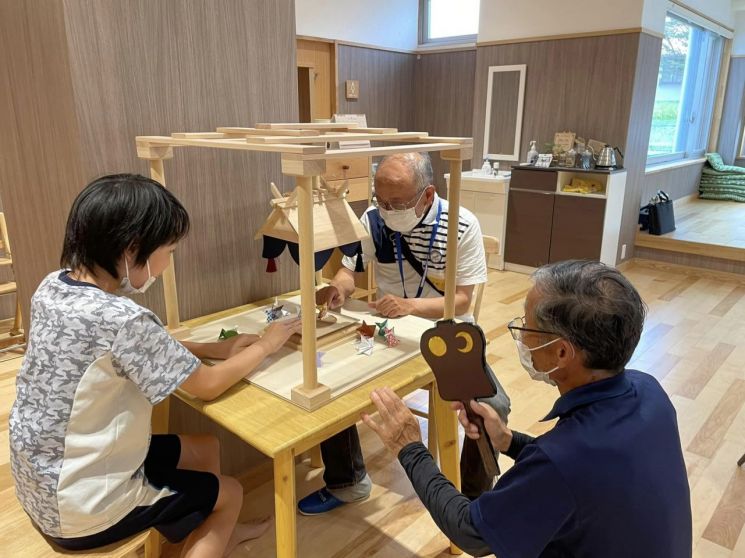 Elderly people are spending playtime with children at 'Nagi Child Home.' (Photo by Nagi Child Home official website)
What stands out in Nagi-cho village’s childcare policy is the encouragement of elderly residents’ participation in childcare support service programs. They established the "Nagi Child Home," a childcare hub in the center of the village, and had elderly people with childcare experience support childcare duties. The elderly formed a community that also counseled young couples on childcare concerns. This allowed simultaneous solutions to low birthrate and aging population issues.
Due to these groundbreaking support measures, the number of newlywed couples moving in from other cities began to increase. A newlywed couple who recently moved to Nagi-cho said in an interview with Japan’s TBS broadcast, "In Nagi-cho, it feels like the entire community raises the children."
Nagi-cho’s remarkable achievements are evaluated to have been possible due to broad understanding and voluntary participation of local residents even before the financial input. An administrative official from Nagi-cho said in an interview with Nikkei, "This policy is a measure that other municipalities can also implement," but emphasized, "However, a system where administration and residents respond with one heart does not come overnight. The driving force behind childcare support is the understanding of the entire community, which is more difficult than securing funds."
© The Asia Business Daily(www.asiae.co.kr). All rights reserved.


















