If China's Economy Recovers, It Will Help Improve Semiconductor and Trade Balance
However, China-Driven Oil Price Rise Negatively Affects Korea's Inflation and Interest Rates
China's economy has emerged as a key variable determining South Korea's growth, inflation, and benchmark interest rate trends this year. Since South Korea has a very high dependence on exports and tourism to China, the positive momentum from China is expected to help boost South Korea's growth rate immediately. However, as China is reviving its economy with a focus on domestic demand, some analyses suggest it may not have the same effect as in the past. The Bank of Korea explained that China is the most important 'variable' determining the growth and inflation trends of South Korea's economy this year, but the uncertainty remains high, making it difficult to assess the extent of its impact.
According to the Bank of Korea on the 24th, China's economy, after abandoning its 'zero-COVID' policy, has recently shown rapid recovery. Earlier this year, the market expected that the easing of China's quarantine policies would cause the economy to stall at least until the first half of the year due to an increase in COVID-19 cases and the resulting contraction in consumer sentiment. However, as the number of confirmed cases has recently declined, the recovery momentum has increased. The Bank of Korea stated in its revised economic outlook released the day before that "China's economy was initially expected to recover in earnest after the second half of the year, but the recovery is now projected to begin earlier, from the second quarter."
Jeong Won-il, a researcher at Yuanta Securities, analyzed, "With the rapid easing of China's lockdown orders and strong policy stimulus intentions, South Korea needs to consider the possibility of changes in export trends again. If China can resume its role as a production base, South Korea's exports could soon see a directional shift." Although there are many opinions that South Korea should reduce its dependence on China and diversify production plants due to the fallout from US-China conflicts, this process will take considerable time. Therefore, South Korea's economic fortunes are expected to be closely tied to China's movements for the foreseeable future.
If China's Economy Recovers... Benefits for South Korean Semiconductors and Exports
The government and market have high expectations for China this year. A representative area is exports. Semiconductors are South Korea's largest export item, accounting for 20% of total exports, and 55% of these semiconductors are destined for China. As China's economy revives and semiconductor demand increases, there is much hope that the trade deficit, which has accumulated for 11 consecutive months, will improve. In fact, last month's trade deficit was recorded at $12.69 billion, with semiconductor export contraction accounting for 19.8% and China-related factors 20.3%, both representing significant shares.
In particular, the economic structure between South Korea and China involves South Korea exporting intermediate goods to China, which then processes them and exports to other countries. Therefore, the ripple effect on South Korea's economy depends heavily on the degree of China's recovery. However, the impact on South Korea's economy varies depending on the direction of China's recovery, so it is difficult to evaluate it as purely positive. For example, if China recovers centered on investment and exports, South Korea can gain secondary benefits, but if consumption or real estate sectors dominate, the effect will be significantly reduced.
Lee Chang-yong, Governor of the Bank of Korea, said at a press conference following the monetary policy meeting the day before, "Unlike in the past, China's economic recovery is centered on consumer goods rather than investment goods, raising concerns about whether South Korea, which supplies intermediate goods to China, can see the same effects as before." He added, "Previously, a 1% increase in China's economy was estimated to help South Korea's growth rate by about 0.2 to 0.25%, but this time, we conservatively included about half of that effect in our internal forecasts."

GDP Increases by 0.08% per 1 Million Chinese Tourists
The extent to which Chinese tourists increase this year is also expected to be an important variable for South Korea's economic recovery. Before the spread of COVID-19 in 2019, the number of Chinese tourists reached 6 million, but now it has sharply dropped to around 200,000. The Bank of Korea expects that with the easing of China's stringent quarantine measures this year, about 1.95 million Chinese tourists will visit, recovering to 33% of the pre-COVID-19 level, and by the end of the year, this ratio will increase to 55%.
According to the Bank of Korea's analysis, South Korea's economic growth rate increases by 0.08 percentage points for every 1 million Chinese tourists. Even if the number recovers to the 3 million range, it would arithmetically result in a 0.24 percentage point growth rate increase. Starting next month, post-arrival COVID-19 PCR testing for arrivals from China will be lifted, and entry will be possible through airports other than Incheon Airport, which is expected to further increase travel demand. Kim Woong, Director of the Bank of Korea's Research Department, said, "(If) more Chinese tourists come than expected, it will have a positive effect on the growth rate."
A significant increase in Chinese tourists would also positively impact South Korea's employment. This year, the number of employed persons is expected to sharply decrease from 820,000 last year to the 100,000 range due to the full-scale economic slowdown. Nevertheless, the Bank of Korea raised its employment increase forecast from 90,000 in November last year to 130,000 the day before, reflecting expectations of employment growth due to the resumption of Chinese travel. Director Kim explained, "We adjusted the numbers considering that employment in related industries will increase as tourists come in due to the China reopening effect."
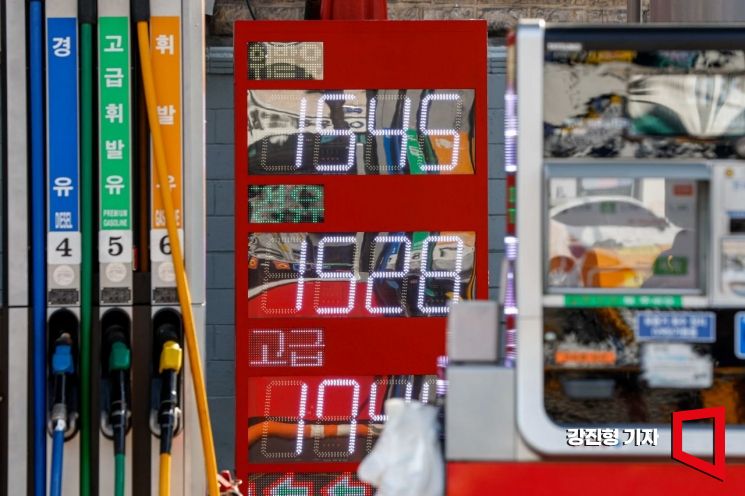 On the 15th, gasoline was being sold at 1,545 won per liter and diesel at 1,528 won per liter at a gas station in Incheon. The price of diesel, which had been more expensive than gasoline, has recently narrowed to the lowest difference of the year due to the rise in gasoline prices and the fall in diesel prices. Photo by Jinhyung Kang aymsdream@
Rising Oil and Raw Material Prices from China Pose a Burden
However, since both the speed of China's economic recovery and the scale of Chinese tourists are highly uncertain, the possibility of the Bank of Korea's forecast missing the mark cannot be ruled out. The Bank of Korea significantly raised China's growth forecast for this year from 4.5% in November last year to 5.0%, but it still cannot guarantee the timing and effect of recovery following China's reopening. If China's economic recovery is slower than expected or US-China conflicts worsen, the contribution of exports and tourism could decrease, potentially failing to secure even the 1.6% growth rate forecast for this year.
If China regains growth momentum and increases demand for oil and raw materials, it could rekindle domestic and international inflationary pressures. Rising international oil prices would stimulate import prices, dampen consumer sentiment, and increase pressure on the Bank of Korea to raise benchmark interest rates. The Bank of Korea expects inflation to fall to the 4% range next month and drop to the low 3% range by the end of the year, which is why it kept the benchmark interest rate unchanged this time. If inflation does not follow this path, the Bank will have no choice but to consider raising rates again, which is likely to lead to a decline in domestic growth. The international oil price forecast was lowered from $93 per barrel in November last year to $84, but how much China will push it up remains a key variable.
Governor Lee said, "There is much discussion about the possibility of global oil prices rising due to China's reopening, but looking at the inflation futures market, that factor has not yet been reflected." He added, "If China's economic recovery raises international energy prices, it will be negative for South Korea. This is an issue that needs to be closely monitored beyond the second quarter."
© The Asia Business Daily(www.asiae.co.kr). All rights reserved.



















