Ministry of Science and ICT Finalizes Basic Concept for Power Generation Demonstration Reactor
ITER to Verify Chain Reaction in 2030s, Aiming for Power Production in 2050s
South Korea is preparing in advance for the era of nuclear fusion power generation, which is expected to become full-scale in the 2050s. The country has decided to develop a 500MW-class power production demonstration reactor and has established related technology development and operational goals as well as design standards.
On the afternoon of the 23rd, the Ministry of Science and ICT held the 18th National Nuclear Fusion Committee meeting and deliberated and approved the agenda titled "Basic Concept of Power Production Demonstration Reactor for Realizing Nuclear Fusion."
South Korea began full-scale nuclear fusion energy research as part of the Korea-US international research cooperation project during the Kim Young-sam administration. The ambitious goal is to create an "artificial sun" that replicates the nuclear fusion chain reaction occurring in the sun on Earth, aiming to simultaneously resolve humanity's energy crisis and environmental issues such as climate change. In particular, in 2008, Korea invested 400 billion won to install the Korea Superconducting Tokamak Advanced Research (KSTAR) device at the Daedeok Research Complex in Daejeon. This facility acquires technology and operational know-how to maintain ultra-high temperature plasma above 100 million degrees Celsius, which is essential for nuclear fusion, for extended periods. In November 2021, KSTAR succeeded for the first time in the world in maintaining an ion temperature of 100 million degrees Celsius for more than 30 seconds, leading international research.
However, there are facility limitations for full-scale nuclear fusion chain reaction research, which is essential for energy production. Therefore, South Korea, along with seven countries including the United States and the European Union (EU), is constructing the International Thermonuclear Experimental Reactor (ITER) in southern France. ITER is expected to achieve the first ignition of the magnetic confinement fusion chain reaction, which has not yet been realized, by incorporating neutron shielding devices that occur during nuclear fusion. The international research team developing ITER anticipates achieving a Q factor of 10, far exceeding the 1.5Q (output energy to input laser energy ratio) achieved last year by the US Lawrence Livermore National Laboratory through laser fusion. This means that the theoretical proof and technical foundation necessary for the energy production of magnetic confinement fusion will be completed. Due to delays caused by the COVID-19 pandemic and other factors, ITER is expected to be completed around 2035 to 2038. Consequently, the success of the nuclear fusion chain reaction is also postponed until after that time.
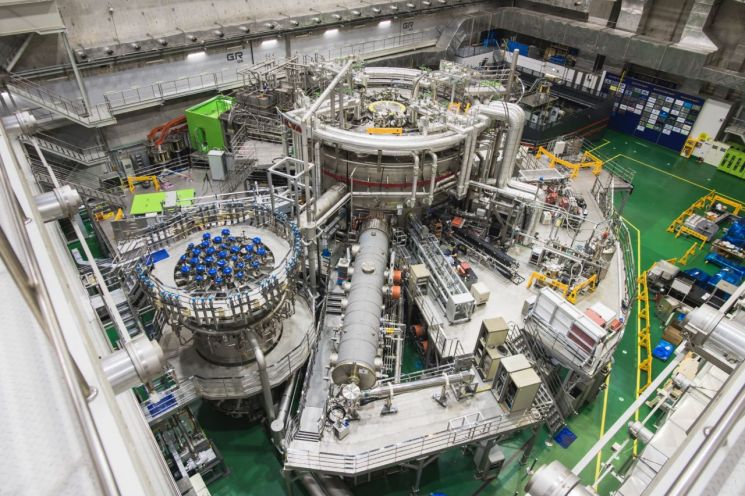
However, the major participating countries have already begun full-scale development of related technologies to actually produce power using neutrons, assuming the success of ITER's nuclear fusion chain reaction. By finalizing the basic concept on this day, South Korea has officially entered the competition for practical nuclear fusion energy. First, through this basic concept, South Korea plans to build a demonstration reactor with a maximum electric output of 500MW or more. The effective self-sufficiency rate of tritium fuel is set to be 1 or higher. Safety will be verified regarding the handling of tritium and the treatment of low- and intermediate-level radioactive waste, while data will be secured to calculate competitive power production costs and verify "economic feasibility." The demonstration reactor will be a tokamak type with a major radius within 7 meters, designed to operate with over 60% device availability, a design life of over 40 years, and safety standards for earthquakes up to magnitude 7.0.
Going forward, preliminary conceptual design will be completed by 2026, conceptual design by 2030, and actual engineering design will begin in 2035. To achieve a tritium effective self-sufficiency rate of 1 or higher, South Korea plans to jointly research with the EU to secure breeding blanket technology for fuel self-sufficiency in the demonstration reactor. The breeding blanket is a component of the nuclear fusion reactor core's inner wall that produces tritium, the nuclear fusion fuel, through neutron-lithium reactions.
Lee Jong-ho, Minister of Science and ICT, said, "Nuclear fusion energy, the technology of the artificial sun, is a challenging field with the potential to simultaneously solve carbon neutrality and energy security. Based on Korea's excellent technological capabilities, we will prepare to lead nuclear fusion energy development in the demonstration stage following ITER."
© The Asia Business Daily(www.asiae.co.kr). All rights reserved.
![Clutching a Stolen Dior Bag, Saying "I Hate Being Poor but Real"... The Grotesque Con of a "Human Knockoff" [Slate]](https://cwcontent.asiae.co.kr/asiaresize/183/2026021902243444107_1771435474.jpg)










