Five Outstanding Cases Selected Among 18 Cultural Cities
Annual Support of 1.5 Billion KRW for Selected Cultural Cities
[Asia Economy Reporter Kim Heeyoon] Seogwipo City has been selected as this year’s Cultural City leading regional development through local content.
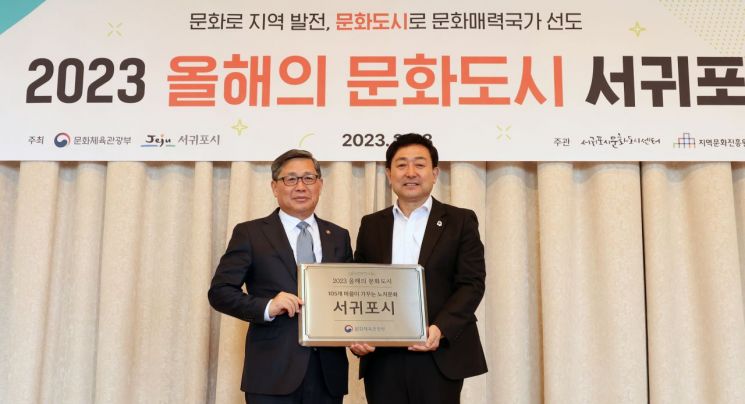 Jeon Byeong-geuk, the 1st Vice Minister of the Ministry of Culture, Sports and Tourism, is taking a commemorative photo on the 23rd after presenting a plaque to Lee Jong-woo, the Mayor of Seogwipo City, representing Seogwipo City, which was selected as the 2023 City of Culture, at the Kal Hotel in Seogwipo City, Jeju Island.
 [Photo by Ministry of Culture, Sports and Tourism]
The Ministry of Culture, Sports and Tourism announced on the 23rd at the Seogwipo KAL Hotel in Jeju that Seogwipo City was selected as this year’s Cultural City. The ‘Cultural City of the Year’ is a system that selects one city representing cultural cities among the top cities every year, and Seogwipo City was chosen as the first Cultural City of the Year.
A Cultural City refers to a city designated by the Minister of Culture, Sports and Tourism under the ‘Regional Culture Promotion Act’ to effectively utilize the region’s unique cultural resources and strengthen cultural creativity. From 2019 to 2022, a total of 24 cultural cities were designated: 7 in the 1st phase, 5 in the 2nd phase, 6 in the 3rd phase, and 6 in the 4th phase.
The Ministry, together with the Cultural City Deliberation Committee, reviewed the achievements of 18 cultural cities that promoted cultural city projects last year and selected five top cities leading balanced development through culture: Seogwipo City, Cheongju City, Chuncheon City, Wanju County, and Miryang City.
The Ministry supported a total of 1.5 billion KRW in national funds to each of the 18 cities from the 1st to 3rd phases in 2022 to comprehensively and systematically back regional development through culture by ▲improving local cultural conditions ▲discovering and supporting cultural content based on unique local culture ▲nurturing creative cultural talents.
Seogwipo’s cultural city project begins with ‘Noji Culture,’ where the lives of local residents living with nature such as Hallasan Mountain, oreums (volcanic cones), forests, fields, coastlines, and the sea become culture itself. Seogwipo was designated as the 1st phase cultural city to create a global ecological cultural city for future generations together with citizens, based on diverse Noji cultures rooted in 105 villages, which are cultural assets that are both the source of culture and open the future.
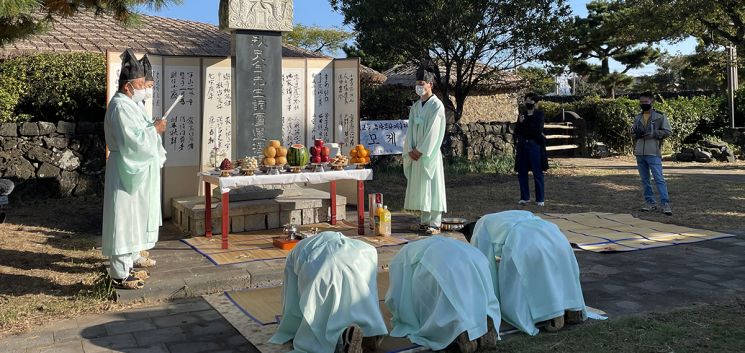 Seogwipo, selected as this year's Cultural City, plans to promote projects based on the 'Noji Culture,' which is composed of 105 villages. The photo shows the ancestral rites culture in the Seogwipo area.
 [Photo by Seogwipo City]
Seogwipo is promoting five core tasks: ▲‘Ecological Cultural Seeds’ to establish a cultural foundation where Noji culture can be enjoyed ▲‘Future Cultural Garden’ as the basis of cultural economy for future generations ▲‘Creative Cultural Farmers’ to nurture creative and challenging talents in Seogwipo ▲‘Building a Seogwipo-style Cultural City Brand’ to make Seogwipo, an agricultural and tourist city, an international cultural city ▲Establishing a cultural city foundation led by local residents.
At the event, Jeon Byeonggeuk, 1st Vice Minister of the Ministry of Culture, Sports and Tourism, announced five major achievements based on the review of projects promoted last year by 18 cultural cities including Seogwipo.
The main achievements include ▲promotion of a locally led cultural policy system such as establishing mid- to long-term cultural development strategies and local cultural foundations ▲improvement of local cultural conditions through expansion of cultural spaces and cultural programs utilizing them ▲creation of new city brands using unique local culture ▲revitalization of the local economy by developing cultural products using local content ▲cultural cities functioning as platforms for linkage and cooperation among various urban policies.
Since the announcement of the cultural city promotion plan in 2018, out of 243 metropolitan and local governments nationwide, 103 (42%) have diagnosed their unique cultural conditions led by the region and established mid- to long-term strategies for urban development, and 88 local governments have enacted ‘Cultural City Ordinances,’ making culture the central axis of regional development. In particular, the number of cultural foundations at the local government level surged from 71 in 2018 to 117 currently, contributing to the establishment of a locally led cultural policy promotion system.
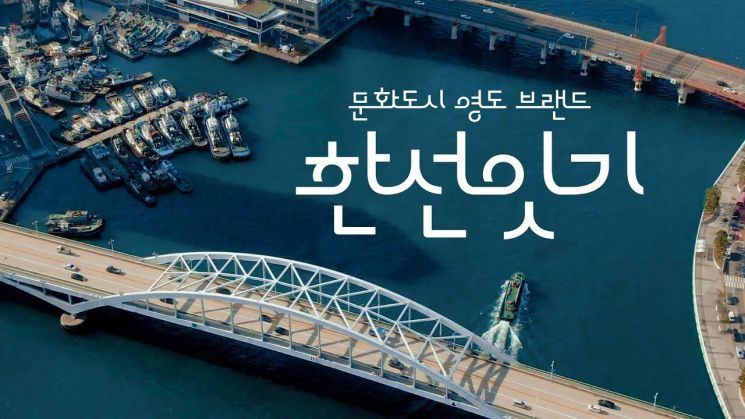
Yeongdo District in Busan achieved a remarkable feat by winning three awards at world-renowned design awards in 2022 alone, implementing the island culture characteristics connected to the city through the ‘Hanseon Itgi’ brand method rather than promoting specific places or specialties of the city.
Wanju County, considering geographical constraints and the characteristics of a mixed urban-rural area, is carrying out the ‘Byeolbyeol Village Hall’ project linking senior centers and village halls, as well as supporting cultural activities during the off-season, achieving a ‘city where urban and rural meet and are completed by culture, a city where people settle through culture.’
Chuncheon City, utilizing abandoned empty houses and vacant stores in the old downtown as cultural activity spaces, runs projects such as ‘Urban Salon,’ where space owners like chicken restaurants, jjambbong (spicy noodle soup) shops, and bowling alleys plan cultural activity spaces and share them with citizens, creating a lifestyle-oriented cultural city that citizens can feel closely.
Cheongju City produced and performed the creative opera ‘Opera Cheongju Arirang’ through the ‘Made in Cheongju’ project, which discovers regionally specialized artistic content, receiving a positive response. Additionally, through the ‘Youth Culture Shop Goodju’ project (a unique cultural city Cheongju brand combining ‘goods’ and the Chungcheong dialect ending “~yu”), it developed over 200 types of goods from 20 local brand teams and supported their global expansion by entering the Osaka Umeda goods shop ‘Hantime (韓time)’ in Japan.
Miryang City transformed the old Miryang University campus site, abandoned as urban waste for over 10 years, into the ‘Sunshine Culture Campus’ through the cultural city creation project. This campus has become a hub for inter-ministerial and regional cooperation by linking with the Ministry of the Interior and Safety’s communication and cooperation space creation project, Gyeongnam Office of Education’s Sea of Wisdom library project, and Ministry of Education’s Polytechnic University creation project.
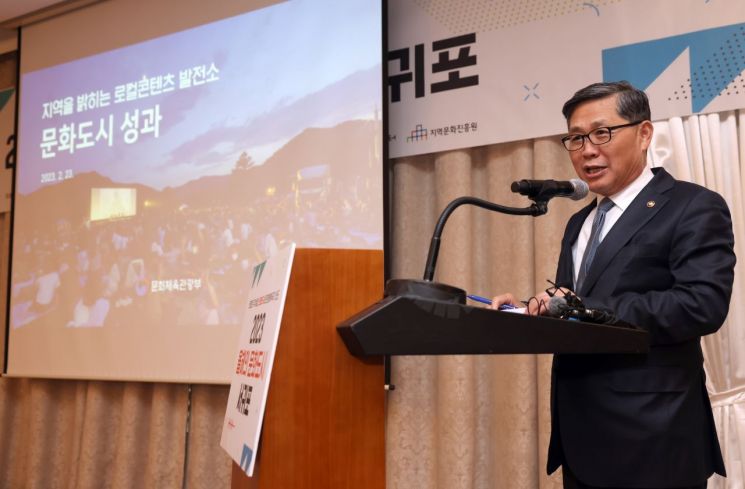 Jeon Byeong-geuk, the 1st Vice Minister of the Ministry of Culture, Sports and Tourism, is holding a press briefing on the 23rd regarding Seogwipo City, which was selected as this year's Cultural City, and related projects.
 [Photo by Ministry of Culture, Sports and Tourism]
The Ministry plans to support a total of 36.4 billion KRW to 24 cultural cities from the 1st to 4th phases in 2023 to back locally led cultural city creation projects. Furthermore, it plans to newly designate about seven ‘Korea Cultural Cities’ to lead balanced cultural development through inter-city linkage and cooperation.
Jeon Byeonggeuk, Vice Minister of the Ministry of Culture, Sports and Tourism, stated, “Since the core of cultural cities is to discover and newly design unique local cultural content and enhance the city’s competitiveness and differentiation, we will create an environment where any region can enjoy culture without discrimination, raising local residents’ pride and satisfaction. Together with Seogwipo, the Cultural City of the Year, we will show a role model of regional development through culture.”
© The Asia Business Daily(www.asiae.co.kr). All rights reserved.
![Clutching a Stolen Dior Bag, Saying "I Hate Being Poor but Real"... The Grotesque Con of a "Human Knockoff" [Slate]](https://cwcontent.asiae.co.kr/asiaresize/183/2026021902243444107_1771435474.jpg)


















