"Is it illegal to have a job code and pay taxes?"
Tattooing is illegal under current law, based on the Medical Service Act
'42299' is the occupational code for tattoo artists according to the Korean Standard Classification of Occupations.
Recently, Ryu Ho-jeong, a member of the Justice Party, tattooed this number on her arm. Two years ago, Ryu staged a shocking protest in front of the National Assembly wearing a backless dress, calling for tattoo legislation. At that time, it was a removable tattoo sticker, but this time she received an actual tattoo procedure from Kim Do-yoon, head of the Tattoo Union branch. This shows how 'serious' Ryu is about legalizing tattoos.
Ryu’s shocking protest became a topic of public interest, but it did not lead to tattoo legalization. At a press conference on the 23rd, Ryu urged legislative discussion on tattoos, saying, "The Korean administration assigns the occupational classification code '42299' to tattoo and semi-permanent makeup workers, but the Korean judiciary considers tattoo labor as criminal. And the Korean legislature simply neglects the blind spots in protecting citizens' basic rights."
Tattoo procedures are illegal under current law. The basis for punishment is Article 27, Paragraph 1 of the Medical Service Act, which does not explicitly prohibit tattoos. It states that only medical professionals may perform medical acts.
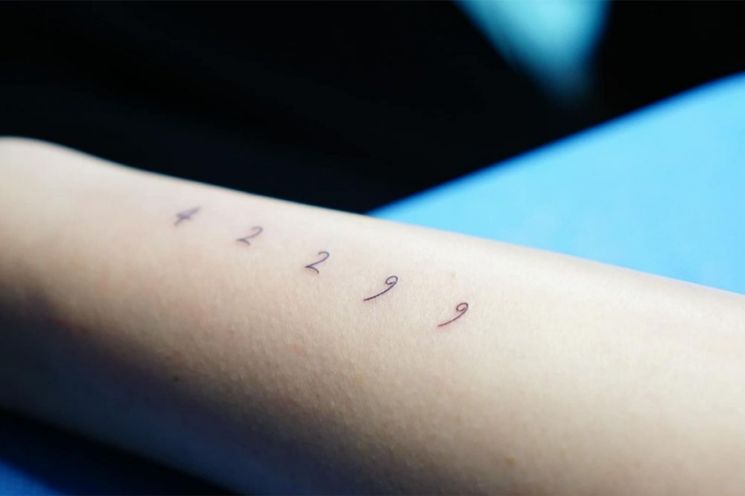 Ryu Ho-jeong, a Justice Party lawmaker, tattooed the occupational classification code '42299' for tattoo artists on her arm. [Image source=Ryu's Facebook]
In other words, the key to legalizing tattoos lies in whether tattoos are considered medical acts. The medical community and the tattoo industry dispute this issue.
The medical community argues, "In the process of injecting dye, infections and side effects may occur, and medical knowledge limited to tattoo procedures cannot guarantee the same level of safety as medical professionals."
On the other hand, the tattoo industry claims, "Unlike in the past, social perceptions of tattoos have changed, and concerns about infections and side effects can be resolved by legalizing tattoos." In 2020, the Tattoo Union, together with Green Hospital, created the 'Hygiene and Infection Control Guide for Tattoos' and conducts infection and hygiene education.
The first precedent that judged tattoos as medical acts was in 1992. That year, the Supreme Court ruled that tattoos fall under medical acts according to the Medical Service Act, thus branding tattoos as illegal for 30 years. Kim Do-yoon, head of the Tattoo Union branch, filed a constitutional complaint arguing that interpreting tattoos as medical acts infringes on the freedom of occupational choice, but the Constitutional Court dismissed it last year. The court held that the current Medical Service Act provisions do not violate the constitution, citing the risks involved in pigment injection procedures.
 Ryu Ho-jeong, a Justice Party lawmaker, held a press conference with tattoo artists at the National Assembly on June 16, 2021, urging the enactment of tattoo legislation. [Image source=Yonhap News]
However, the government's administrative judgment differs. In 2015, the Park Geun-hye administration designated 'tattoo artist' as a government-promoted new occupation, and in 2019, the National Tax Service added tattoo services (930925) to the industry classification codes, allowing tattoo artists to register their businesses as 'tattoo industry.' They are also subject to tax collection. Tattoo artists thus stand at the boundary of contradiction between administrative judgment and judicial precedent.
Related legislation has also stalled. Various bills have been proposed under names such as Ryu’s 'Tattoo Industry Act,' the Tattoo Artist Act (by Park Ju-min of the Democratic Party), and the Semi-Permanent Makeup Tattoo Artist Act (by Eom Tae-young of the People Power Party), but none have passed the National Assembly.
However, winds of change are blowing. In December 2021, the government classified 'tattoo artist' as a mid- to long-term review task in the 'Plan for Discovering and Activating Future Promising New Occupations.' Although the feasibility of promotion exists, follow-up measures have been delayed due to conflicts between the medical and tattoo industries, and the government plans to proceed with institutionalization after gathering opinions.
In the same year, the National Assembly Research Service released a research report titled 'The Current Status and Implications of U.S. Laws and Systems Related to Tattoos and Body Art,' pointing out that "it is worth considering whether it is desirable to continue leaving the institutional gap in the management and supervision of tattoo procedures unaddressed." It is time to draw a conclusion on whether to legalize tattoo procedures, comprehensively considering the changing social perceptions of tattoos and the overall reality of Korean society.
© The Asia Business Daily(www.asiae.co.kr). All rights reserved.


















