President-led '4th Export Strategy Meeting'
Export Expansion Strategies in Agriculture, Food, and Marine Fisheries
Achieving $23 Billion Export Target by 2027
[Asia Economy Sejong=Reporter Joo Sang-don] The government plans to expand the export value of the 'K-Food front and back industries' to $13.5 billion this year, aiming to create innovative momentum in the agricultural industry. The strategy is to secure export growth engines by improving distribution and logistics efficiency for high-quality agricultural product exports, establishing production bases, and focusing on nurturing new growth industries such as food tech and green bio.
On the 23rd, the Ministry of Agriculture, Food and Rural Affairs reported the 'K-Food Plus Export Expansion Strategy' at the 4th Export Strategy Meeting chaired by President Yoon Seok-yeol, in cooperation with related ministries. 'K-Food+' encompasses the entire agricultural front and back industries.
According to the Ministry, agricultural food exports recorded a historic high of $8.8 billion in 2022, growing about fivefold over the past 20 years. Especially, the average annual growth rate over the past three years reached 8%, indicating expectations for sustained growth. Additionally, exports of front and back industries such as smart farms and agricultural machinery grew by 13.7% year-on-year to $3 billion, resulting in total agricultural food and agricultural front and back industry exports of $11.8 billion in 2022 ($8.8 billion in agricultural food and $3 billion in front and back industries).
Accordingly, the Ministry has set a policy direction to create innovative momentum in the agricultural industry through export industrialization of agricultural food, new industries such as food tech and green bio, and front and back industries including smart technology and agricultural machinery. The goal is to achieve $23 billion in K-Food+ exports by 2027 ($15 billion in agricultural food and $8 billion in front and back industries).
First, to achieve $10 billion in agricultural food exports, the Ministry will foster integrated export organizations and improve distribution and logistics efficiency. To establish a consistent management system from production, sorting, packaging to marketing of export agricultural products, the nationwide integrated marketing corporation, jointly invested by producers and exporters, will be developed to global standards and its operational system advanced to strengthen export capabilities. Furthermore, to export high-quality agricultural products, a cold chain suitable for agricultural products will be established from ports to final consumption destinations, and promising new export varieties will be developed. To ensure stable supply of export agricultural products, a 100-hectare K-Food+ smart farm export complex will be created using reclaimed land and developed as an export hub involving export companies and farmers.
To stabilize the management of processed food export companies, support for operating funds for raw materials and ingredients will be expanded, and export insurance support will be strengthened to respond to exchange rate risks. In particular, for exporters to the Japanese market, which faces significant exchange rate burdens due to the weak yen, insurance co-payments will be temporarily waived until June this year.
Efforts will also be made to focus on nurturing promising industries such as food tech and green bio. By concentrating R&D on the top 10 core areas of food tech to differentiate quality, a foundation for export expansion will be established. Additionally, a dedicated fund of over 100 billion KRW will be raised by 2027, and a 'Food Tech Industry Development Council' involving multiple ministries and private sectors will be formed and operated to actively resolve company difficulties.
To industrialize exports of agricultural front and back industries, the Ministry plans to expand market entry bases such as establishing pilot greenhouses for intelligent farms (smart farms). Smart farms will have pilot greenhouses set up in the Middle East, Australia, Kazakhstan, and Vietnam to serve as export hubs. Furthermore, greenhouses supported by Official Development Assistance (ODA) in the Philippines, Cambodia, Indonesia, and Uzbekistan will be used to promote the excellence of K-Smart Farms and link to overseas expansion and orders for Korean companies.
Market competitiveness will also be enhanced through strengthened R&D of agricultural machinery and equipment. To improve export competitiveness through technology development, an intelligent agricultural machinery demonstration complex will be built on the Saemangeum reclaimed land, and 52.6 billion KRW will be invested by 2026 to support R&D for autonomous driving, electric, and hydrogen agricultural machinery. For fertilizers, sulfur, sulfuric acid, and ammonium sulfate will be added to the list of raw materials eligible for purchase fund support (600 billion KRW) to reduce raw material burdens for exporters, and tariff reductions on all imported pesticide active ingredients will be maintained.
Export market and product diversification for veterinary medicines will also be pursued. To this end, key base facilities such as the Green Vaccine Demonstration Center (Pohang) and new drug production facilities (Iksan) will be established. To strengthen export competitiveness in promising industries such as pet food and pet tech, 31.4 billion KRW will be supported from 2022 to 2026 for the development of pet food with functional additives like palatability enhancers and atopy prescription diets, as well as pet-specific medicines and medical technologies for the entire lifecycle industrialization of pets.
The government will also enhance the image of K-Food+ by leveraging popular Korean Wave content such as K-pop and dramas. First, by producing product placements (PPL) in K-dramas and variety shows, the connection with the Korean Wave will be strengthened to raise awareness of K-Food+ in the Middle East and Southeast Asia. Additionally, to spread recognition of high-quality Korean cuisine and K-Food+, 20 excellent Korean restaurants will be designated this year in major cities such as Paris, New York, and Tokyo. Kimchi and fermented sauces will emphasize the distinctiveness of superior Korean products, and alcoholic beverages will promote low-alcohol fruit wines. Customized support plans will be actively pursued for each product category, such as addressing safety issues for ramen and snacks.
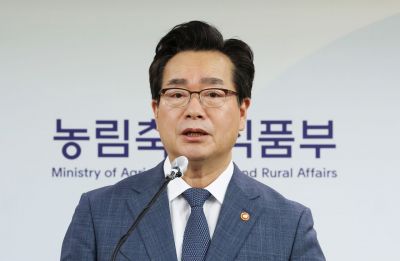
Jung Hwang-geun, Minister of Agriculture, Food and Rural Affairs, said, "Since January, the Ministry has been operating the K-Food+ Export Expansion Headquarters to foster agricultural food, smart farms, agricultural machinery, veterinary medicines, and new industries such as food tech, green bio, and pet food as export strategic industries. All Ministry employees are committed to acting as overseas sales representatives, and we will do our best to double the export scale to $23 billion by 2027, making it a key export industry for the Republic of Korea."
© The Asia Business Daily(www.asiae.co.kr). All rights reserved.

















