Childcare Policy in Nagi-cho, Okayama Prefecture, Japan
Cash Support and Establishment of Childcare Centers for Elderly Participation
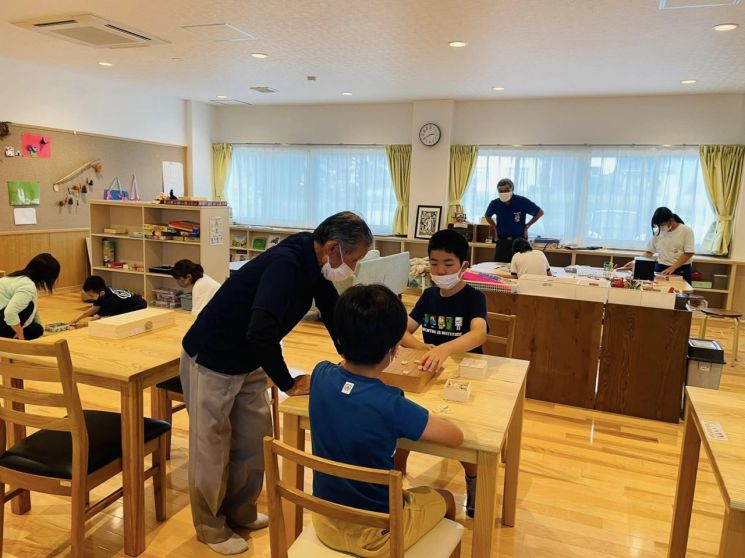 At Nagi's childcare hub facility 'Nagi Child Home,' a grandfather is teaching children how to play Janggi. (Photo by Nagi Child Home official website)
[Asia Economy Reporter Jeon Jinyoung] As South Korea's total fertility rate has plummeted to the 0.7 range, a local government in Japan, where low birth rates are also severe, has attracted attention for raising its total fertility rate to 2.95. This local government has even reduced the number of local council members to secure a budget for low birth rates, employed retired elderly people, and created childcare hubs, setting a standard for low birth rate and aging population countermeasures within Japan.
According to the Nihon Keizai Shimbun (Nikkei) on the 23rd, Nagi-ch? (奈義町) in Okayama Prefecture recorded a total fertility rate of 2.95, ranking first among Japanese local governments. This figure is 1.6 percentage points higher than the national average. Earlier, on the 19th, Japanese Prime Minister Fumio Kishida personally visited and inspected Nagi-ch? village. Within Japan, where low birth rates have become extreme, it is literally called a "miracle village."
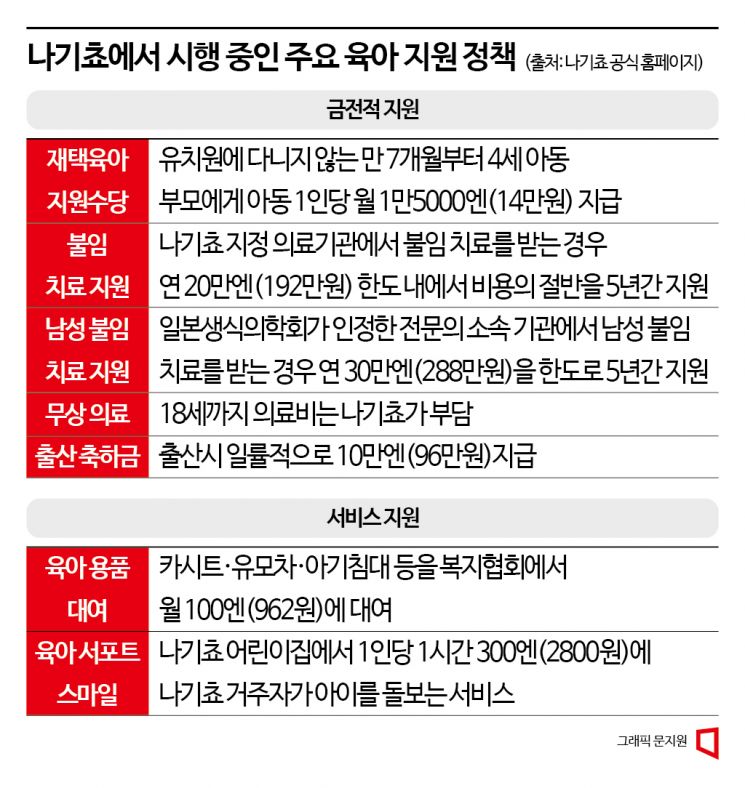
Nagi-ch? village did not have a high birth rate from the beginning. The population declined to the point that in 2002, a resident referendum was held on merging with neighboring municipalities. At that time, residents opposed the merger and decided to remain independent, but a sense of crisis over population decline permeated the entire village.
To secure a budget for low birth rates, Nagi-ch? reduced the number of local council members and created more than 100 million yen (about 960 million KRW) annually in its own resources. Through this, it established 20 new support items, including monthly home childcare support of 15,000 yen (140,000 KRW) and annual high school enrollment support of 135,000 yen (1.3 million KRW).
In particular, Nagi-ch? focused on childcare policies by encouraging the participation of elderly people in childcare support projects. The village created a childcare hub called "Nagi Child Home" at its center and assigned elderly residents with childcare experience to childcare duties. A community was formed where elderly people not only helped with childcare but also counseled young couples on childcare concerns.
A job placement program for parents raising children and elderly people was also created. Nagi-ch?'s "Job Convenience Store" introduces short-term jobs that can be done during brief free periods. This was the first project of its kind introduced nationwide and is popular because parents can briefly come out to work during free time while raising children.
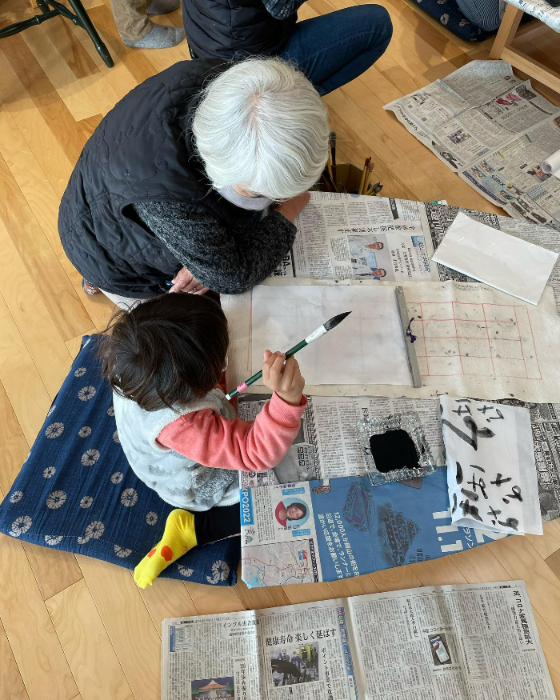 An elderly person is teaching calligraphy to a child at 'Nagi Child Home.' (Photo by Nagi Child Home official website)
Due to these unprecedented support measures, newlywed couples have moved in from other cities. A parent who moved to Nagi-ch? from another city told Japan's TBS TV in an interview, "When I tried to send my child to a daycare center, they told me to wait first. You can't just quit your job because daycare isn't resolved." Another resident said in an interview with TBS, "In Nagi-ch?, it feels like the whole community raises the children."
The miracle of Nagi-ch? was not achieved overnight. An administrative official told the Nihon Keizai Shimbun (Nikkei), "This village is seeing results over a span of 20 years." He added, "Other local governments can also implement these measures, but a system where the administration and residents respond with one heart does not form overnight. The driving force behind childcare support is the understanding of the entire community, which is more difficult than securing funding."
Meanwhile, Prime Minister Kishida's visit to Nagi-ch? appears to be aimed at gaining momentum to implement "a different level of low birth rate measures" in earnest. Having declared at the New Year's press conference that he would implement different low birth rate policies than before, he announced at the National Assembly on the 15th, "We plan to double family-related expenditures, including child allowances and childcare policies," and "We intend to increase the budget from the current 2% of GDP to 4%."
© The Asia Business Daily(www.asiae.co.kr). All rights reserved.



















