One Vascular Angiography Specialist, No Pediatric Specialist
No Capacity for Essential Critical Care... "Reduction Needs Reconsideration"
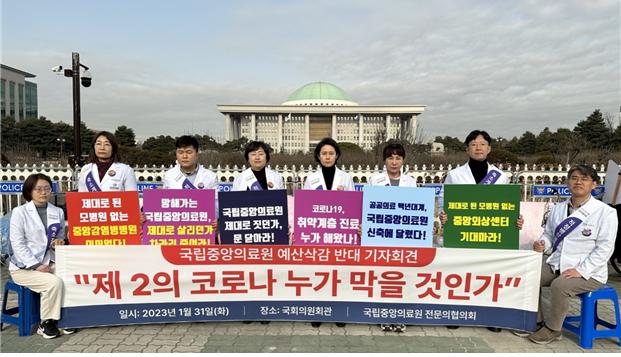 The Council of Specialists at the National Medical Center held a press conference in front of the National Assembly on the 30th of last month, criticizing the government's reduction of the scale for the new construction and relocation of the National Medical Center.
 [Photo by the Council of Specialists]
[Asia Economy Reporter Lee Gwan-joo] "Already this year, four young doctors have resigned. At this rate, the National Medical Center will collapse even before building a new hospital."
Amid the significant downsizing of the National Medical Center's reconstruction and relocation project, the 'National Medical Center Specialists Council,' composed of the center's specialists, urged the government on the 23rd to reconsider the reduction of the project plan and to make efforts to secure and retain specialists, highlighting the center's dire situation.
The reality of the National Medical Center conveyed by the Specialists Council that day was too poor to be considered a public healthcare institution responsible for public health. The collapse of essential medical services due to staff shortages has already become a reality. For example, emergency embolization procedures required for patients with acute gastrointestinal bleeding are handled by only one vascular interventional radiologist who provides emergency care 24/7 throughout the year. If this doctor is sick or on leave, the National Medical Center cannot even accept patients needing emergency embolization.
There are no neonatal specialists or neonatal intensive care units, making it impossible to admit mothers who gave birth prematurely at 32 weeks or premature infants. Similarly, pediatric patients requiring surgeries such as appendectomies cannot be treated due to the absence of pediatric surgeons. There are no pediatric specialists such as pediatric neurologists for treating febrile seizures, pediatric cardiologists for heart diseases like Kawasaki disease, or pediatric radiologists for performing neonatal brain ultrasounds. Although it is a dedicated COVID-19 hospital, lung transplants for severe COVID-19 pneumonia patients are impossible, and there is no medical team for acute stroke interventions. This means there is no capacity to care for emergency and critically ill patients whose lives depend on timely treatment. The council also reported that it is impossible to admit psychiatric patients, which is one of the important roles of public medical institutions.
Doctors at the National Medical Center, who cannot treat essential critically ill patients, continue to resign. The council stated, "Nearly half of the attending specialists have resigned over the past five years," adding, "The number of resignations is increasing, and already this year, four young doctors have given up hope in the National Medical Center and resigned." They especially appealed, "If we fail to create a national hospital where doctors who are currently contemplating resignation daily can work with hope, the National Medical Center will collapse even before building a new hospital."
The council further emphasized, "The new National Medical Center, which is being reconstructed and relocated, must be scaled to become a tertiary general hospital with more than 800 beds at the main hospital to ensure that no essential critically ill patients are left untreated due to a lack of human and material infrastructure," and "We strongly demand a full review of the downsized National Medical Center modernization project plan and responsible government measures to secure and retain specialists immediately."
© The Asia Business Daily(www.asiae.co.kr). All rights reserved.

![A Woman with 50 Million Won Debt Clutches a Stolen Dior Bag and Jumps... A Monster Is Born [Slate]](https://cwcontent.asiae.co.kr/asiaresize/183/2026021902243444107_1771435474.jpg)















