Announcement of Last Year's Big Data Analysis Results on Firefighting Activities
[Asia Economy Reporter Kiho Sung] The National Fire Agency announced on the 23rd that it has completed the analysis of six tasks across five areas?fire prevention, on-site safety, response, rescue, and emergency medical services?based on last year's big data analysis projects.
Big data analysis has been actively conducted since 2021, following the establishment of the Big Data Department within the National Fire Agency on July 14, 2020. Since then, annual demand surveys have been conducted nationwide targeting fire agencies and external industry-academic-research institutions, and key fire service issues are finalized through one to two rounds of expert review.
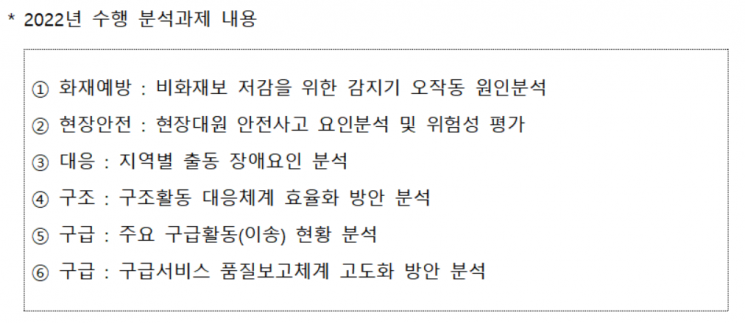
As a result of last year's fire prevention task, "Analysis of Causes of Detector Malfunctions to Reduce Unwanted Alarms," it was found that over the past 10 years, photoelectric (smoke) detectors had the highest malfunction rate during unwanted alarm dispatches, with the most occurrences during summer weekdays in July and August mornings.
Additionally, the rate of unwanted alarms has increased approximately fivefold over the past five years, indicating the need for systematic management of frequently dispatched unwanted alarm targets.
Accordingly, the National Fire Agency plans to develop an unwanted alarm prediction model that quantifies the likelihood of malfunctions based on alarm location, time, and weather conditions to minimize the loss of firefighting resources and improve efficient deployment.
Through the on-site safety task, "Analysis of On-Site Firefighter Accident Factors and Risk Assessment," it was revealed that serious injuries frequently occurred during fire suppression, with firefighters and fire sergeants accounting for 56.1% of accidents by rank, a notably high proportion.
To prevent firefighter accidents, a risk assessment technique for on-site personnel will be developed to identify peak accident times and days, recognize risk factors during fire, rescue, and emergency medical activities, and provide daily risk levels and past accident alerts using risk indices and grades by activity classification.
Regarding the response task, "Analysis of Regional Dispatch Obstruction Factors," the most common reason for difficult access was "narrow roads," with difficult access types ranked as other residential areas, traditional markets, and densely packed commercial districts.
Going forward, the National Fire Agency will share regional dispatch obstruction analysis data with fire stations nationwide to appropriately allocate fire vehicles (light pump trucks) per station and provide detour routes through additional traffic and weather information analysis.
For the rescue task, "Analysis of Efficient Rescue Activity Response Systems," it was found that among the top six rescue types (fire, others, leakage accidents, traffic, elevators, suspected suicides), there are five regions nationwide at the eup, myeon, dong administrative level where on-site arrival times exceed 30 minutes.
Based on this, the agency plans to actively utilize this data to improve dispatch response systems by deploying pump rescue teams in rescue gap areas and establish systematic management systems for rescue personnel to enable rapid deployment of specialized rescue teams according to accident types.
For the emergency medical services task, "Analysis of Major EMS Activity Status," it was found that in March 2022, during the COVID-19 pandemic, 119 ambulances took the longest time to transport patients to hospitals.
This result will serve as a basis for evaluating the effectiveness of policies related to emergency patient transport delays and will be designed as a real-time visual status display at the 119 EMS Situation Management Center to monitor transport delays and enable prompt responses.
Choi Jaemin, Director of the Fire Analysis System Division at the National Fire Agency, stated, "We will continue to expand the utilization base of critical data secured from firefighting activities as part of proactive administration and advance the big data analysis system integrated with artificial intelligence (AI) and machine learning to establish systematic and scientific safety measures."
© The Asia Business Daily(www.asiae.co.kr). All rights reserved.
![Clutching a Stolen Dior Bag, Saying "I Hate Being Poor but Real"... The Grotesque Con of a "Human Knockoff" [Slate]](https://cwcontent.asiae.co.kr/asiaresize/183/2026021902243444107_1771435474.jpg)
















