[Asia Economy New York=Special Correspondent Joselgina] The U.S. central bank, the Federal Reserve (Fed), reaffirmed its tightening stance, stating that inflation remains at a threatening level and that it will continue raising the benchmark interest rate. To confirm the effects of the accumulated tightening policies, the rate hike is likely to maintain the usual 0.25 percentage point increase in March.
According to the minutes of the February Federal Open Market Committee (FOMC) meeting released by the Fed on the 22nd (local time), participants judged that "although there are signs that inflation is falling recently, it is not yet sufficient," and "interest rates need to continue rising." They also diagnosed that "to be confident that inflation is continuing to decline, evidence of more progress across a broader range will be necessary," and that "the labor market remains tight, putting upward pressure on wages and prices."
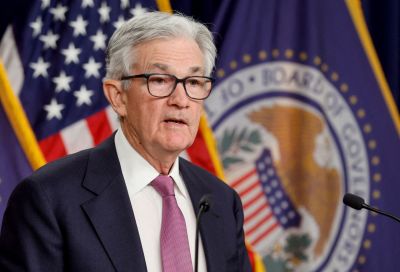
Earlier, at the FOMC meeting held from January 31 to February 1, the Fed raised the benchmark interest rate by 0.25 percentage points to 4.5?4.75%. However, the rate hike size was reduced from the previous 0.5 percentage points to 0.25 percentage points, signaling a further pace adjustment. A 0.25 percentage point increase is the usual rate hike size.
At the last meeting, most participants agreed that a 0.25 percentage point increase was appropriate. They judged that slowing the pace of hikes would be suitable for assessing whether economic conditions improve going forward. They also expected this approach to balance the risks posed by both 'over-tightening' and 'under-tightening.'
Accordingly, the Wall Street Journal (WSJ) reported that the Fed is highly likely to take a 'baby step' by raising the benchmark interest rate by 0.25 percentage points again at the March FOMC meeting following February. According to the Chicago Mercantile Exchange (CME) FedWatch, despite heightened tightening concerns, the federal funds (FF) futures market still reflects over a 70% probability of a baby step in March. Separate from forecasts of additional rate hikes, the possibility of expanding the rate hike size immediately in March is considered low.
However, voices advocating a 'big step' (a 0.5 percentage point increase) are also emerging. The minutes confirmed that some participants preferred a 0.5 percentage point hike at the February FOMC. They argued that a large rate hike would bring rates to a sufficiently restrictive level. However, the minutes did not specify how many or who these minority opinions were. Earlier, James Bullard, president of the Federal Reserve Bank of St. Louis and a prominent hawk within the Fed, revealed that he advocated a 0.5 percentage point increase at the February FOMC after inflation data exceeded expectations last week.
Before the release of the FOMC minutes that day, President Bullard also made hawkish remarks. Appearing on CNBC's Squawk Box, he supported a more aggressive rate hike, citing that the U.S. economy is stronger than expected. He emphasized, "Our current risk is that inflation does not come down and accelerates again," and "since the labor market remains strong, it is time to fight inflation."
Keeping the possibility of a big step in March open, he reiterated his previous claim that the benchmark interest rate should be raised to around 5.375% as soon as possible, saying, "We need to go above 5%." This level exceeds the median year-end rate forecast (5.1%) on the dot plot presented by the Fed in December last year.
President Bullard drew a line against market concerns that additional rate hikes would push the economy into a recession. He evaluated, "The U.S. economy is more resilient than the market thought 6 to 8 weeks ago," adding, "China is coming back with reopening, and Europe is stronger than expected." Bullard, who pointed out that the market is overestimating the possibility of a recession in 2023, expressed confidence in a soft landing by stating, "I still believe inflation can be lowered while maintaining a strong labor market."
Meanwhile, the New York stock market closed mixed and near flat as it digested the FOMC minutes that day. Quincy Crosby, chief market strategist at LPL Financial, evaluated, "The FOMC minutes included much of what investors had already priced in," adding, "(Upcoming) economic data such as the Personal Consumption Expenditures (PCE) to be released on the 24th will be important."
Later this week, speeches are scheduled by Raphael Bostic, president of the Federal Reserve Bank of Atlanta, and Philip Jefferson, Fed board member. On the following day, the revised U.S. fourth-quarter GDP growth rate will be announced. The preliminary figure released last month was a relatively robust annualized 2.9%, and the revision is expected to show little change. The January PCE price index, to be released on the 24th, is estimated to rise 4.3% year-over-year and 0.4% month-over-month.
© The Asia Business Daily(www.asiae.co.kr). All rights reserved.
!["The Woman Who Threw Herself into the Water Clutching a Stolen Dior Bag"...A Grotesque Success Story That Shakes the Korean Psyche [Slate]](https://cwcontent.asiae.co.kr/asiaresize/183/2026021902243444107_1771435474.jpg)
















