Central Local Governments Expand Paid Marriage Leave from 3 to 30 Days
Singapore Extends Paid Paternity Leave to 4 Weeks... Japan Discusses Expanding Child Allowance
[Asia Economy Reporter Kwon Haeyoung] Major Asian countries such as China, Japan, and Singapore are making desperate efforts to curb the declining birth rates. Various measures are being implemented, including increasing paid leave for marriage and childbirth and significantly expanding child allowances. Since low birth rates and aging populations lead to a decrease in the working-age population and a slowdown in growth rates, each country is approaching the improvement of birth rates as a national priority amid a sense of urgent crisis.
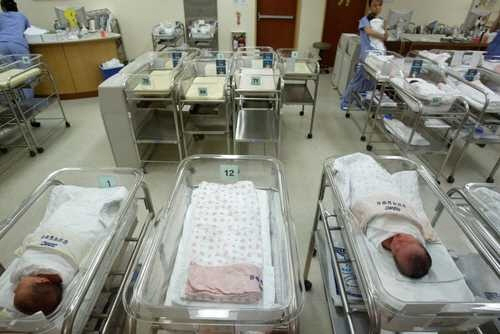
Chinese Local Governments Expand Paid Marriage Leave from 3 Days to 30 Days
According to foreign media including China’s People’s Daily on the 22nd, some local governments in China have expanded paid marriage leave from the previous 3 days to 30 days. China provides newlywed couples with a minimum of 3 days of paid marriage leave. Starting this month, local governments can independently provide allowances, leading Gansu Province and Shanxi Province to offer 30 days, and Shanghai to offer 10 days of paid marriage leave.
Yang Haiyang, head of the Social Development Research Institute at Southwest University of Finance and Economics in China, stated, "Expanding marriage leave is one of the effective ways to increase birth rates," adding, "Various support measures such as housing subsidies and paid paternity leave are also needed."
Cash subsidies for families with multiple children are also being expanded. Yunnan Province in China has decided to provide a one-time childbirth subsidy of 2,000 yuan for the second child and 5,000 yuan for the third child starting this year. Families with a second or third child will receive an annual childcare subsidy of 800 yuan per child until the child turns three. Jinan City in Shandong Province will also provide a monthly childcare subsidy of 600 yuan per child for the second and third children until they reach three years old starting this year.
Following a population decline last year for the first time in 60 years, local governments are rushing to introduce childbirth promotion measures. As of the end of last year, China's population was 1.41175 billion, down 850,000 from the previous year (1.4126 billion). The impact of the 'One Family, One Child Policy' implemented from the 1980s to 2015, along with a sharp increase in education costs, has intensified the younger generation's reluctance to have children. As a result, China's birth rate fell to a record low of 6.77 births per 1,000 people last year.
Singapore Extends Paid Paternity Leave to 4 Weeks... Japan Discusses Expanding Child Allowances
Singapore and Japan are also striving to increase birth rates. Singapore will extend paid paternity leave from 2 weeks to 4 weeks starting next year. The government will cover all costs for the additional paid leave. The government plans to allow companies to choose whether to grant additional paid leave to male employees initially, with the goal of making it mandatory in the long term.
Japan, which was the first Asian country to experience low birth rates and aging populations, is pushing for a revolutionary increase in child allowance payments. Plans include increasing the amount of child allowance for all children and adolescents up to high school graduation and removing income restrictions for parents. When Prime Minister Fumio Kishida identified addressing low birth rates as an urgent task earlier this year and promised a "fundamentally different low birth rate policy," related discussions heated up in Japanese society.
The reason major Asian countries are focusing on increasing birth rates is that changes in population structure, such as population decline and aging, are lowering potential growth rates. As the working-age population decreases, economic growth inevitably slows down.
South Korea Has One of the Lowest Birth Rates in the World
The birth rate improvement measures of major Asian countries carry significant implications for South Korea. South Korea’s birth rate is at one of the lowest levels globally, and the situation is much more severe than in other countries. According to Statistics Korea, the total fertility rate, which is the average number of children a woman is expected to have in her lifetime, was 0.78 last year. This is 0.03 lower than the previous year and the lowest since statistics began in 1970. It is also the lowest in the world. South Korea was the first country worldwide to record a total fertility rate in the 0.8 range in 2020 and has set a new record again after two years. In comparison, Japan’s total fertility rate was 1.33 in 2020. China and Singapore’s total fertility rates were 1.3 and 1.1, respectively, both better than South Korea’s 0.84 in 2020.
Although the South Korean government has spent a total of 271.9 trillion won on low birth rate countermeasures from 2006 to 2021, it has failed to stop the steep decline in birth rates. Starting last year, an additional 150 trillion won budget will be invested through 2025, but whether this will have a policy effect remains uncertain.
© The Asia Business Daily(www.asiae.co.kr). All rights reserved.
!["The Woman Who Threw Herself into the Water Clutching a Stolen Dior Bag"...A Grotesque Success Story That Shakes the Korean Psyche [Slate]](https://cwcontent.asiae.co.kr/asiaresize/183/2026021902243444107_1771435474.jpg)















