[Asia Economy Reporter Yoo Hyun-seok] Ultimately, Korean Air has decided to fully reconsider its mileage program reform. The core of the controversial Korean Air mileage reform plan is that the deduction criteria have been subdivided from 'region' to 'flight distance.'
Consumers feel that mileage benefits have decreased due to the segmented deduction rates. In fact, under the reform plan, the deduction rate has increased for long-haul routes. However, depending on the region and city, there are places where the deduction rate actually decreases.
Korean Air first announced the mileage system reform in December 2019, just before COVID-19. Until then, mileage deductions were made by dividing into four regions: Northeast Asia, Southeast Asia, Southwest Asia, and North America/Europe/Oceania. The reform plan divides by flight distance. The deduction criteria will be subdivided into a total of 10 segments.
This reform plan was scheduled to be implemented from April 2021 but was postponed due to the COVID-19 pandemic restricting overseas travel. It was set to be applied from April 1 of this year. However, amid consumer dissatisfaction and intervention by Minister Won Hee-ryong of the Ministry of Land, Infrastructure and Transport, Korean Air decided to postpone the system reform.
So, what is the actual Korean Air mileage system reform plan like? The conclusion is that overall deduction rates increase, but vary by region.
Consumers' complaints are that the deduction rates for long-haul tickets have increased. Under the existing mileage system, 70,000 miles (economy class, round trip) were deducted for North America, Europe, the Middle East, and Oceania during off-peak seasons. However, under the new system, most of North America, Europe, the Middle East, and Oceania fall under segments 7 to 9. For segment 7, 65,000 miles are deducted; for segment 8, 80,000 miles; and for segment 9, 90,000 miles are deducted. As consumers pointed out, the deduction rate increases for long distances.
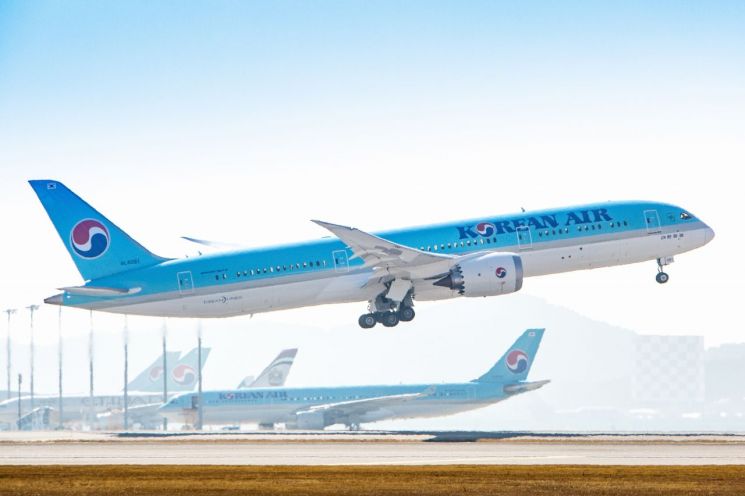
However, compared to foreign airlines, the deduction rate is still relatively low. For example, the mileage deduction for the Incheon?LA route, which is segment 8, is 80,000 miles. In contrast, Delta Air Lines (Incheon?Seattle) requires 130,000 to 150,000 miles, United Airlines (Incheon?San Francisco) requires 137,000 to 160,000 miles, and Air France (Incheon?Paris) requires 140,000 to 300,000 miles.
On the other hand, the deduction rate decreases depending on the region and city. For instance, Tokyo, Japan, a popular destination for Koreans, is classified as segment 2 under the newly reformed system. This means 25,000 miles are deducted. Under the previous system, 30,000 miles were deducted. Also, Vietnam, the third most visited country by Koreans before COVID-19 in 2019, had a deduction of 40,000 miles from Incheon under the old system. But under the reform plan, segment 4 (Da Nang) deducts 35,000 miles and segment 5 (Nha Trang) deducts 45,000 miles, showing that deduction rates vary by region and city.
However, this reform plan has ultimately entered a phase of reconsideration. Due to protests from the government and consumers, Korean Air announced that it is reviewing overall improvement measures. The industry expects that the plan to change the mileage deduction criteria from the existing 'region' to 'flight distance' will be maintained. However, it is predicted that the deduction rates required for ticket issuance or seat upgrades by segment will be adjusted downward.
Additionally, Korean Air plans to expand the supply of bonus seats, offer various mileage discount promotions, and broaden mileage usage options. The mileage mixed payment service, ‘Cash & Miles,’ will also add the US dollar as a payment currency and operate it starting in March.
© The Asia Business Daily(www.asiae.co.kr). All rights reserved.
![Clutching a Stolen Dior Bag, Saying "I Hate Being Poor but Real"... The Grotesque Con of a "Human Knockoff" [Slate]](https://cwcontent.asiae.co.kr/asiaresize/183/2026021902243444107_1771435474.jpg)











