Still in the LCD→OLED Transition, Soon the Ex-OLED Era
"OLED Alone Cannot Guarantee the Future of Korean Displays"
Samsung Focuses on "Notebooks & Tablets," LG on "Transparent Displays" as Ex-OLED Mainstream
[Asia Economy Reporter Moon Chaeseok] Samsung and LG are preparing for the Ex-OLED (Extended Organic Light Emitting Diode) era in devices such as laptops, tablet PCs, and XR (mixed reality). Samsung plans to focus on displays for IT electronic devices like laptops and tablets, while LG will emphasize transparent displays as their main products.
The display industry has warned that after LCD (Liquid Crystal Display), the OLED market could also be overtaken by China. Since maintaining the number one position in the OLED market is already challenging, they stressed that the leadership in the Ex-OLED market must never be lost. Ex-OLED refers to applying OLED panels not only to traditional TVs but also to various devices. It is a promising field that the government announced will be commercialized by 2027.
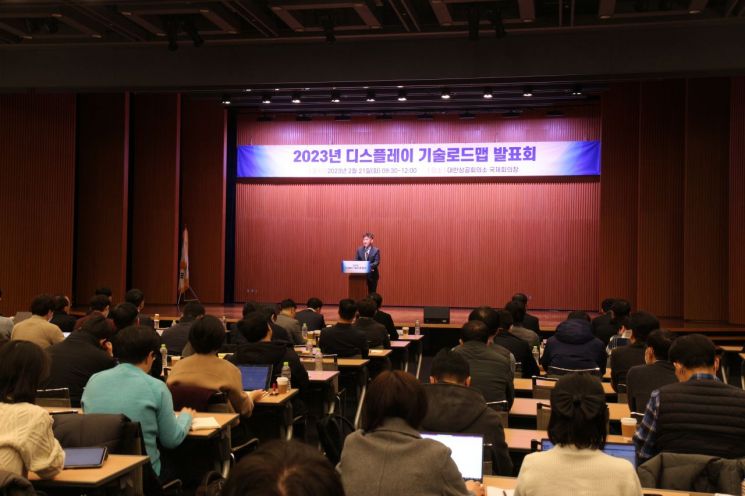 The scene of the '2023 Display Technology Roadmap Presentation' jointly hosted by the Korea Display Industry Association and the Korea Institute for Advancement of Technology on the morning of the 21st at the Korea Chamber of Commerce and Industry building in Jung-gu, Seoul. Only the first 300 people were admitted, but the venue was packed.
 [Photo by Display Industry Association]
On the 21st, the Korea Display Industry Association and the Korea Institute for Advancement of Technology held the '2023 Display Technology Roadmap Presentation' at the Korea Chamber of Commerce and Industry building in Jung-gu, Seoul.
The presentation was attended by Seongchan Cho, Vice President of Samsung Display; Junho Yeo, Group Leader of LG Display; Dongwook Lee, Vice Chairman of the Display Association; Yoonjong Jeon, President of KIAT; Heondo Kim, CEO of Jusung Engineering; Byungwook Kim, Vice President of Dongjin Semichem; Cheoljong Han, Center Director of Korea Electronics Technology Institute; Minsu Kang, Senior Researcher at Omdia; and Mincheol Seo, Professor at Kyung Hee University. The venue was packed with about 300 industry-academia-research participants who registered on a first-come, first-served basis.
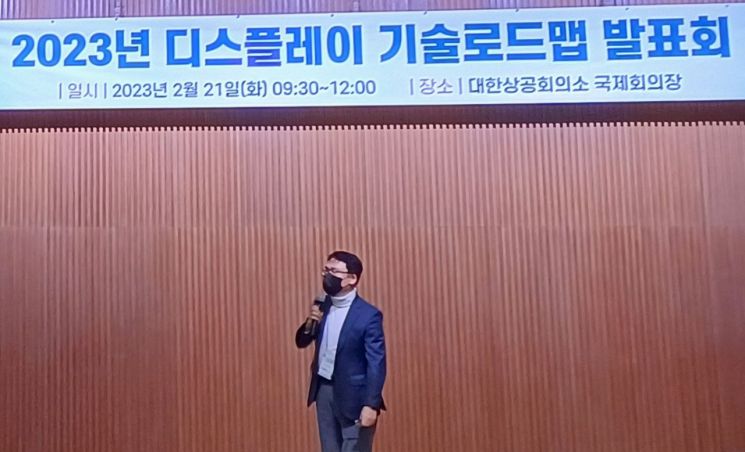 Vice President Jo Seong-chan of Samsung Display presenting at the '2023 Display Technology Roadmap Presentation' held on the 21st at the Korea Chamber of Commerce and Industry building in Jung-gu, Seoul.
 [Photo by Moon Chae-seok]
Samsung Display and LG Display presented the trends in Ex-OLED technology and their respective business strategies at this event.
Vice President Seongchan Cho emphasized, "It is important to expand the application range of OLED for IT electronic devices such as laptops and tablets." He stated that Samsung Display's biggest goal is 'Personalize.' This means making consumers 'see' Samsung Display anytime and anywhere. He stressed increasing the adoption of medium-sized IT OLEDs such as tablets and laptops, as well as traditional devices like TVs and smartphones.
He said, "Before OLED became widespread in TVs, IT OLED was much more advantageous for us in terms of price per area," adding, "We believe that all markets where OLED has not yet been applied (IT devices) should be entirely made into 'IT OLED'." He continued, "We will increase adoption so that the 'Ultra' title can be attached in every aspect," and "We will achieve true 'personalization' by breaking away from the conventional notion of displays being light, thin, and narrow, firmly instilling in consumers the perception that only we (Samsung) can do this."
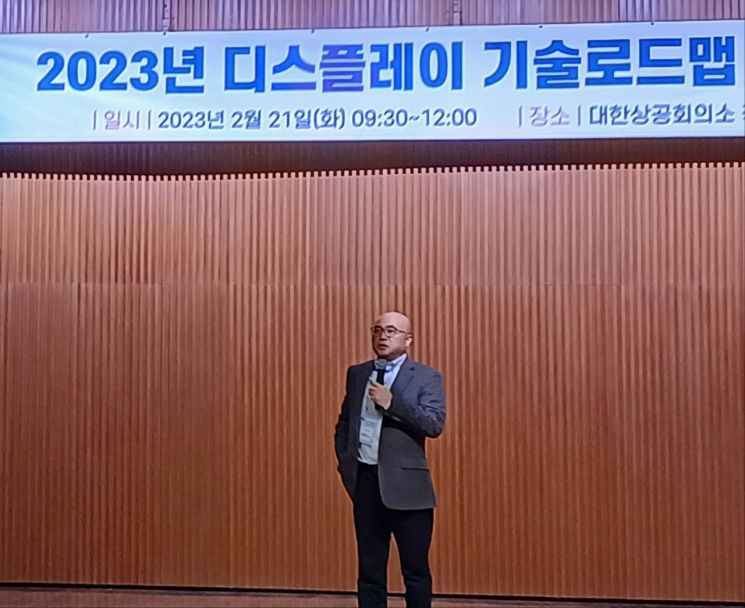 Ye Jun-ho, Head of LG Display Group, presenting at the '2023 Display Technology Roadmap Presentation' held on the 21st at the Korea Chamber of Commerce and Industry building in Jung-gu, Seoul.
 [Photo by Moon Chae-seok]
Group Leader Junho Yeo explained, "The market can be expanded through transparent displays (Ex-OLED)." LG Display is a leader in the large OLED market. They have identified transparent OLED for public places such as subways as their next growth engine and started technology development early. Junho Yeo cited mobile, mobility, and home lifestyle as future trends.
The goal of LG's transparent OLED is to realize 'open' displays in office spaces and homes. Currently, LG Display's transparent OLED panel transparency rate (55-inch) is 40%. They plan to release a new product with 45% transparency soon. They intend to focus on five sectors: offices, retail stores, culture & entertainment (museums, etc.), mobility (subways), and home.
He said, "From the perspective of aesthetics and resolution, LEDs are better than OLEDs, but transparency is the most important factor, and LG OLED holds the advantage in this area," adding, "We will leverage OLED's advantage of being lighter than LCD and implement panel designs that fit well in any space to increase consumer demand."
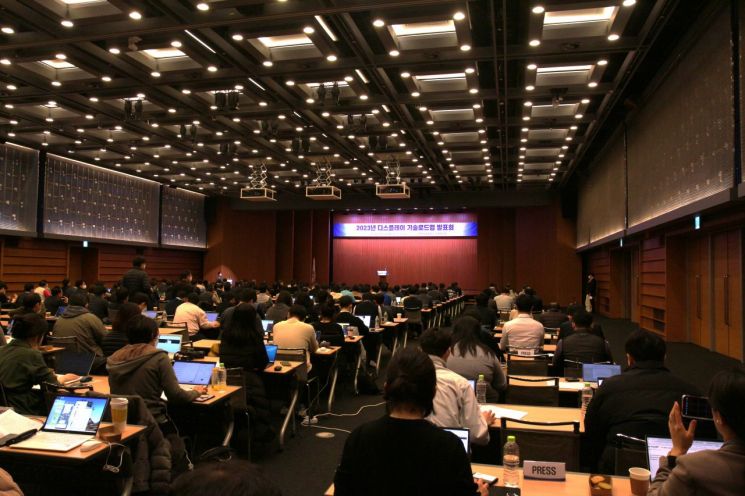 Korean display industry at risk of losing its leadership position to China's pursuit. The international conference room at the Sangui Hall is packed with officials who came to hear the technical explanations.
 [Photo by Display Industry Association]
The global display market size is 150 trillion KRW. Among this, OLED holds a 36% share, and LCD holds 64%. OLED's share is gradually catching up to LCD. The key issue is price competitiveness. In Q4 last year, the price of a 55-inch TV panel was $89 (about 115,400 KRW) for LCD and $430 (about 557,410 KRW) for OLED. OLED panels are still about five times more expensive. The association stated, "The challenge is to expand OLED applications in premium home appliances and advanced IT."
Researcher Minsu Kang predicted that by 2029, OLED will account for 40% of global display sales. Small OLEDs for smartphones and smartwatches have already caught up with LCD in sales. However, TVs accounted for only 17% last year, and tablets and laptops less than 10%. Kang emphasized, "Korean display panel companies need to increase their market share in medium-to-large OLED markets such as TVs, tablets, and laptops."
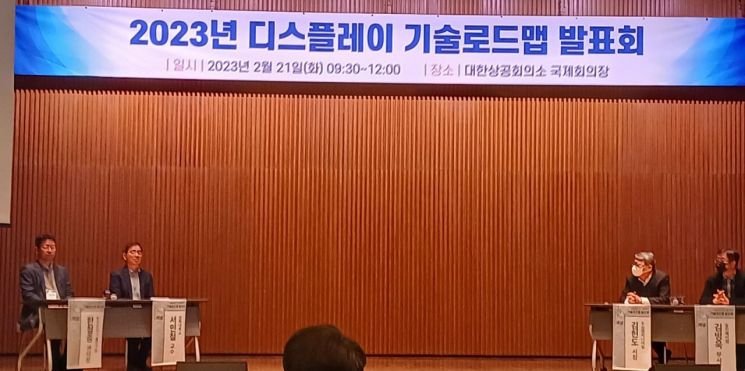 Representatives from academia, research institutes, material companies, and equipment companies gathered to discuss support for display technology policies. From the left, Cheoljong Han, Center Director at Korea Electronics Technology Institute; Mincheol Seo, Professor at Kyung Hee University; Byungwook Kim, Vice President of Dongjin Semichem (representing material companies); Heondo Kim, President of Juseong Engineering (representing equipment companies).
 [Photo by Chaeseok Moon]
Participants unanimously agreed that while preparing for a rapid OLED transition, China must also be outpaced in the Ex-OLED market. They diagnosed that the leadership in the LCD market has already been lost to China, and OLED is also precarious. They stressed that if the Ex-OLED super-gap is not secured now, it will be too late.
Professor Mincheol Seo of Kyung Hee University said, "Academia should focus on developing core technologies in 6 to 7 areas such as next-generation light-emitting materials, large substrate patterning, and encapsulation materials," adding, "To maximize academic capabilities, a new program involving companies and the government should be prepared by academia."
Center Director Cheoljong Han of Korea Electronics Technology Institute proposed the 'orchard model.' The seed (core technology) is nurtured by schools, and the fruit (sales) is harvested by large corporations. The research community works on 'standardization' to expand convergence technologies in the middle. Han said, "We need to develop related technologies so that standardization, which both Samsung and LG display giants can agree on, can be used as a technical evaluation criterion."
Vice President Byungwook Kim, a materials company representative, emphasized that the Ex-OLED market must achieve not just a super-gap but a 'true super-gap.' Maintaining a 5-year technology gap is just a super-gap. Even if the Chinese government provides subsidies to specific companies and Korea loses price competitiveness, having technology that can compensate for this is a 'true super-gap.' Kim said, "China has already overtaken Korea in LCD and is likely to surpass Korea in OLED capacity this year or next," adding, "To maintain a true super-gap, the government must carefully design how much and which parts to support."
CEO Heondo Kim of an equipment company expressed concern that Korean equipment prices are too high compared to the US, Japan, and Germany. Kim said, "A small part can stop a factory that invested 5 to 10 trillion KRW," adding, "To prevent this, component reliability must be improved so that demand companies (panel makers) can trust them." He added, "Localization and globalization of display equipment are impossible with only small and medium-sized enterprises' power," and "The government should implement consistent equipment support policies, such as creating large-scale national projects related to display equipment."
© The Asia Business Daily(www.asiae.co.kr). All rights reserved.
![Clutching a Stolen Dior Bag, Saying "I Hate Being Poor but Real"... The Grotesque Con of a "Human Knockoff" [Slate]](https://cwcontent.asiae.co.kr/asiaresize/183/2026021902243444107_1771435474.jpg)


















