Amid the Exit of People Power Party, Opposition Lawmakers Approve by Voice Vote
Parliamentary Procedures Including the Legislation and Judiciary Committee Remain
Ruling Party Considers Proposal for President Yoon's Veto Exercise
[Asia Economy reporters Naju-seok and Park Jun-yi] The National Assembly's Environment and Labor Committee plenary session passed the "Yellow Envelope Act (Amendment to Articles 2 and 3 of the Labor Union and Labor Relations Adjustment Act)" solely by the opposition party. The People Power Party, protesting the passage of the bill by walking out, declared their intention to block it even if it means requesting President Yoon Seok-yeol to exercise his veto power.
On the 21st, during the Environment and Labor Committee plenary session, the Yellow Envelope Act was passed with unanimous approval from members of the Democratic Party and the Justice Party who participated in the roll-call vote, while members of the People Power Party had left the session.
People Power Party members attached signs reading "Firm opposition to the law promoting illegal strikes" on their laptops in front of their seats to express their opposition. The ruling and opposition parties clashed over the law's impact on peace in labor-management relations. People Power Party lawmaker Ji Seong-ho criticized, "Can we pretend not to know that illegal strikes sporadically occur and affect economic activities?" Justice Party floor leader Lee Eun-joo countered, "This law is an industrial peace guarantee law," adding, "It represents a substantial step toward guaranteeing the constitutionally protected three labor rights."
Before the vote, the People Power Party also pointed out that there was insufficient discussion on the Yellow Envelope Act. People Power Party lawmaker Lee Joo-hwan criticized, "There was no proper debate," and said, "We should strive to guarantee property rights and labor rights, but if it is rammed through recklessly, who will take responsibility?" Democratic Party lawmaker Jeon Yong-gi criticized the claim of a rushed passage, saying, "The People Power Party has been avoiding deliberation."
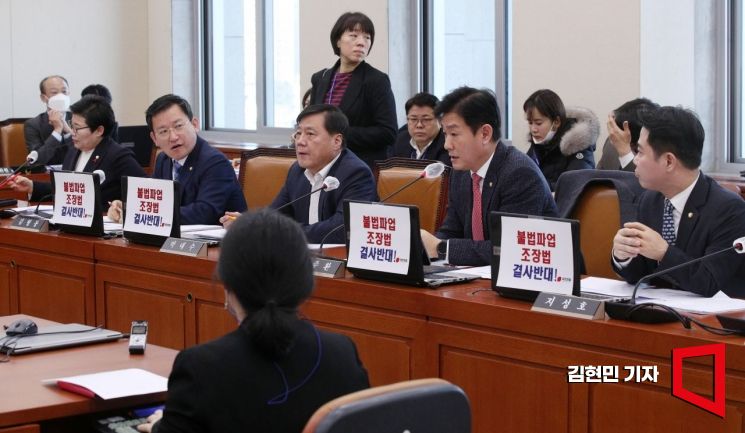 On the 21st, at the Environment and Labor Committee plenary meeting held at the National Assembly in Yeouido, Seoul, placards opposing the amendment to the Labor Union Act were attached to the seats of ruling party lawmakers. The Democratic Party of Korea announced plans to pass amendments to Articles 2 and 3 of the Labor Union Act at this meeting. Photo by Kim Hyun-min kimhyun81@
After the bill passed, Jeon Hae-cheol, chairman of the Environment and Labor Committee from the Democratic Party, explained, "The Yellow Envelope Act was initiated in 2020 by Democratic Party lawmaker Kang Byung-won, followed by 11 lawmakers including Lee Su-jin and Lee Eun-joo, and a petition with 50,000 signatures was submitted to the committee." He added, "As chairman, I believed it was important to operate the standing committee based on bipartisan consultation, so we held a legislative public hearing, four subcommittee meetings, and a bill adjustment committee, going through various review processes." He expressed regret that "dialogue or compromise on contentious issues did not progress and no consensus was reached," but said, "The amendment to the Labor Union Act passed this time is meaningful in that it aims to implement the three labor rights and the purpose of the Labor Union Act, reflecting Supreme Court and lower court rulings as well as decisions by the National Human Rights Commission." He continued, "The Labor Union Act amendment passed by the Environment and Labor Committee plenary session protects the constitutionally guaranteed three labor rights and aims to alleviate the suffering of workers and their families who have endured difficult times due to excessive damages and provisional seizures," and expressed "strong regret over the attacks and criticisms based on the mistaken frame that it completely prohibits damages."
Before the vote, the opposition also condemned a press conference held by Minister of Employment and Labor Lee Jeong-sik, who pointed out problems with the Yellow Envelope Act. The minister held a press conference the previous day requesting the National Assembly to reconsider the bill, calling it "legislation that shakes the foundation of the rule of law." Chairman Jeon commented, "It was inappropriate for the minister to hold a press conference externally," adding, "While the government can naturally oppose during the discussion process, the more important thing is that the government must continuously strive to find a compromise solution."
With the Yellow Envelope Act passing the Environment and Labor Committee plenary session, it will be referred to the Legislation and Judiciary Committee for systematic and detailed review. However, since the Legislation and Judiciary Committee is chaired by a People Power Party member, the bill's submission and review process is expected to face difficulties. If the bill is blocked in the Legislation and Judiciary Committee, the opposition is expected to attempt direct submission to the plenary session.
The People Power Party leadership also views the passage of the Yellow Envelope Act in the National Assembly plenary session as inevitable, though it may take time. In this regard, the exercise of the presidential veto is being taken as a foregone conclusion. On the day of the Environment and Labor Committee session, People Power Party floor leader Joo Ho-young said at a party floor strategy meeting held before the committee session, "If the Yellow Envelope Act passes (the National Assembly), it is not only unconstitutional but could cause serious harm to our economy, so I intend to actively recommend the president exercise his veto power."
People Power Party lawmaker and Environment and Labor Committee secretary Im E-ja told this outlet in a phone interview, "If it goes to the Legislation and Judiciary Committee, it can be held up for up to 60 days, and if it does not pass, it will return to the Environment and Labor Committee and then be directly submitted to the plenary session, where it is likely to be approved," but added, "If President Yoon exercises his veto, a two-thirds majority in the National Assembly is required for reapproval, so it will likely be rejected." Lawmaker Im added, "It may be burdensome for President Yoon to exercise the veto, but there is no other way."
After the meeting, People Power Party members of the Environment and Labor Committee held a press conference pointing out problems with the Yellow Envelope Act.
Ruling party Environment and Labor Committee members said, "The Yellow Envelope Act lacks legal stability and undermines the foundation of the rule of law," adding, "It will unjustly label many companies as lawbreakers and increase confusion and legal disputes over who is the employer and who is the employee." They further criticized, "It encourages strike absolutism and disguises illegal strikes as legal strikes."
Lawmaker Im E-ja said, "If this law passes, the concept of employer will expand, making it unclear who is the employee and who is the employer. If the primary contractor becomes the counterpart in collective bargaining, existing employment contracts or work rules with the original employer will become invalid," adding, "Employment contracts themselves could become hollowed out."
On the other hand, the opposition believes that this law amendment can end controversies over illegal strikes.
Democratic Party Environment and Labor Committee secretary Kim Young-jin explained immediately after the bill's passage, "Even those who are not parties to the employment contract but have substantial status will be regarded as employers, and the scope of labor disputes has been expanded to include matters related to working conditions, adjusting the scope of disputes so that the debate over illegal strikes as legitimate strike actions will no longer escalate." Regarding criticism that the bill's content is abstract, Kim countered, "These points have been specifically addressed in Supreme Court and local administrative court rulings."
Regarding the possibility of the president exercising veto power, Kim said, "The constitutional value is that the president, as the representative of the executive branch, should accept what the National Assembly, representing the people's voice, has decided," adding, "If there are issues, they should be resolved through discussions in the Legislation and Judiciary Committee and plenary session and through various opinions and consensus adjustments." Kim added, "I will wait for the Legislation and Judiciary Committee and plenary session approval procedures so that it does not reach the point of the president exercising veto power," and regarding direct submission to the plenary session, said, "There is still time, so we should follow the National Assembly Act procedures."
© The Asia Business Daily(www.asiae.co.kr). All rights reserved.

















