21st 'Public-Private Joint ESG Policy Council'
KCCI "Need for Tax, Financial, and Workforce Support"
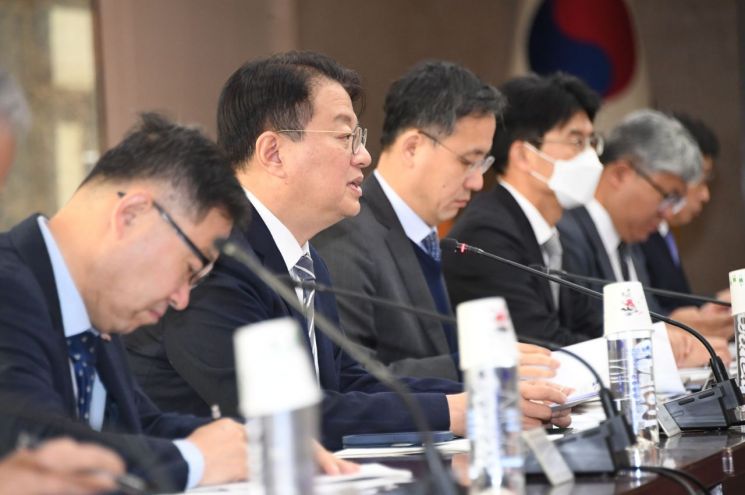 Bang Gi-seon, Vice Minister of Strategy and Finance, is delivering the opening remarks at the "1st Public-Private Joint ESG Policy Council" held on the 21st at the Government Seoul Office in Jongno-gu, Seoul.
[Asia Economy Sejong=Reporter Song Seung-seop] As the international community and global companies intensify demands for ESG (Environmental, Social, and Governance) management, the government and businesses have come together to discuss. Companies, citing burdens in manpower and costs, have requested large-scale support from the government. The government plans to establish evaluation standards and support the training of specialized personnel.
On the 21st, the Ministry of Economy and Finance chaired the 'Public-Private Joint ESG Policy Council' at the Government Seoul Office. The council was formed following the 'ESG Infrastructure Advancement Plan' announced by the government last December. It is a body to discuss countermeasures in preparation for the accelerated global ESG institutionalization led by international organizations and the EU. Officials from related ministries including the Ministry of Economy and Finance, Ministry of Trade, Industry and Energy, Ministry of Environment, Ministry of SMEs and Startups, Financial Services Commission, as well as representatives from the Korea Chamber of Commerce and Industry and the Korea Federation of SMEs attended.
At the council meeting, the Korea Chamber of Commerce and Industry argued that since companies face significant difficulties such as cost burdens and manpower shortages in supply chain due diligence, government support is needed in the form of industry-specific guidelines, consulting, tax and financial support, and training of specialized personnel. They also requested that when adopting ESG standards prepared by the International Sustainability Standards Board (ISSB), sufficient grace periods be granted and autonomy be ensured regarding disclosure timing. For industries with high carbon emissions such as steel and chemicals, voices were raised asking the government to support energy efficiency and process optimization.
Companies are voicing these concerns because the intensified international pressure to comply with ESG obligations is burdensome. According to the Korea Chamber of Commerce and Industry, companies identify the biggest ESG issues this year as 'supply chain due diligence (40.3%)' and 'mandatory ESG disclosure (30.3%)'. Environmental regulations such as 'circular economy (15.7%)' and 'carbon border adjustment mechanism (12.0%)' also ranked.
The international community has already announced stringent ESG regulations. The EU plans to introduce a supply chain ESG due diligence law, requiring mandatory ESG disclosure for some foreign companies starting in 2025. The U.S. Securities and Exchange Commission will finalize mandatory climate disclosure requirements for listed companies early this year. Private companies like Apple and BMW are cutting ties with partners whose ESG management levels are insufficient.
In response, the Ministry of Economy and Finance plans to conduct ESG supply chain due diligence diagnostic evaluations and provide consulting for export-oriented small and medium-sized enterprises (SMEs) and mid-sized companies this year. To enhance transparency and fairness in ESG evaluations, guidance for ESG evaluation agencies will be developed. To activate private social bonds, guidelines will be prepared, and graduate-level ESG education programs will be promoted to train ESG experts.
The Financial Services Commission will finalize and announce detailed plans for mandatory ESG disclosure this year through consultations with industry, investors, and private experts. It also announced plans to establish domestic ESG disclosure standards (draft) through the operation of the Sustainability Standards Board (KSSB) within the Korea Accounting Standards Board.
Additionally, the government will conduct industry consultations during the introduction of disclosure standards, rationalize regulations to promote the circular economy, and hold inter-ministerial consultations related to support for carbon reduction technology development.
Bang Ki-seon, Vice Minister of Economy and Finance, emphasized, “If our companies fall behind in the rapidly changing global ESG environment, they will face significant difficulties in exports, investment, and international competitiveness.” He added, “Going forward, the ESG Policy Council will actively listen to private sector difficulties, discuss key ESG policy tasks, and concretize measures for each task, functioning as a public-private joint ESG control tower.”
© The Asia Business Daily(www.asiae.co.kr). All rights reserved.
![User Who Sold Erroneously Deposited Bitcoins to Repay Debt and Fund Entertainment... What Did the Supreme Court Decide in 2021? [Legal Issue Check]](https://cwcontent.asiae.co.kr/asiaresize/183/2026020910431234020_1770601391.png)
















