Capital area accounts for 80%
Seoul Gangseo-gu has the highest number by city and district criteria
[Asia Economy Reporter Kim Min-young] The number of tenants rushing to the courts to apply for 'Leasehold Registration Orders' due to landlords failing to return their jeonse or monthly rent deposits has surged sharply. This is analyzed to be because cases of deposit non-return have increased as both sale prices and jeonse prices have fallen simultaneously.
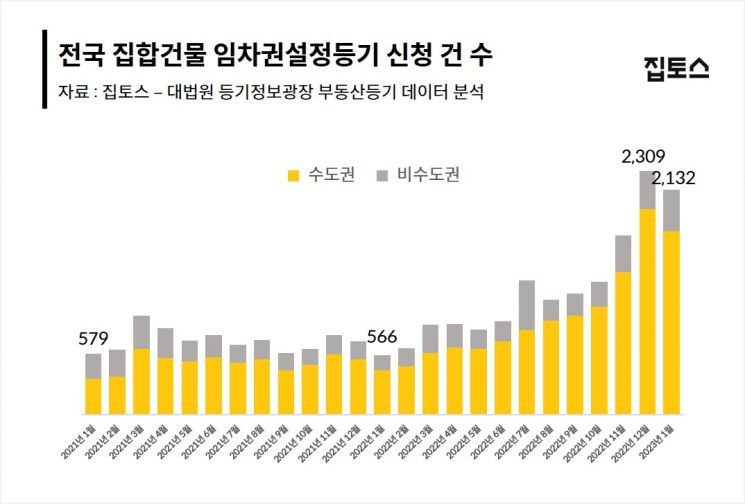 Number of Applications for Registration of Leasehold Rights on Collective Buildings Nationwide (Photo by Jiptos)
On the 21st, real estate brokerage firm Jiptoss analyzed real estate registration data from the Supreme Court Registry Information Plaza and found that the number of leasehold registration applications for collective buildings nationwide was 4,441 in December 2022 and January this year, more than 3.5 times higher than the same period last year. Leasehold registration is applied for by tenants who have not received their deposits back from landlords despite the expiration of the lease contract, by court order. The increase in leasehold registrations can be interpreted as indicating that cases of deposit non-return are occurring more frequently.
Looking at the number of leasehold registration applications for collective buildings over the past year, out of 14,297 cases nationwide, 11,218 cases (78%) were in the metropolitan area. By city and district, Seoul Gangseo-gu had the highest number with 1,145 cases, followed by △ Bucheon-si, Gyeonggi-do with 831 cases, △ Seo-gu, Incheon with 766 cases, Michuhol-gu with 762 cases, and △ Guro-gu, Seoul with 731 cases. In Seoul Gangseo-gu and Bucheon-si, Gyeonggi-do, about 11% (639 cases) of the 5,861 collective building jeonse contracts signed two years ago, based on actual transaction prices from the Ministry of Land, Infrastructure and Transport over the past two months, have led to leasehold registration applications, indicating frequent occurrences of deposit non-return cases. Recent leasehold registration applications mainly stem from jeonse contracts signed two years ago. This is due to the continuous decline in housing prices and jeonse prices.
The number of leasehold registration applications is expected to increase further. This is because the jeonse prices in 2021, which will reach two years this year, were higher than in 2020. According to the Korea Real Estate Board, the comprehensive housing jeonse price index rose from 96.9 in December 2020 to 103.2 in December 2021.
Jin Tae-in, head of the apartment brokerage team at Jiptoss, said, "Cases where tenants fail to receive their lease deposits from landlords are increasing due to the decline in jeonse transaction prices and the impact of jeonse fraud." He added, "If tenants who have not received their deposits back after the contract expires report moving out before registering the leasehold, they lose their opposability and will not be able to protect their deposits. Tenants should be careful not to report moving out until the leasehold registration is completed."
© The Asia Business Daily(www.asiae.co.kr). All rights reserved.

















