Establishing a Base Factory in Nagoya by 2026
Planning to Introduce AI for Aircraft Weight Reduction"
[Asia Economy Reporter Jeon Jinyoung] Toray, a leading Japanese advanced materials company, announced plans to establish a base factory in Nagoya by 2026 for the production of materials for drone taxis. The strategy is to take the lead in the emerging market by being the first to develop carbon fiber exclusively for drone taxis.
According to the Nihon Keizai Shimbun (Nikkei) on the 21st, Toray plans to create a base factory in Nagoya and begin developing carbon fiber to reduce the weight of aircraft bodies. Since the Nagoya factory site already handles the production of materials for automobiles, the base will be constructed centered around this location.
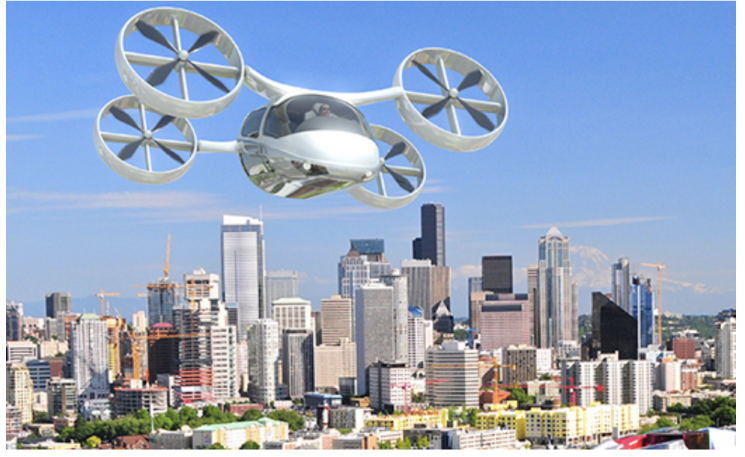 Conceptual diagram of Urban Air Mobility (UAM) including drone taxis introduced by Toray. (Photo by Toray official website)
Toray decided to incorporate artificial intelligence (AI) into the process to shorten material development time and reduce costs. Nikkei analyzed, "By inputting customer-desired conditions such as weight and strength into the AI and selecting resins and chemicals to add to the carbon fiber, materials tailored to customer requirements can be created," adding, "Compared to the traditional method relying on researchers' experience and intuition, this is expected to reduce development time to about one-quarter."
In addition, Toray will establish a lab at the Nagoya base for joint research with client companies and universities, where about 140 personnel will conduct research and development. The total investment is expected to be around 6 billion yen (approximately 58 billion KRW). A Toray representative stated, "We will broadly cover material development not only for drone taxis but also for next-generation passenger aircraft."
Nikkei viewed this as aligned with Toray's strategy to capture the emerging market. Although drone taxis, along with autonomous vehicles, are gaining attention as promising industries, material development still has a long way to go. Currently, drone taxis are made using carbon fiber for passenger aircraft, so there is a need to develop even lighter materials. Until now, development has mostly been led by startups, but with major companies like Toray and Honda declaring their entry into development, competition is expected to intensify.
In Japan, drone taxis are being actively promoted for commercialization as a means of transportation in mountainous and remote island areas as well as a solution to urban traffic congestion. According to the Ministry of Economy, Trade and Industry of Japan, the drone taxi market is expected to expand to 30 trillion yen (approximately 290 trillion KRW) by 2030. Earlier, on the 17th, the incorporated association MASC, a coalition of small and medium-sized aviation and automobile companies in Okayama Prefecture, succeeded in a test flight of a two-seater drone taxi held in Oita City. The drone taxi automatically flew 400 meters for 3 minutes and 30 seconds.
© The Asia Business Daily(www.asiae.co.kr). All rights reserved.
![Clutching a Stolen Dior Bag, Saying "I Hate Being Poor but Real"... The Grotesque Con of a "Human Knockoff" [Slate]](https://cwcontent.asiae.co.kr/asiaresize/183/2026021902243444107_1771435474.jpg)
















