[Asia Economy Reporter Lee Ji-eun] On the morning of the 21st, President Yoon Seok-yeol approved the arrest consent bill, passing the ball to the National Assembly. While the Democratic Party of Korea, raising voices for a "united front," strongly insists that "there will be no rejection," the ruling party seems to be subtly hoping for dissenting votes, saying "at least 35 votes will defect." Regarding the 'shield' frame likely to be imposed on the Democratic Party if the bill is rejected, the party actively defended itself, saying "it's not a shield," but "a defense, not a shield."
On the 21st, Ha Tae-kyung, a member of the People Power Party, maintained his forecast on MBC's 'Kim Jong-bae's Focus' that "at least 35 dissenting votes will come from within the Democratic Party," adding, "This is an open secret among lawmakers."
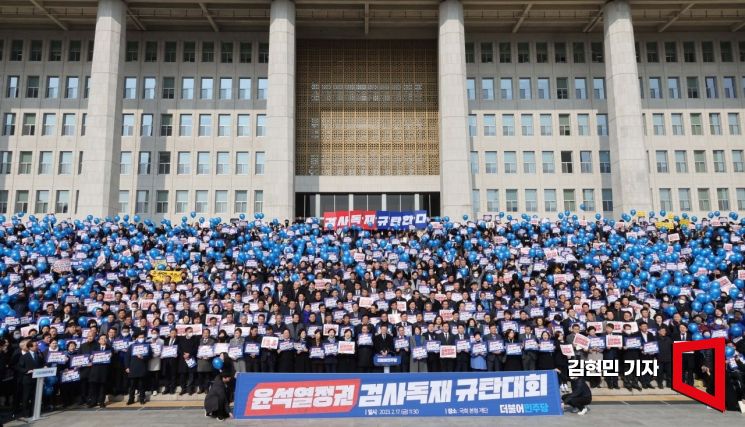 Lee Jae-myung, leader of the Democratic Party of Korea, Park Hong-geun, floor leader, members of the National Assembly, party committee chairpersons, and party members are shouting slogans at the "Condemnation Rally Against Prosecutorial Dictatorship of the Yoon Seok-yeol Administration" held on the stairs in front of the main building of the National Assembly in Yeouido, Seoul, on the 17th. Photo by Kim Hyun-min kimhyun81@
He said, "The reason for specifying this number is that since the Democratic Party's party convention last year, many lawmakers thought that if Lee Jae-myung became the leader, it would become a kind of 'second defense of Cho Kuk'?a 'defense of Jae-myung'?and that the Democratic Party's approval ratings would continue to fall, making the general election difficult. So, quite a few lawmakers tried to dissuade others from supporting him."
This criticism has existed since the party convention. Ha said, "Listening to lawmakers within the Democratic Party, if Lee's leadership continues and he exercises the nomination rights, at least about 35 members will not follow along. This is practically an open secret among lawmakers."
He emphasized that even if this consent bill is rejected, if arrest consent bills related to Baekhyeon-dong, Jeongja-dong, or North Korea remittances come up in the future, dissenting votes within the Democratic Party could continue to increase. He said, "This is not the first and last arrest consent bill. More than three new arrest consent bills will be submitted on new charges," and expressed confidence that "the number of votes in favor of these arrest consent bills will continue to rise."
Kim Jung-jae, also from the People Power Party, gave a similar forecast on YTN's 'News King with Park Ji-hoon.' He said, "Through the previous two rehearsals (arrest consent bill for Democratic Party lawmaker Noh Woong-rae and impeachment motion for Minister of the Interior and Safety Lee Sang-min), there will be almost no dissenting votes this time," but questioned, "If the Democratic Party's approval ratings continue to fall like this, they will reject it this time, but when the second arrest consent bill comes next time, will they be able to reject it again?"
Former Supreme Council member Kim Jae-won also said on KBS's 'Choi Kyung-young's Strong Current Affairs,' "The North Korea remittance case is currently under investigation, and if an arrest warrant is requested combined with that case, Democratic Party lawmakers will be in considerable trouble," adding, "They rejected it once because he was the party leader, but if they embrace this again and reject it, more people will argue that 'the party will be abandoned by the people.'"
However, Democratic Party lawmaker Park Joo-min rebutted that linking 'rejection' directly to the shield frame is inappropriate. On MBC's 'Kim Jong-bae's Focus,' he said, "Around me, I don't sense such a trend or atmosphere for approval, so I believe there will be no dissenting votes or very few," adding, "I don't feel the investigation is being conducted properly. Therefore, naturally, rejection votes should be cast, and simply calling that a shield is not appropriate."
Former Blue House Senior Secretary for Political Affairs Choi Jae-sung also emphasized that it is a 'defense,' not a 'shield.' He said, "The prosecution has conducted the largest number of searches and the most intense attacks since the founding of the nation. They are just firing bullets indiscriminately," adding, "This is not shielding but blocking with a shield." Regarding parliamentary immunity, he stated, "The Democratic Party views this (the investigation into Lee) as excessive prosecution, political action, and political retaliation by the prosecution. In such cases, whether to exercise the current parliamentary immunity by asking the National Assembly for consent is a duty the Assembly must fulfill," expressing the position that parliamentary immunity should be actively exercised.
© The Asia Business Daily(www.asiae.co.kr). All rights reserved.

















