Re-promotion Triggered by Various Strikes Last Year
Gyo-ye to Force Processing at Environment and Labor Committee Today
"Exemption Even for Illegal Union Strikes"
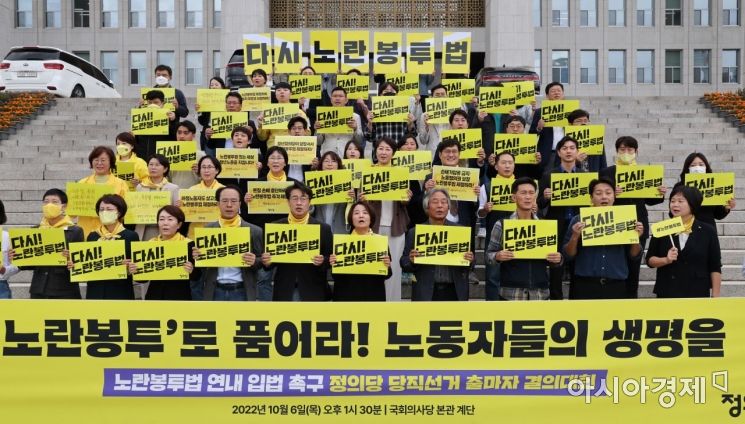 Justice Party lawmakers are holding a resolution rally on the steps in front of the National Assembly main building, urging the enactment of the Yellow Envelope Act. Photo by Yoon Dong-joo doso7@
[Asia Economy Reporter Kim Bo-kyung] The business community is strongly opposing the 'Yellow Envelope Act' (Amendment to the Labor Union and Labor Relations Adjustment Act, hereinafter referred to as the Labor Union Act) pushed by the opposition party. This bill stipulates that employers cannot claim damages for losses caused by illegal labor disputes such as workplace occupation by labor unions. The business sector is raising their voices, saying that if the Yellow Envelope Act passes, it would be tantamount to condoning illegal acts and encouraging illegal strikes. However, since the major opposition parties, the Democratic Party of Korea and the Justice Party, have made the passage of the Yellow Envelope Act a key agenda, repercussions are expected in the future. The opposition plans to pass the Yellow Envelope Act at the full meeting of the National Assembly's Environment and Labor Committee scheduled for 10 a.m. today (21st).
◆Looking at the progress of the Yellow Envelope Act = Several illegal strikes occurred in industrial sites last year. In March, members of the Cargo Solidarity Union under the Korean Confederation of Trade Unions (KCTU) went on strike and occupied the rooftop of the HiteJinro headquarters. The direct damage to HiteJinro amounted to 6 billion KRW, and indirect damage reached 20 billion KRW. HiteJinro filed criminal charges against 12 union members who participated in the illegal strike and filed a lawsuit claiming 2.77 billion KRW in damages.
The subcontractor workers' union at Daewoo Shipbuilding & Marine Engineering (DSME), affiliated with the KCTU, went on strike in June last year demanding a 30% wage increase and a 300% bonus increase. The subcontractor union occupied key points within the Okpo shipyard and the No. 1 dock. The No. 1 dock is the world's largest shipbuilding yard capable of constructing four ships simultaneously. It is said that the suspension of operations at the No. 1 dock was the first time in 50 years since 1973. The subcontractor union conducted an illegal strike for 51 days, causing over 800 billion KRW in damages to DSME. The company filed a lawsuit claiming 47 billion KRW in damages against the union leadership.
The labor sector urged amendments to Articles 2 and 3 of the Labor Union Act, arguing that such civil and criminal prosecutions filed by employers against illegal strikes undermine constitutionally guaranteed labor rights. This is the Yellow Envelope Act. In a press conference last August, the KCTU stated, "We will prevent employers from disciplining workers with the weapon of damage claims." The Democratic Party and the Justice Party have designated the Yellow Envelope Act as a priority bill and have introduced more than ten related bills, showing strong legislative intent. Considering the current distribution of seats in the National Assembly, the likelihood of the Yellow Envelope Act passing is high.
◆What are the problems and opposition views regarding the Yellow Envelope Act? = South Korea's Labor Union Act already explicitly prohibits claims for damages arising from lawful labor disputes. The core of the Yellow Envelope Act is that it extends this prohibition to damages caused by illegal labor disputes. If the bill passes, companies (prime contractors) cannot claim damages from perpetrators of illegal strikes such as the subcontractor union's dock occupation in the DSME case. Claims can only be made for damages arising from acts of deviation beyond union control.
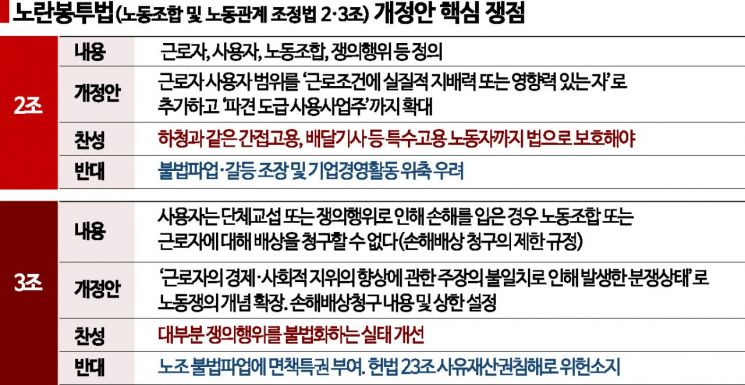
The Korea Economic Research Institute recently reported that losses incurred by domestic companies due to illegal strikes over the past six years, including production disruptions and sales losses, amounted to 7.1005 trillion KRW. The Korea Employers Federation pointed out that "exempting illegal labor disputes from liability under the Yellow Envelope Act excessively infringes on employers' property rights, which are fundamental constitutional rights." Yoon Sang-hyun, a member of the People Power Party, said at a forum on "Resolving Labor Polarization" held with the National Labor Union last year, "It means that employers must accept any damage unconditionally," adding, "It is an attempt that fundamentally shakes the survival foundation of companies."
◆Examining the contents of the Yellow Envelope Act bills = There are about ten Yellow Envelope Act bills pending at the National Assembly's Environment and Labor Committee. Most of the amendments are unfavorable to employers when strikes occur. The bills mainly focus on two points. First, expanding the scope of workers and employers defined in Article 2 of the Labor Union Act to allow direct negotiations between subcontractor workers and companies (prime contractors). For example, Justice Party lawmaker Kang Eun-mi's bill includes provisions to expand the scope of workers to freelancers and workers in special types of employment (special types of workers, or "teukgo"). Second, expanding the scope of lawful strikes defined in Article 3 to exempt liability for damages and limit damage claims. The amendments commonly specify that "unless caused by violence or destructive acts, damages caused by union activities cannot be claimed from workers." They also include provisions limiting damage claims "if the employer caused the workers' violent or destructive acts" (Democratic Party lawmaker Kang Min-jung's bill) and "if planned by the union" (Democratic Party lawmaker Kang Byung-won’s bill).
Hwang Yong-yeon, head of the Labor Policy Department at the Korea Employers Federation, said, "Prohibiting lawsuits for damages solely because one is an employer infringes on fundamental rights such as equality and the right to sue, raising constitutional concerns." Lawyer Park In-hwan said, "The Yellow Envelope Act, proposed by opposition parties holding an overwhelming majority of seats, is an unconstitutional bad law," adding, "It is legislative populism, an abuse of legislative power for political calculation."
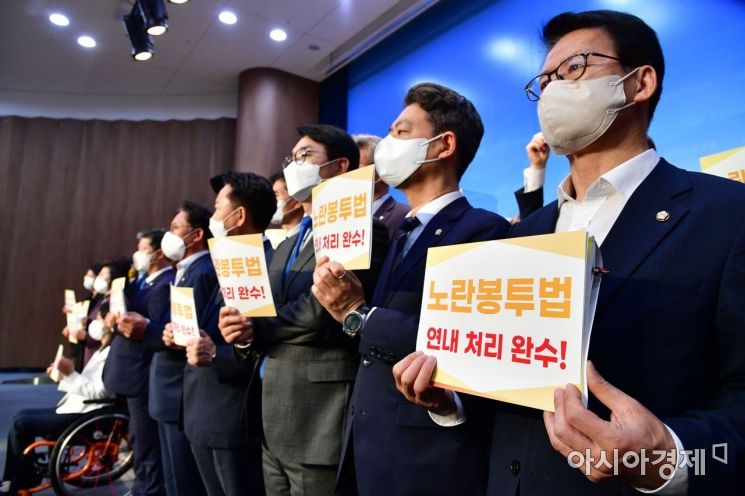 Members of the Democratic Party of Korea, the Justice Party, the Basic Income Party, independents, and representatives of civil society organizations are holding a "Press Conference Urging the Passage of the Yellow Envelope Act During the Regular National Assembly Session" at the National Assembly. Photo by Yoon Dong-ju doso7@
*Yellow Envelope Act
In 2014, members of the Ssangyong Motor union were ordered by the court to pay 4.7 billion KRW in damages for illegal strikes. A citizen started sending support donations by putting 47,000 KRW in a yellow envelope, and a total of about 47,000 citizens raised 1.47 billion KRW. In other words, it means "a helping hand from the public to workers who have been excessively sued for damages." However, the employer side argues that the name lacks the element of 'illegal acts.' They claim that the essence of illegal acts is concealed, and the law is packaged as a kind and righteous law. The Yellow Envelope Act bills were also proposed in the 19th and 20th National Assemblies but were all discarded.
© The Asia Business Daily(www.asiae.co.kr). All rights reserved.



















