Promotion of 6G Preliminary Feasibility Study Worth 600 Billion KRW
International Standard Patent Share from 26% to 30%
6G Demonstration in 2026... Commercialization in 2028
[Asia Economy Reporter Oh Su-yeon] The government is pushing forward a preliminary feasibility study worth 625.3 billion KRW to expedite the commercialization of 6G and secure leadership. The goal is to increase the standard patent share to 30% and proactively secure 6G competitiveness.
On the morning of the 20th, the Ministry of Science and ICT announced that it presented the 'K-Network 2030 Strategy' at the emergency economic ministers' meeting chaired by the Deputy Prime Minister for Economy.
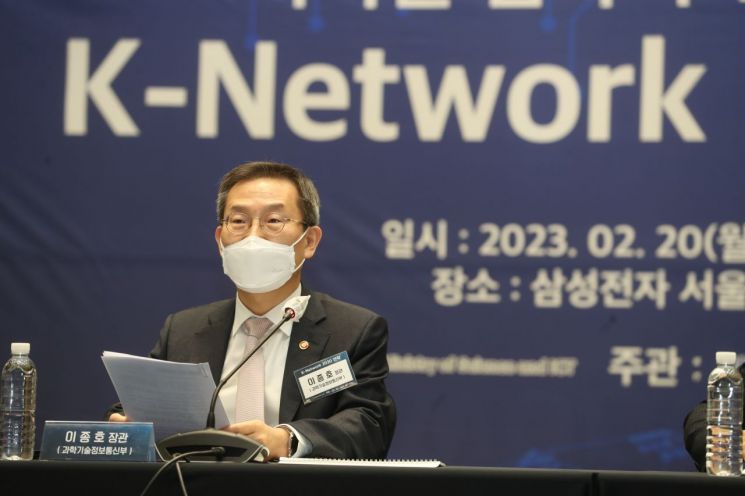 Minister Lee Jong-ho of the Ministry of Science and ICT is delivering a greeting at the 'K-Network 2030 Strategy Presentation' held on the afternoon of the 20th at Samsung Electronics Seoul R&D Campus in Seocho-gu, Seoul.
 [Photo by Ministry of Science and ICT]
The 'K-Network 2030 Strategy' is a next-generation network development plan prepared to successfully implement President Yoon Suk-yeol's New York initiative and the 'Digital Korea Strategy' announced last September. As digital innovation accelerates across society, competition among countries such as the United States, China, and the European Union (EU) to dominate technology is intensifying. The Ministry of Science and ICT recognizes the need for proactive investment and industrial foundation establishment for next-generation networks and will actively pursue policy tasks to achieve three main goals: ▲ securing world-class 6G technology ▲ software (SW)-based network innovation ▲ strengthening the network supply chain.
First, to secure leadership in the 6G era, a preliminary feasibility study procedure for research and development (R&D) worth 625.3 billion KRW will be conducted. Adding the 191.7 billion KRW budget for the 6G Core Technology Development Project running until 2025, the total exceeds 800 billion KRW. The plan is to simultaneously promote 6G R&D, which has so far focused on fundamental technologies, along with commercialization, materials, parts, and equipment (MP&E), and Open RAN (open radio access network) technology development.
According to a survey by German patent information analysis firm Iplytics, Korea's share of international 5G standard patents was 25.9% in 2022, ranking second after China (26.8%). For 6G, the plan is to raise the standard patent share to over 30%. In 2026, a 'Pre-6G Vision Fest' will be held, inviting major countries' telecom operators, manufacturers, experts, and government officials to gather and demonstrate 6G research achievements. Commercialization is planned as early as 2028.
Kim Jung-sam, Director of Information Security and Network Policy at the Ministry of Science and ICT, said, "The 6G hegemony competition is accelerating more than 5G, so the commercialization timeline may be brought forward. From a national strategy perspective, it is essential to secure related patents in preparation for global competition."
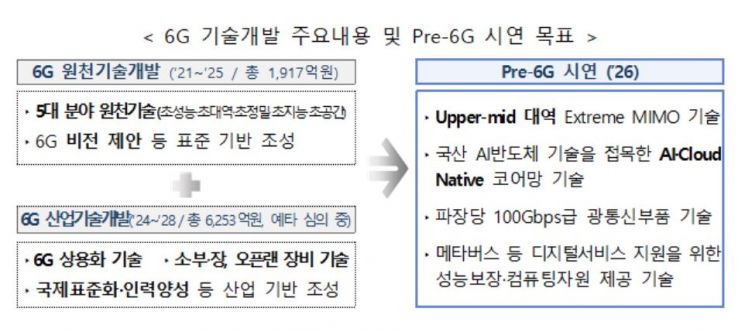 Key Contents of 6G Technology Development and Pre-6G Demonstration Goals
 [Photo by Ministry of Science and ICT]
Efforts will also be made to build a low-earth orbit satellite communication pilot network and achieve self-reliance in core technologies. In 2027, through the 'Low-Earth Orbit Communication Satellite Test Launch,' key technologies such as antennas and modems will be demonstrated, with full-scale expansion into the defense sector after 2030. To dominate the quantum communication market, plans include building a pilot network for quantum device interconnection (quantum internet), expanding quantum cryptography communication in the public sector, and actively promoting quantum-resistant cryptography technology development and demonstration.
To accommodate high-performance services, network infrastructure such as local area networks, backbone networks, and submarine cables will be upgraded. For local area networks, from June this year, optical cables will be fully installed in new buildings to improve perceived internet quality, Wi-Fi 6E usage will be expanded, and next year, evolution to the next-generation standard Wi-Fi 7 will be pursued. Backbone network transmission speeds will be quadrupled by 2030. Service stability will be enhanced through capacity expansion of submarine cables and diversification of landing countries. AI semiconductor technology for communications will be secured, and low-power design and high-efficiency new device technologies will be developed to reduce power consumption of network equipment.
A competitive industrial ecosystem will be established. Domestic small and medium network equipment companies will be intensively nurtured, increasing the current five global strong small and medium enterprises to 20 by 2030. Support will be provided for the development of core Open RAN equipment and component technologies, and a public-private coalition will be operated to promote international standardization and commercialization. Talent development will also be strengthened. Advanced talents with master's and doctoral degrees in next-generation technology fields such as 6G and quantum, as well as urgently needed practical talents in network software fields, will be cultivated simultaneously.
Minister Lee Jong-ho visited Samsung Electronics' Seoul R&D Campus in the afternoon and listened to the achievements and future plans of 6G, Open RAN, and optical communication technology development from Samsung Electronics, LG Electronics, Electronics and Telecommunications Research Institute (ETRI), HFR, and Oisolution. Minister Lee and representatives of major companies and institutions also signed a 'Win-Win Cooperation Agreement' pledging mutual cooperation among the public sector, private sector, universities, large corporations, and SMEs to realize the vision of a 'model country for next-generation networks.'
Minister Lee said, "Networks are an essential foundation for providing digital services, a major national infrastructure industry, and a core element of national security. We will engage in the global technology hegemony competition through proactive investment in next-generation network technologies such as 6G, Open RAN, and satellites based on public-private cooperation." He also stated, "In preparation for the paradigm shift to cloud- and software-centered networks, we will continue to support the competitiveness of our companies to expand network equipment exports and global market share."
© The Asia Business Daily(www.asiae.co.kr). All rights reserved.


















