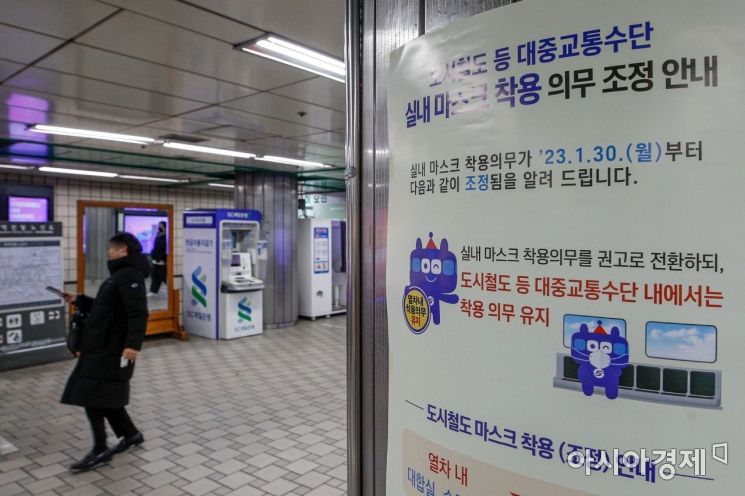
 An indoor mask-wearing mandate adjustment notice for public transportation is posted at Sinchon Station on Subway Line 2 in Seodaemun-gu, Seoul. Photo by Jinhyung Kang aymsdream@
[Asia Economy Reporter Lee Gwan-ju] As the indoor mask-wearing mandate is adjusted and the COVID-19 outbreak clearly declines, expectations for a return to normal life are growing. With no increase in severe cases or deaths as feared, there are also prospects that the timeline for lifting remaining quarantine measures?such as the complete removal of indoor mask mandates and the 7-day isolation for confirmed cases?could be accelerated.
According to the quarantine authorities on the 21st, the number of severe patients hospitalized as of midnight the previous day was 197, dropping to the 100s for the first time in four months since October 22 last year (196 patients). The number of deaths also increased by 9, showing a single-digit daily death toll for the first time since October 18 last year (6 deaths). Since the indoor mask-wearing mandate was adjusted to a recommendation for all but some high-risk facilities on the 30th of last month, no signs of a resurgence have appeared even after three weeks, easing concerns to some extent.
In fact, a survey showed that Koreans are undergoing a 'gradual adjustment' regarding the lifting of indoor mask-wearing. According to a recent COVID-19 perception survey conducted by Professor Yoo Myung-soon’s team at Seoul National University Graduate School of Public Health, 69.1% judged the quarantine authorities’ decision to lift the indoor mask mandate as a ‘reasonable decision’ (50.0% somewhat reasonable, 19.1% completely reasonable). However, respondents generally reported no significant change in indoor mask-wearing levels at six major indoor multi-use facilities: restaurants and cafes, gyms and exercise facilities, department stores and marts, performance halls and cinemas, religious facilities such as places of worship and temples, and educational and learning facilities. Professor Yoo analyzed, “While the decision to adjust the indoor mask recommendation excluding vulnerable facilities and public transportation is seen as reasonable, the actual response shows a gradual and stepwise adjustment rather than a binary ‘wear or not wear’ approach.”
As the quarantine situation remains stable, attention is focused on the timing of lifting the remaining measures, such as the mask-wearing mandate in medical institutions, public transportation, and high-risk facilities, as well as the 7-day isolation for confirmed cases, which are practically the last remaining quarantine measures. The quarantine authorities previously stated that full recovery of daily life would be possible when the current infectious disease crisis alert level of ‘severe’ is downgraded or when COVID-19’s legal infectious disease classification (level 2) is lowered to level 4.
One proposed timing for this is the World Health Organization (WHO) lifting the public health emergency of international concern. Considering that WHO holds the World Health Assembly (WHA) every May, it is expected that the emergency status might be lifted around that time. If WHO lifts the emergency, discussions for full recovery of daily life could begin in earnest domestically as well. If the domestic situation remains stable as it is now, discussions could proceed even sooner. A quarantine official explained, “The second phase adjustment of the mask-wearing mandate will be reviewed along with monitoring the COVID-19 outbreak situation after the first phase adjustment and considering changes in the infectious disease crisis level.”
Experts also believe it is time to move toward a phased return to normal life. At a recent meeting of the National Infectious Disease Crisis Response Advisory Committee, the advisory group recommended the government prepare for a gradual transition to a routine management system while stably managing the outbreak, considering the global decline in COVID-19 cases, the easing of quarantine measures in major countries, and social demands for a normal life. They also emphasized the importance of multifaceted review and discussion to ensure protection of high-risk groups is not compromised amid future easing of quarantine measures. Chairman Jeong Ki-seok of the advisory committee said, “Although the world has not completely escaped the COVID-19 crisis, given the current stable domestic situation and sufficient response capacity, it is time to discuss preparations for the public’s return to normal life while closely monitoring the emergence of new variants overseas.”
© The Asia Business Daily(www.asiae.co.kr). All rights reserved.
![User Who Sold Erroneously Deposited Bitcoins to Repay Debt and Fund Entertainment... What Did the Supreme Court Decide in 2021? [Legal Issue Check]](https://cwcontent.asiae.co.kr/asiaresize/183/2026020910431234020_1770601391.png)
















