Jeju Lowers Free Ride Age to 65 from 5
Jeju Lacks Subway and Has Poor Public Transport Accessibility
Funding Covered by Local Government, Need for Burden Relief Measures
[Asia Economy Reporter Park Hyun-joo] Jeju Province is drawing attention as it announced plans to lower the age for bus fare exemption within the province from the current 70 to 65. This move contrasts with other local governments that propose raising the free ride age from 65 and above to 70 and above, citing subway deficits as the reason.
The senior free ride system has become a burden after 40 years since its introduction, being pointed out as a cause of chronic subway deficits. There have even been claims to abolish the free ride system or reduce the eligible age group due to the increasing elderly population. In Seoul, when the free transportation system was introduced, the population aged 65 and over was 3.8%, but now it is 17.4%, resulting in a significant financial burden from free transportation.
However, Jeju Province has decided to take a completely opposite approach from other local governments. It plans to exempt bus fares for residents aged 65 and over living in the eup and myeon areas within the province. Public transportation fares are also planned to be frozen until the first half of the year. Currently, the number of people eligible for bus fare exemption in the province is about 76,000 aged 70 and above, and with the age expansion plan, an additional 15,000 people aged 65 to 69 are expected to benefit. Additionally, the eligible age for using the Happy Taxi service in eup and myeon areas will be lowered from 70 and above to 65 and above.
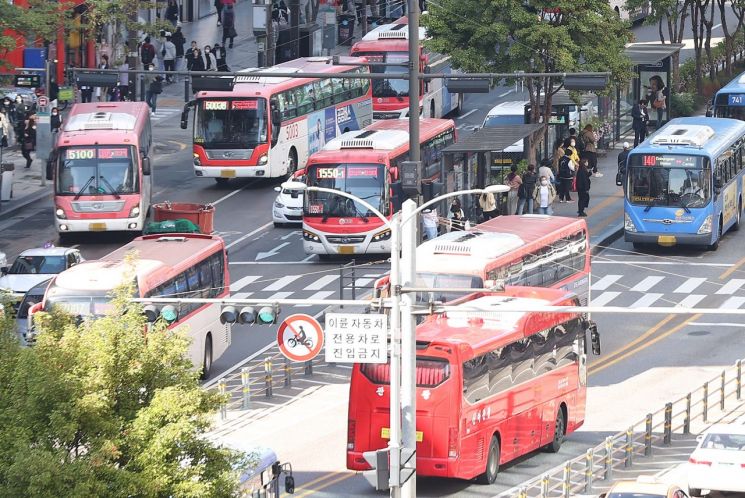 A metropolitan bus operating on Gangnam-daero, Seoul, on the afternoon of October 12 last year.
 [Image source=Yonhap News]
The background for this initiative is the lower accessibility to public transportation compared to other cities and provinces. Jeju has no subway, and public transportation access in eup and myeon areas is poorer than in urban areas, making it difficult for the elderly population to use public transportation.
The additional funding required will be covered 100% by local government funds without national funds such as lottery funds or provincial subsidies. The province estimates the additional budget needed to be 3.45 billion KRW this year, totaling 25 billion KRW over five years until 2027.
However, Jeju’s bus system also needs measures to ease financial burdens. Under the quasi-public operation system, Jeju Province, responsible for compensating losses, provides subsidies to bus companies amounting to around 100 billion KRW annually. The province is also pursuing route consolidation, adjustment of operation frequency, and conversion to medium and small-sized buses to reduce bus financial support.
The aging trend is also an issue. With the increase in the elderly population, Daegu City recently announced it is considering raising the subway free ride age from 65 to 70, and Seoul City has also expressed intentions to revise the age criteria.
According to Statistics Korea, as of the end of last year, the elderly population aged 65 and over in Jeju Province was 17.1% (115,768 people), already entering a super-aged society (elderly population ratio over 14%). In Jeju City as well, concerns arise that as the elderly ratio increases, the burden of free transportation costs will grow, worsening financial strain.
© The Asia Business Daily(www.asiae.co.kr). All rights reserved.