Resolution of the Bill at the Full Meeting of the Political Affairs Committee
Coordination Between Ruling and Opposition Parties Completed, Expected to Be Submitted to the Plenary Session
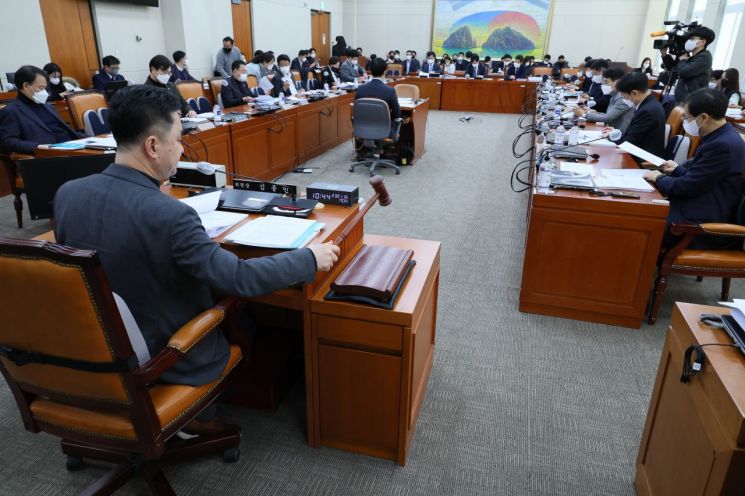
[Asia Economy Reporter Park Jun-yi] The amendment to the Subcontracting Act for the introduction of the 'Delivery Price Linkage System' passed the National Assembly's Judiciary Committee on the 20th. The Delivery Price Linkage System is a system that reflects fluctuations in raw material prices in the delivery price during the subcontracting contract period. It was proposed as a campaign pledge by President Yoon Seok-yeol during last year's presidential election, following the surge in raw material prices caused by the collapse of global supply chains amid the COVID-19 pandemic.
The Judiciary Committee held a plenary session at the National Assembly on the same day and approved the 'Partial Amendment to the Act on Fairness in Subcontracting.' The amendment is one of the pillars of the Delivery Price Linkage System, along with the 'Partial Amendment to the Act on Promotion of Mutual Growth between Large and Small-Medium Enterprises,' which was passed by the National Assembly plenary session last year. The Mutual Growth Cooperation Act, which deals with supply and consignment transactions, is under the jurisdiction of the Ministry of SMEs and Startups, while the Subcontracting Act, which governs subcontracting transactions, is under the jurisdiction of the Korea Fair Trade Commission.
Since both ruling and opposition parties adopted the Delivery Price Linkage System as their party policy and the Mutual Growth Cooperation Act passed the plenary session, it is expected that the Subcontracting Act will also be smoothly processed in the plenary session after review by the Legislation and Judiciary Committee.
The amendment includes provisions allowing adjustment of subcontracting payments linked to fluctuations when the price of major raw materials, accounting for more than 10% of the subcontracting payment, changes beyond a rate agreed upon by the principal and subcontractor within a 10% range. Unlike the Mutual Growth Cooperation Act, the Subcontracting Act contains a supplementary clause stipulating that if a separate relaxed rate is set by presidential decree considering industry-specific characteristics, that rate shall apply.
It also includes provisions allowing the Korea Fair Trade Commission to expand the scope of major raw materials subject to linkage, considering industry-specific characteristics. Exceptions are made so that the linkage system does not apply when the principal is a small enterprise, the contract is small-scale (under 100 million KRW), short-term (within 90 days), or when both parties agree not to apply the linkage.
However, to prevent abuse of these exceptions, a prohibition on evasion acts is stipulated, and companies violating this are subject to fines of up to 50 million KRW. Additionally, regulations were established to support the spread of the subcontracting payment linkage system, including the Korea Fair Trade Commission's establishment and revision of standard subcontracting payment linkage contracts, designation of linkage support centers, and selection and support of excellent companies in subcontracting payment linkage.
Furthermore, the current requirement for special conditions to apply for mediation of subcontracting payment adjustments has been removed, allowing mediation negotiations through small and medium enterprise cooperatives without special conditions.
© The Asia Business Daily(www.asiae.co.kr). All rights reserved.
![User Who Sold Erroneously Deposited Bitcoins to Repay Debt and Fund Entertainment... What Did the Supreme Court Decide in 2021? [Legal Issue Check]](https://cwcontent.asiae.co.kr/asiaresize/183/2026020910431234020_1770601391.png)