2022 Annual Regional Economic Trends
[Asia Economy Sejong=Reporter Joo Sang-don] Last year, nationwide inflation rose by 5.3% compared to the same period the previous year, continuing the high inflation situation, with Gangwon and Chungbuk recording the steepest price increases at 5.9%.
On the 20th, Statistics Korea released the '2022 Q4 and Annual Regional Economic Trends' report containing these details.
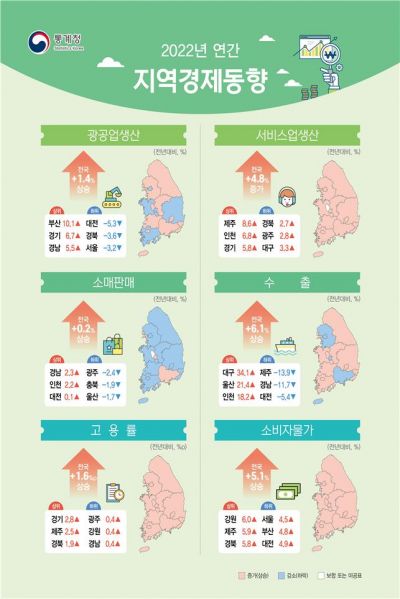
Nationwide prices rose 5.3% year-on-year due to increases in dining out and processed foods. Seoul (4.9%), Busan (5.0%), and Daejeon (5.1%) saw lower-than-average increases due to declines in agricultural and livestock products, while Gangwon (5.9%), Chungbuk (5.9%), and Chungnam (5.8%) experienced higher-than-average increases driven by dining out.
Regarding employment rates, the national rate was 62.3%, rising by 1.2 percentage points year-on-year due to increased employment rates among people in their 30s, those aged 60 and above, and those in their 20s. Regionally, Gangwon's employment rate fell by 0.2 percentage points, whereas Jeju (3.4 percentage points), Sejong (2.4 percentage points), and Incheon (1.7 percentage points) saw increases.
Nationwide exports decreased by 9.9% year-on-year due to reduced exports of ships and memory semiconductors. Daegu (28.1%), Ulsan (9.1%), and Incheon (0.9%) saw export increases driven by other organic and inorganic compounds and passenger cars. However, exports declined in Gyeongnam (-21.5%), Chungnam (-20.6%), and Jeju (-18.9%) due to reduced exports of ships, memory semiconductors, and semiconductor parts.
Retail sales nationwide fell by 1.8% year-on-year due to decreased sales in specialty retail and non-store retail. Gyeongnam (5.8%), Incheon (1.2%), and Chungnam (0.8%) experienced increases due to higher sales in passenger cars, fuel retail stores, and duty-free shops, while Daejeon (-5.2%), Jeju (-5.1%), and Seoul (-5.0%) saw declines due to reduced sales in specialty stores and duty-free shops.
Nationwide construction orders decreased by 15.8% year-on-year due to reduced orders for housing, offices, and stores. Ulsan (106.5%), Gyeongnam (74.4%), and Chungbuk (15.6%) saw increases driven by orders for machinery installation, land development, and factories/warehouses. Gwangju (-74.9%), Daegu (-73.5%), and Incheon (-70.1%) experienced declines due to reduced housing orders.
Manufacturing production nationwide fell by 4.1% year-on-year due to decreased production of electronic components and chemical products. Busan (14.0%), Incheon (6.3%), and Gyeongnam (5.0%) saw increases driven by production of other transportation equipment, automobiles, and trailers, while Seoul (-11.8%), Chungbuk (-11.7%), and Jeonnam (-9.0%) experienced declines due to reduced production of other machinery equipment, semiconductors/electronic components, and chemical products.
In the case of service industry production, nationwide production increased by 3.9% year-on-year due to growth in finance/insurance and health/welfare sectors, with all regions showing increases.
In the fourth quarter of last year, net population migration by province showed net inflows in eight regions including Gyeonggi (15,363 people), Incheon (7,926 people), and Chungnam (5,061 people). Conversely, nine regions including Seoul (-20,255 people), Busan (-3,100 people), and Gyeongnam (-2,767 people) experienced net outflows.
© The Asia Business Daily(www.asiae.co.kr). All rights reserved.

















