Statistics Korea 'Quality of Life 2022' Report
Korean Satisfaction Score 6.3... Lower Tier in OECD
Suicide Rate and Child Abuse Victimization Rate Worsen Further
[Asia Economy Sejong=Reporter Song Seung-seop] Indicators related to travel and health, which had been stagnant due to COVID-19, began to show slight improvements starting in 2021. As quarantine guidelines were implemented in daily life and social distancing measures were eased, the previously deteriorated indicators appeared to return to normal trajectories. However, many indicators still had not recovered to pre-COVID-19 levels, and some, such as suicide rates and child abuse victimization, even worsened.
According to the "Quality of Life of the People 2022" report published by Statistics Korea on the 20th, the life satisfaction score of Koreans in 2021 was 6.3 points. Satisfaction had remained around 6.0 points since 2017, but this year it rose slightly by 3.0 points compared to the previous year. In an international comparison, the score was 5.9 points, ranking in the lower tier among OECD countries, 0.8 points below the average score of 6.7 points.
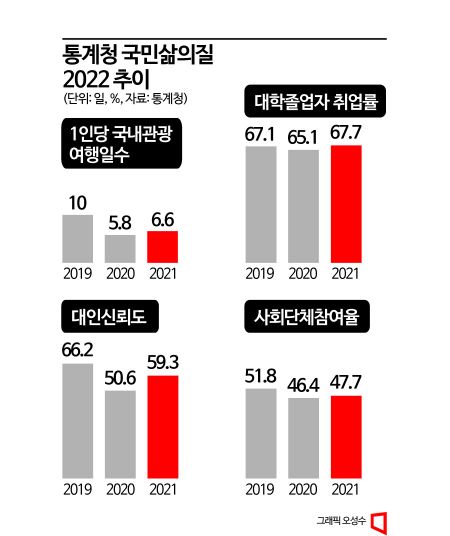
By category, the participation rate in social organizations, which had decreased due to COVID-19, increased. The participation rate in social organizations, which dropped by 5.4 percentage points to 46.4% in 2020 compared to the previous year, rose again to 47.7%. During this period, participation rates in political parties (2.0% → 8.0%), civic groups (2.3% → 6.5%), and labor unions (2.8% → 7.4%) showed particularly notable increases. However, among social organizations, only religious organizations showed little change amid the decrease and subsequent increase in participation rates.
The average number of travel days per person also slightly increased to 6.58 days in 2021 from 5.81 days the previous year. This appears to be a base effect caused by the sharp decline in travel days in 2020 due to restrictions not only on overseas travel but also on domestic travel and movement because of COVID-19. The travel experience rate for domestic tourism increased from 75.5% to 89.0%, exceeding the pre-COVID-19 level of 85.0%.
The obesity rate, which earned the nickname "Hwakjjinja" due to increased weight gain from remote work and prolonged social distancing during COVID-19, decreased to 37.1% in 2021 from 38.3% the previous year. Statistics Korea analyzed, "It is presumed that the obesity rate sharply increased as outdoor activities and use of exercise facilities were restricted and people stayed home more," adding, "Although it decreased slightly, it remains at a higher level than the previous trend."
Interpersonal trust rose by 8.7 percentage points to 59.3%, but it still did not reach pre-COVID-19 levels. Interpersonal trust hovered around 65% from 2015 to 2019 but plummeted to 50.6% in 2020. This is believed to be due to anxiety over interpersonal infection during COVID-19 and restrictions on outdoor activities, which led to disrupted human relationships.
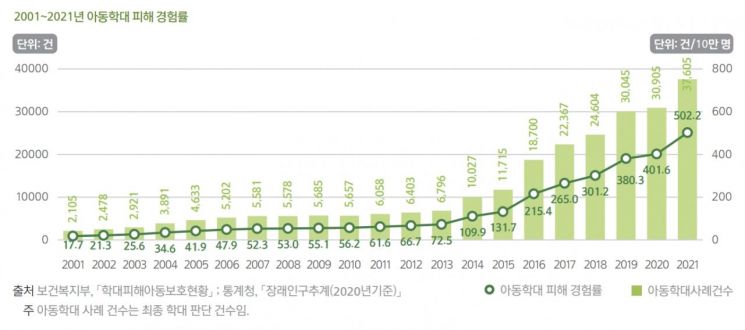
However, some statistics worsened during the COVID-19 period. The rate of child abuse victimization was 502.2 cases per 100,000 people in 2021, an increase of 100.6 cases compared to the same period last year, marking the largest rise since 2013. The number of child abuse cases also increased from 30,045 in 2019 to 30,905 in 2020 and 37,605 in 2021. However, since the number of child abuse cases is counted based on reports of child abuse victims, it is unclear whether actual abuse increased or if reporting increased.
Statistics Korea explained, "It can be interpreted that the increase in reported child abuse victims is not due to an actual rise in abuse but because the social safety net has been secured, revealing previously hidden child abuse cases," adding, "Recent child abuse cases show many hidden instances and a structure that makes reporting difficult, indicating the need for active responses."
The suicide rate has been on the rise since 2017, reaching 26 per 100,000 people in 2021. The suicide rate among men was about twice that of women, with men recording 35.9 and women 16.2 in 2021, both increasing compared to the previous year. While suicide rates increase with age, rates among those aged 40 and above have been declining, whereas rates among those in their 10s to 30s have been rising. Notably, the suicide rate for men in their 20s was 27.1%, and for men in their 30s, it was 33.4%.
© The Asia Business Daily(www.asiae.co.kr). All rights reserved.


















