Seoul Asan Hospital Professor Jeong Heewon Research Team
"Oral Health as an Indicator of Overall Health"
[Asia Economy Reporter Lee Gwan-ju] A study has found that elderly people with reduced chewing ability have a higher risk of frailty. Frailty refers to a condition where physical functions rapidly decline beyond normal aging, increasing the likelihood of disability or hospitalization. Early diagnosis and treatment of overall oral health are expected to prevent the vicious cycle leading to frailty in old age.
Professor Jeong Hee-won of the Department of Geriatrics at Seoul Asan Medical Center and Professor Kang Min-gu of the Department of Geriatrics at Bitgoeul Jeonnam National University Hospital analyzed the degree of frailty and masticatory function in over 3,000 elderly people aged 65 and older. On the 20th, they announced that elderly people who have difficulty chewing food have about 2.68 times higher frailty rates compared to those who do not. Elderly individuals with reduced masticatory function had more periodontal disease and fewer teeth than normal elderly people.
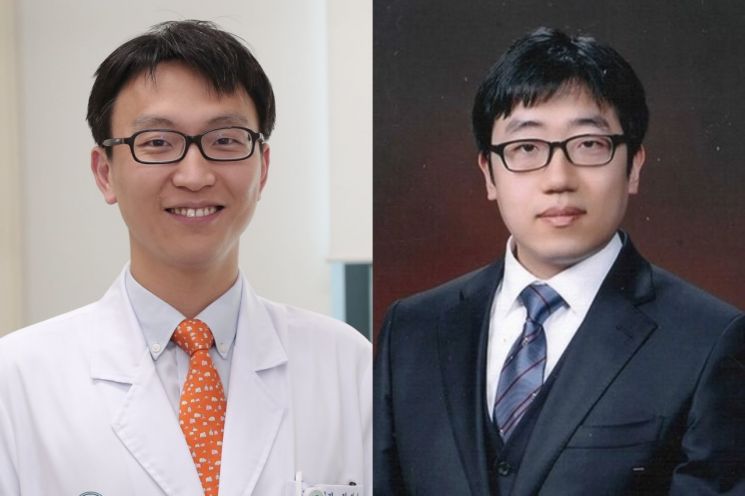 Professor Jeong Heewon, Department of Geriatrics, Asan Medical Center, Seoul (left), Professor Kang Mingu, Department of Geriatrics, Bitgoeul Jeonnam National University Hospital. [Photo by Asan Medical Center, Seoul]
The research team investigated the degree of frailty and masticatory function in 3,018 elderly people aged 65 and older who participated in the Korea National Health and Nutrition Examination Survey from 2016 to 2018. Masticatory function was surveyed by asking whether participants had difficulty chewing food, and frailty was calculated as the proportion of currently applicable items among 36 factors that could influence frailty. Factors affecting frailty included ▲comorbidities such as asthma, diabetes, and stroke ▲functional assessments such as motor ability, social activity limitations, and hearing loss ▲signs and symptoms of frailty such as depression, weight loss, and stress.
First, among all surveyed elderly, 1,222 were classified as a healthy non-frail group, 1,014 as a pre-frail group, and 782 as a frail group. When checking masticatory function by group, 365 people (29.9%) in the healthy group, 426 people (42%) in the pre-frail group, and 465 people (59.5%) in the frail group reported difficulty chewing. After adjusting the figures to ensure similar age, gender, body mass index, and various diseases among comparison groups, analysis showed that elderly people reporting chewing difficulties were about 2.68 times more likely to be in the frail group and 1.49 times more likely to be in the pre-frail group than those without such difficulties.
Statistical analysis of factors related to chewing difficulties confirmed that having periodontal disease increased the difficulty of chewing food by about 1.29 times. Additionally, for each healthy permanent tooth lost, excluding wisdom teeth or decayed teeth, masticatory function decreased by 3%.
Professor Jeong Hee-won said, "Chewing ability greatly affects nutritional intake and diet selection, so it can serve as an indicator of overall health status in old age. It is necessary to maintain healthy teeth through regular oral examinations and, for elderly people already experiencing difficulty chewing, to prevent frailty by ensuring balanced nutrition through elderly-friendly foods or supplements."
The results of this study were recently published in the international journal Clinical Interventions in Aging.
© The Asia Business Daily(www.asiae.co.kr). All rights reserved.
![User Who Sold Erroneously Deposited Bitcoins to Repay Debt and Fund Entertainment... What Did the Supreme Court Decide in 2021? [Legal Issue Check]](https://cwcontent.asiae.co.kr/asiaresize/183/2026020910431234020_1770601391.png)