Economic 6 Organizations Hold Press Conference Urging Suspension of Labor Union Act Amendment Deliberation
[Asia Economy Reporter Su-yeon Woo] The amendment to Articles 2 and 3 of the Labor Union and Labor Relations Adjustment Act, commonly known as the 'Yellow Envelope Act,' has passed the subcommittee of the National Assembly's Environment and Labor Committee, prompting the business community to once again call for a halt to the review. The business sector expressed concerns that the amendment to the Labor Union Act could effectively encourage illegal strikes, damaging not only companies but also the nation's competitiveness.
On the afternoon of the 20th, six major economic organizations, including the Korea Employers Federation, issued a joint statement at the National Assembly urging the suspension of the review of the Labor Union Act amendment. The six economic organizations participating in the joint statement are the Korea Employers Federation, the Korea Chamber of Commerce and Industry, the Federation of Korean Industries, the Korea International Trade Association, the Korea Federation of Small and Medium Business, and the Korea Federation of Medium-sized Enterprises. The core of the amendment is to expand the concept of 'user' under the Labor Union Act and the scope of labor disputes, and to limit the employer's right to claim damages for illegal dispute actions.
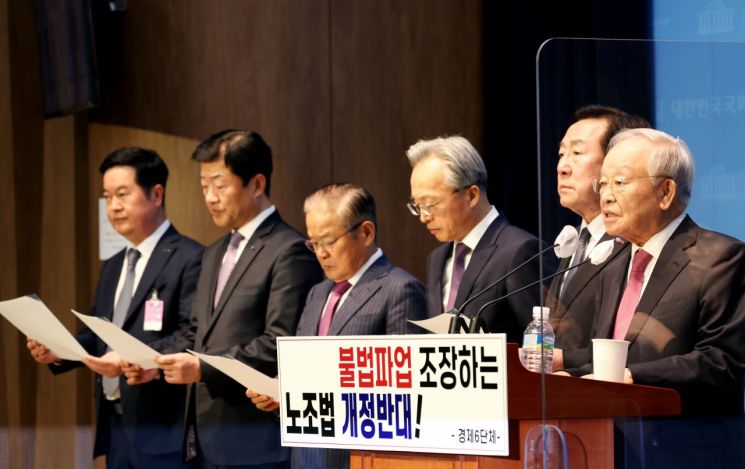 On the 20th, six economic organizations held a press conference at the National Assembly urging the suspension of deliberations on the amendment to the Labor Union Act. (From left) Kim Gohyeon, Executive Director of the Korea International Trade Association; Woo Taehee, Senior Vice President of the Korea Chamber of Commerce and Industry; Kwon Taeshin, Senior Vice President of the Federation of Korean Industries; Choi Jinsik, Chairman of the Korea Association of Mid-sized Enterprises; Kim Gimun, Chairman of the Korea Federation of Small and Medium Business; Son Kyungsik, Chairman of the Korea Employers Federation.
 [Photo by Kyeongchong]
The six economic organizations argue that the amendment effectively forces primary contractors to assume the status of employer over subcontracted workers. The amendment defines the concept of 'user' as 'a person who, even if not a party to the labor contract, is in a position to substantially and concretely control or determine the working conditions of the worker.'
In response, the six economic organizations stated, "This denies the substance of the civil law contract of subcontracting and attempts to expand the scope of disputes by dragging primary large corporations, which are not parties to the labor contract, into labor relations." They expressed concern that "primary contractors, who are not actually involved in the labor contract, will become targets of disputes, leading to continuous labor disputes."
They also pointed out the expansion of the scope of 'labor disputes' in the amendment. Previously, the scope of labor disputes was defined as 'disagreements over claims related to the determination of working conditions.' The amendment changes this to 'disagreements over claims related to working conditions,' significantly broadening the scope of labor disputes. The six economic organizations warned, "This will allow labor unions to demand negotiations and strike even over highly managerial decisions and cases under litigation," and expressed concern that "the industry will be engulfed in labor disputes throughout the year due to strike absolutism."
Furthermore, the business community pointed out that the amendment limits the right to claim damages for illegal dispute actions. Under current law, damages caused by illegal dispute actions are subject to joint and several liability. However, the amendment stipulates that "if liability for damages is recognized, the scope of responsibility must be determined for each obligor." The business sector argues that it is practically impossible to claim damages for illegal dispute actions caused by collective acts on an individual basis. They explain that since illegal dispute actions are collective acts, joint liability is appropriate.
Meanwhile, a survey conducted by the Korea Employers Federation targeting 30 major companies found that all 30 companies responded that the amendment to the Labor Union Act would negatively affect corporate competitiveness. Among them, 93% of companies expressed concern that legal disputes would surge due to the expanded scope of users. The same percentage, 93%, worried about prolonged labor disputes caused by the expansion of the scope of disputes.
© The Asia Business Daily(www.asiae.co.kr). All rights reserved.

















