IBS Research Team Launches World's Second DFSZ Axion Search Experiment
The most precise experimental facility for searching the ‘Axion,’ a candidate for dark matter, has been developed by a domestic research team.
The Institute for Basic Science (IBS) announced on the 20th that the research team led by Director Yanis Semertzidis of the Center for Axion and Extreme Matter Research has started the world’s second axion dark matter search experiment based on the ‘Grand Unified Theory’ (GUT), following the University of Washington in the United States.
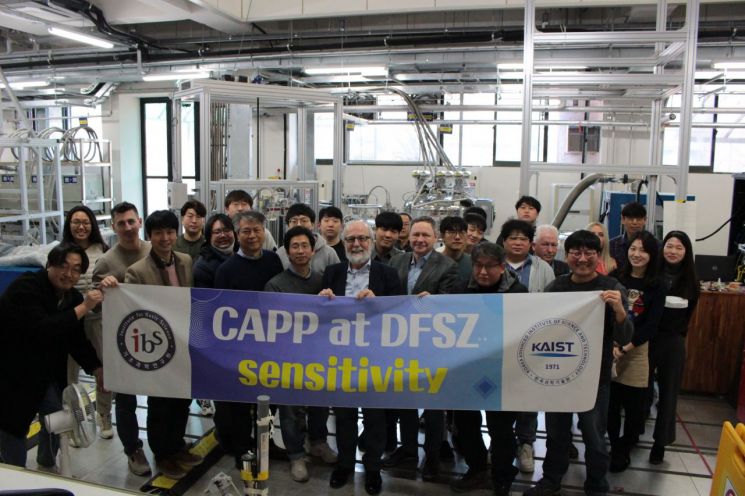 A view of the CAPP-12TB laboratory for axion dark matter search equipment at the Institute for Basic Science (IBS) and the participating researchers. Photo by IBS
The Standard Model, the essence of modern physics, considers that the universe consists of fundamental particles and four fundamental forces: gravity, electromagnetic force (the force that binds electrically charged nuclei and electrons to form atoms), strong force (the force that holds protons and neutrons together in the nucleus), and weak force (the force involved in nuclear decay and fusion). The Standard Model has been experimentally verified by scientists. However, the matter it can explain accounts for only about 5% of the entire universe. The existence of dark matter, estimated to make up 26.8% of the universe, cannot be explained by the Standard Model.
To overcome the limitations of the Standard Model, physicists have proposed various theories and are making efforts to experimentally verify them. One such theory is the ‘Grand Unified Theory (GUT).’ It hypothesizes that originally there was only one force, which separated into four during the Big Bang. The Standard Model successfully explains the weak and electromagnetic forces as one force, which has been experimentally proven. Combining this with the strong force is called the ‘Grand Unified Theory (GUT).’ When gravity is also unified with these forces, it is called the ‘Theory of Everything (ToE).’
However, the Grand Unified Theory has not yet been experimentally verified. Even the Large Hadron Collider (LHC) at the European Organization for Nuclear Research (CERN), the device capable of accelerating particles to the highest energies on Earth, lacks sufficient energy to verify the Grand Unified Theory.
If axion dark matter based on the Grand Unified Theory is discovered, it would provide evidence supporting the theory. The axion predicted based on the Grand Unified Theory is called the ‘DFSZ (Dine-Fischler-Srednicki-Zhitnitskii) axion.’ The DFSZ axion, proposed by Professor Jin Eui Kim of Kyung Hee University, interacts less with ordinary matter than the well-known standard KSVZ axion, making it more difficult to detect.
Axions convert into photons when they encounter a strong magnetic field, which has been the basis for axion search experiments worldwide since 1989. However, due to the difficulty of detecting DFSZ axions, the only international collaborative experiment has been the ‘ADMX (Axion Dark Matter eXperiment)’ at the University of Washington.
The research team has elevated experimental parameters to state-of-the-art levels and initiated the world’s second DFSZ axion search experiment. The probability of detecting axions increases with the strength of the magnetic field. They installed a 12T (Tesla) magnet, which is 300,000 times stronger than the Earth’s magnetic field. ADMX uses an 8T magnet. Additionally, to minimize background noise that interferes with signal detection, they combined an ultra-low temperature environment close to absolute zero with quantum technology. They developed a processing system capable of reading 100% of the signals from the resonator, significantly increasing the search speed. As a result, they developed equipment that can analyze in just half a month the bandwidth that ADMX would take 60 days to analyze, while maintaining world-class sensitivity.
The study includes experimental results conducted from March 1 to 18, 2022. The team confirmed that there are no axions in the frequency band around 1.1 GHz (gigahertz). Current axion searches proceed by investigating frequency bands where axions are theoretically expected to exist and eliminating regions where no signals are detected one by one.
Research Fellow Shin Rok Ko of IBS said, “If axions are discovered and confirmed as dark matter, humanity will be able to understand 32% of the universe, beyond the current 5%. We hope that our challenging research will become a stepping stone toward the ultimate physical theory, the ‘Theory of Everything.’”
The research results were published online on the 16th in the physics journal Physical Review Letters (IF 9.161).
© The Asia Business Daily(www.asiae.co.kr). All rights reserved.
![User Who Sold Erroneously Deposited Bitcoins to Repay Debt and Fund Entertainment... What Did the Supreme Court Decide in 2021? [Legal Issue Check]](https://cwcontent.asiae.co.kr/asiaresize/183/2026020910431234020_1770601391.png)















