India's Leading Electric Two-Wheeler Market Share
Success in Cost-Effectiveness and Localization Strategy
Building Own Ecosystem Through Vertical Integration
Dreaming of 'Tesla'
[Asia Economy Reporter Oh Gyumin] Ola, a startup that received a $300 million (about 380 billion KRW) investment from Hyundai Motor Company, has achieved the number one market share in the Indian electric two-wheeler market. The secret to its rapid growth lies in cost-effectiveness and localization. The company is attempting vertical integration similar to the top two electric vehicle companies, Tesla and BYD (Biyadi).
According to the Korea Automotive Technology Institute's industry trend report, "Ola Shines a Light on the Indian Mobility Market," Ola's subsidiary 'Ola Electric' models such as the S1 accounted for 120,000 units out of 670,000 newly registered electric two-wheelers in India last year, securing an 18% market share and ranking first. This achievement was made within one year of starting production. Ola was founded in 2010 as a startup company. It currently stands shoulder to shoulder with 'Uber' in the Indian ride-hailing market. It has received investment funds totaling $4.7 billion (about 6 trillion KRW) from Hyundai Motor Company, SoftBank, and others, which it has utilized to enter the electric vehicle market.
The company overwhelms competitors with so-called cost-effectiveness. It targets the market with products that offer high performance relative to price. For example, the S1 model has a top speed of 95 km/h and a real driving range of 128 km. Its price is 110,000 rupees (1.65 million KRW). The competitor 'Ather Energy's Ather 450 Plus has both a lower top speed and real driving range (90 km/h and 85 km) than the S1, but its price is 135,000 rupees (2.03 million KRW).
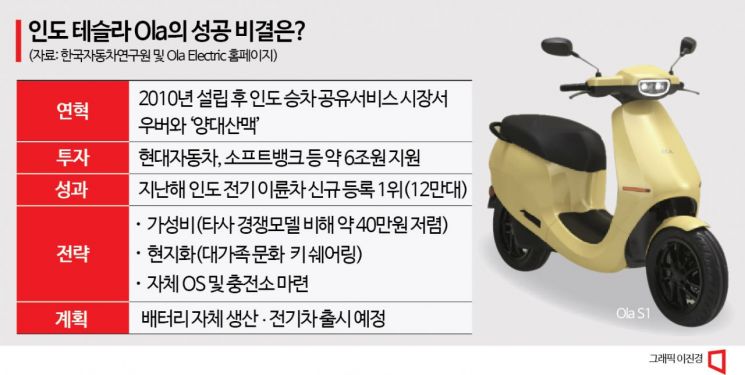
The localization strategy, honed through the ride-hailing business, is also noteworthy. Ola's products incorporate features such as digital key sharing and multiple profiles (setting multiple profiles under one account) to accommodate India's extended family culture, allowing families to share vehicles. This resembles Ola's differentiated services in the ride-hailing market, such as cash payments, which reflect Indian characteristics differently from Uber.
The ultimate goal is to become the Tesla of India. In other words, to create its own ecosystem by vertically integrating parts necessary for electric vehicles. Ola applies its proprietary operating system, MoveOs, to all models and has developed its own high-speed charging station, the Hypercharger. It is also expanding investments for in-house battery production. It plans to mass-produce its self-developed ternary battery NMC2170 starting next year and has invested $500 million in battery technology research and development. It announced plans to launch its first electric vehicle in 2024 and release six models over the following three years. The produced electric vehicles are also expected to be used in ride-hailing services.
The Indian government is also providing generous support. India offers subsidies for electric vehicles with major parts produced locally. Especially for the electrification of two-wheelers, which have high local demand, the government provides national subsidies of up to 15,000 rupees (230,000 KRW) per 1 kWh of battery capacity, covering up to 40% of the electric two-wheeler price. The battery local production subsidy system (with a budget allocation of 2.8 trillion KRW) is also implemented, and the Indian government and Ola have signed an agreement for an annual production capacity of 20 GWh.
However, a lack of experience in mass-producing hardware is considered a weakness. It will take time to acquire the capability to design core chips directly, like Tesla. Accumulating capabilities in material and parts supply chain management also seems necessary.
Korean companies should closely examine Ola's growth secrets. Ola has made various preparations to enter the electric vehicle market, including developing its own OS and building a charging ecosystem. It suggests a direction for companies that have started producing electric vehicles, such as Hyundai Motor Company, Kia, and SsangYong Motor. Although initial investment costs may be high, strategies to maximize operating profit margins through vertical integration, such as battery internalization, are worth considering.
Jung Dahye, a researcher at the Korea Automotive Technology Institute's Industry Analysis Office, said, "It is worth noting that the mobility business started not as vehicle production but as a platform," adding that it could serve as a reference case related to the electric vehicle business.
© The Asia Business Daily(www.asiae.co.kr). All rights reserved.


















