To Promote the Development of Traffic Demand Management Policies
[Asia Economy Reporter Kiho Sung] The Seoul Metropolitan Government announced on the 20th that it will temporarily suspend the collection of congestion tolls for Namsan Tunnel No. 1 and No. 3 to verify policy effects and promote the development of traffic demand management policies. The city plans to implement a phased exemption of congestion tolls for two months from April 17 to June 16 and will establish effective policy directions to suppress vehicles entering the city center and alleviate congestion through traffic volume analysis.
The congestion toll for Namsan Tunnel No. 1 and No. 3 has been a policy under the "Urban Traffic Maintenance Promotion Act" since November 11, 1996, charging 2,000 KRW on weekdays from 7 a.m. to 9 p.m. for vehicles with fewer than 10 seats carrying fewer than three passengers. At the time, it was the only such policy nationwide and is a representative traffic policy of Seoul that alleviated severe traffic congestion in Namsan Tunnel No. 1 and No. 3 and the connecting roads.
However, since its implementation in 1996, the toll has remained at 2,000 KRW for 27 years. Considering inflation, the perceived burden of the congestion toll on citizens has significantly decreased. Additionally, the exemption rate for vehicles such as buses, freight trucks, and electric vehicles under the ordinance has reached 60%, weakening the effect of the congestion toll. In February of this year, the Seoul Metropolitan Council proposed an ordinance to abolish the "Seoul Special City Congestion Toll Collection Ordinance."
Accordingly, Seoul City will conduct a two-month toll exemption and policy effect verification so that citizens can directly experience the effects and promote ‘active administration’ tailored to citizen convenience.
However, the city emphasized that this temporary suspension of congestion toll collection is not a preliminary step toward abolition. Rather, it aims to accurately understand the situation through on-site policy experiments to address citizens’ inquiries.
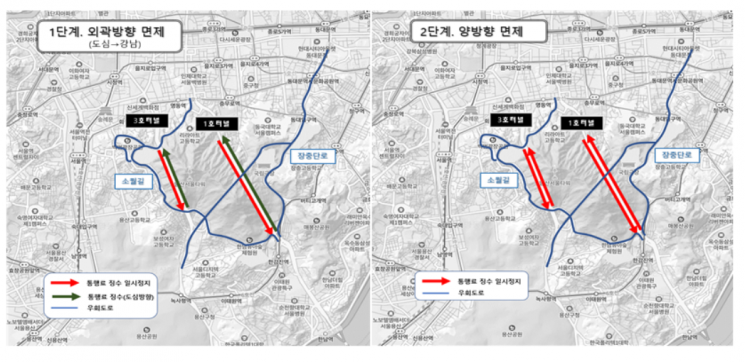
First, in the first phase from April 17 to May 16, the congestion toll collected from the city center toward the Gangnam direction (Hannam Bridge) will be exempted.
The second phase will be implemented from May 17 to June 16 for one month, exempting tolls in both directions between the city center and Gangnam. Therefore, drivers using Namsan Tunnel No. 1 and No. 3 can pass through the toll booths slowly without paying, similar to Saturdays and public holidays. However, starting May 17, immediately after the temporary suspension, congestion tolls will be charged in both directions as before.
Seoul City plans to complete by June the analysis comparing daily traffic volume and speed data from Seoul TOPIS during the ‘temporary suspension’ period with the same period last year to confirm the impact of the Namsan Tunnel No. 1 and No. 3 congestion toll on surrounding roads.
Additionally, based on the traffic change analysis during the ‘temporary suspension’ period, the city will closely examine the extent to which congestion tolls affect traffic flow on major roads in the city center. In collaboration with the Seoul Institute, the city will study ways to link this with various ongoing traffic demand management policies in the city center. Through expert consultation, citizen feedback, and Seoul Metropolitan Council hearings, the city plans to make a final decision within the year on whether to maintain or abolish the Namsan Tunnel No. 1 and No. 3 congestion toll.
Yoon Jong-jang, Director of Urban Transportation at Seoul City, said, “This implementation will be a rare attempt to verify policy effects through a detailed analysis of congestion tolls and to reorganize traffic demand management policies in the city center.” He added, “We will do our best to promote active traffic administration so that citizens can empathize with and enjoy convenience through this social experiment.”
© The Asia Business Daily(www.asiae.co.kr). All rights reserved.

















