[Asia Economy New York=Special Correspondent Joselgina] The United States and China continued their sharp exchanges during a diplomatic summit at the Munich Security Conference in Germany. Despite U.S. President Joe Biden's speech expressing a desire to avoid a new Cold War, tensions between the U.S. and China, which have escalated since the reconnaissance balloon incident, are expected to be difficult to resolve in the near term. The U.S. also raised warnings about the possibility of China supplying lethal weapons to Russia, which invaded Ukraine.
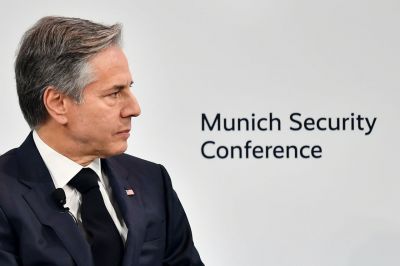
According to the U.S. State Department on the 19th (local time), Secretary of State Antony Blinken held a private meeting for about an hour with Wang Yi, member of the Chinese Communist Party Central Political Bureau, on the sidelines of the Munich Security Conference in Germany the previous day. This was the first high-level meeting since the U.S. shot down a Chinese reconnaissance balloon found in its airspace earlier this month. Ned Price, spokesperson for the U.S. State Department, said in a statement afterward that (Secretary Blinken) conveyed that "the United States cannot tolerate violations of U.S. sovereignty and international law caused by China's reconnaissance balloon in U.S. airspace," and "made it clear that sovereignty violations will not be tolerated and that China's reconnaissance balloon program has been exposed worldwide."
The New York Times (NYT) reported that the meeting took place amid ongoing U.S.-China conflicts and that Secretary Blinken's tone was direct and firm. It also evaluated that these tough remarks "reminded once again that U.S.-China relations are at their worst since President Richard Nixon opened communication channels with Chinese leadership half a century ago (U.S.-China diplomatic normalization)." The Wall Street Journal (WSJ) also reported that until just before the meeting, both sides recognized the need to ease tensions and appeared optimistic, but the actual meeting was different from expectations.
Even immediately after the meeting, strong statements poured out from both sides. Secretary Blinken confirmed in an interview with the U.S. CBS program Face the Nation, which was scheduled to air that day, that "we conveyed a very clear resolve that we cannot tolerate reconnaissance balloons that violate sovereignty and international law and that such incidents must never happen again." He also mentioned that China has not apologized regarding this incident.
In particular, Secretary Blinken claimed that China is considering supplying lethal weapons to Russia, which is invading Ukraine. He referred to the fact that Chinese President Xi Jinping and Russian President Vladimir Putin promised "unlimited cooperation" at a summit before the outbreak of the Ukraine war, saying, "We have been concerned about this possibility since the first day of the invasion." According to Secretary Blinken, this issue is being taken seriously to the extent that such information is being shared among allies at the Munich Security Conference. Specifically, he anticipated that ammunition and weapons could be supplied.
Accordingly, Secretary Blinken confirmed that during this meeting with Wang Yi, he directly warned that China's military support to Russia could become a serious problem in bilateral relations. On the same day, Vice President Kamala Harris also attended the Munich Security Conference in Germany and mentioned the possibility of China supplying lethal weapons to Russia. Vice President Harris warned, "If China provides any form of lethal weapons to Russia, it will be compensation for acts of aggression and continuation of killings."
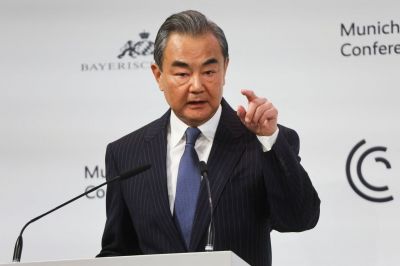
China also raised the level of criticism against the U.S. On the 19th, the Chinese Foreign Ministry issued a statement in the name of its spokesperson, saying that Wang Yi criticized the U.S. balloon shootdown as "beyond common sense and close to hysteria" and "an abuse of force." It also said, "The U.S. should face up to and resolve the damage caused to bilateral relations by its abuse of force," warning, "If the U.S. makes excuses to exaggerate and escalate the situation, China will confront the U.S. to the end. The U.S. will bear the consequences."
Wang Yi used the expression 'Minghuo Zhizhang (明火執仗, meaning openly robbing with fire and weapons)' regarding U.S. economic sanctions against China, claiming, "They are suppressing Chinese companies with state power. It is unilateral." Regarding China's support for Russia, he also rejected the U.S. telling China what to do about China-Russia relations. The day before, Wang Yi indirectly criticized the U.S. in a speech, saying, "China stands on the side of peace and dialogue (regarding the Ukraine war)," and "some forces seem not to want the success of peace talks or a ceasefire."
Experts see the resumption of face-to-face diplomacy between the two countries' foreign chiefs at the Munich Security Conference as meaningful but expect tensions to continue for the time being. The WSJ evaluated this meeting as aimed more at resuming normal communication with China rather than resolving bilateral issues. It is anticipated that through further discussions, the previously abruptly canceled visit of Secretary Blinken to China earlier this month could be rescheduled, and consultations for Treasury Secretary Janet Yellen's visit to China might also take place. Earlier, President Biden expressed hope to consult soon with President Xi Jinping, stating that three unidentified flying objects confirmed after the Chinese reconnaissance balloon shootdown do not appear to be related to China.
© The Asia Business Daily(www.asiae.co.kr). All rights reserved.


















