"Prosecutors' Excessive Warrant Request Will Be Dismissed"
"Even If Representative Lee Is Detained, The Party Will Survive"
"Proper General Election Preparation Possible With New Leadership System"
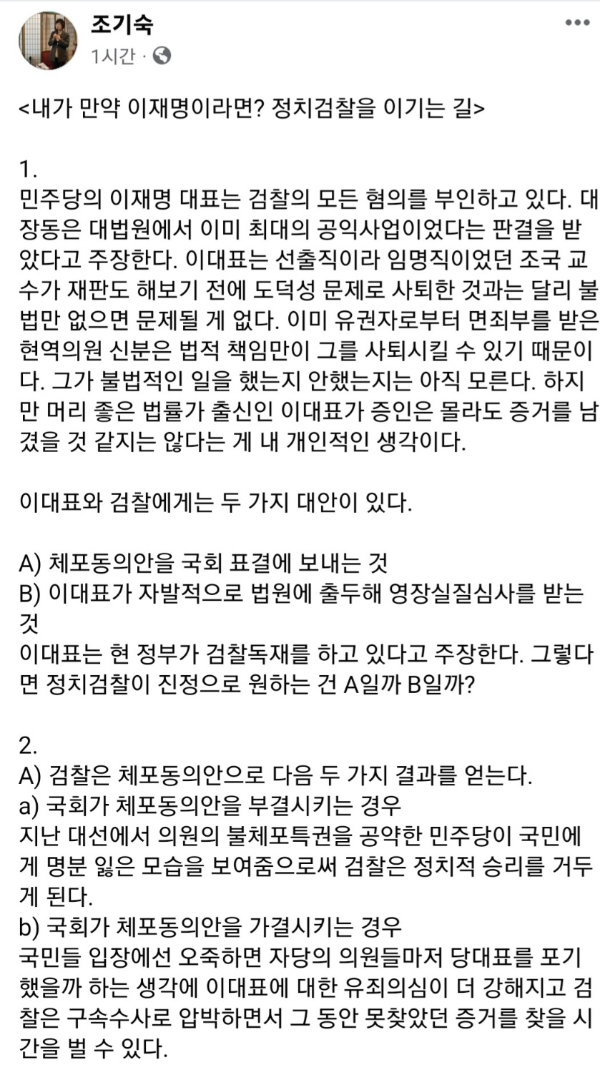 Professor Jo Gisuk of Ewha Womans University posted on her Facebook on the morning of the 19th. / Image source=Professor Jo Gisuk's Facebook
[Asia Economy Reporter Choi Seok-jin, Legal Affairs Specialist] Professor Cho Gi-sook of Ewha Womans University, who served as the Blue House Chief of Public Relations under the Roh Moo-hyun administration, argued on the 19th that Lee Jae-myung, leader of the Democratic Party of Korea, appearing voluntarily at the court to undergo a warrant hearing is a politically advantageous choice for both Lee and the Democratic Party.
In a post titled What If I Were Lee Jae-myung? The Way to Defeat Political Prosecution posted on her Facebook that morning, Professor Cho stated, "In this situation, does Lee need to risk the danger of approval and wait for a parliamentary vote? It is politically advantageous for Lee to voluntarily appear at the court and cooperate with the prosecution under option B)."
She also said, "What if Lee voluntarily appears at the court, gets detained, and is convicted? If he is convicted at the third trial, he would be found guilty even if tried without detention. The result is the same for him, but the Democratic Party survives. Lee Jae-myung, who fulfilled his responsibility as party leader for the party, will be remembered."
In the post, Professor Cho first examined various possible scenarios arising from the prosecution’s request for an arrest warrant against Lee and analyzed the pros and cons for both Lee and the prosecution.
She said, "There are two alternatives for Lee and the prosecution": A) sending the arrest warrant consent bill to the National Assembly for a vote, and B) Lee voluntarily appearing at the court to undergo the warrant hearing. Then she asked, "Lee claims the current government is conducting prosecutorial dictatorship. So, what does the political prosecution truly want, A or B?"
Professor Cho analyzed that if the parliamentary vote on the arrest warrant consent bill proceeds according to procedure, the prosecution obtains two possible outcomes.
She said, "If the National Assembly rejects the arrest warrant consent bill, the Democratic Party, which pledged parliamentary immunity during the last presidential election, loses legitimacy in the eyes of the public, and the prosecution achieves a political victory."
She also predicted, "If the National Assembly approves the arrest warrant consent bill, the public will suspect Lee’s guilt even more, thinking, ‘If even his own party members gave up on their leader, he must be guilty.’ The prosecution can then pressure him with detention and gain time to find evidence they previously could not."
She added, "The reason the prosecution confidently sent the arrest warrant consent bill to the National Assembly is because whether it is rejected or approved, both outcomes are advantageous to the prosecution."
Professor Cho pointed out, "Conversely, for Lee, whatever the result of the arrest warrant consent bill, it is a matter of losing face."
She said, "If the vote takes place in the National Assembly and the bill is rejected, leading to a non-detention trial, 1) Lee cannot avoid public criticism that he sacrificed the party for himself, and 2) if the party does not perform well in the general election, his political career will be at risk."
She continued, "If the bill is approved, 1) it will be the greatest crisis of Lee’s life. The public will suspect his guilt even more, thinking, ‘Why would his own party members want him detained?’ Even if he is later acquitted, his political career will effectively be over, and 2) the Democratic Party will be torn apart by accusations of betrayal."
Professor Cho posed the question, "What would happen if Lee voluntarily appears at the court to undergo the warrant hearing?" and answered, "If the prosecutor’s warrant request was excessive, the warrant will be dismissed."
She added, "Even if Lee is detained, 1) he has another chance to be released through a detention review, and if released, his leadership within the Democratic Party will be strengthened, 2) public criticism of the judicial system will increase, and Lee, who sacrificed himself for the party, will become a martyr, placing considerable pressure on the Yoon Seok-youl administration, and 3) if Lee is detained until the first trial, the Democratic Party will unite under new leadership and properly prepare for the general election. The Democratic Party must win the general election to increase the chances of winning the next presidential election, and winning the next presidential election improves Lee’s chances of winning his trial, as previously explained," she emphasized.
She concluded, "In summary, option A) favors the prosecution, while option B) is politically advantageous for Lee."
The options A) and B) mentioned by Professor Cho refer to those he proposed at the beginning of the post: A) sending the arrest warrant consent bill to the National Assembly for a vote, and B) Lee voluntarily appearing at the court to undergo the warrant hearing.
Professor Cho pointed out, "If Lee’s claim that political prosecution is oppressing him is true, he must consider a highly strategic way to politically defeat the prosecution," and used a seesaw analogy.
She said, "At times like this, the way to easily defeat the opponent is to move the balance weight supporting the seesaw to the opponent’s side. Then, without much effort, I can raise the opponent high up," adding, "If the prosecution is political, it secretly hopes the National Assembly will reject the arrest warrant consent bill, but if it is neutral, it wants the National Assembly to approve the bill so Lee appears at the warrant hearing."
She reiterated, "In this situation, is there any need for Lee to risk the danger of approval and wait for the parliamentary vote? It is politically advantageous for Lee to voluntarily appear at the court and cooperate with the prosecution under option B)."
On the same day, Professor Cho also expressed her opinion on former Democratic Party Emergency Committee member Park Ji-hyun’s claim posted on Facebook on the 17th that Lee should give up parliamentary immunity and voluntarily undergo the warrant hearing.
In that post, former member Park strongly urged, "As promised during the presidential election, Lee should give up parliamentary immunity, and all Democratic Party lawmakers should participate in the vote on the arrest warrant consent bill and cast affirmative votes," adding, "We want Lee Jae-myung who sacrifices himself to protect the people, not Lee who runs away from power. We must show the public a sacrificing and decisive politician, Lee Jae-myung."
Professor Cho said, "Some say Park Ji-hyun is naive for asking Lee to sacrifice himself for the party and appear at the court, but according to my analysis, this is the best long-term option for Lee to survive."
She said, "Everyone knows ‘You must die to live’ and ‘You must give up to win,’ but few politicians actually practice this because there are no politicians with the courage and conviction like Kim Dae-jung or Roh Moo-hyun," adding, "People tend to act reflexively in crises rather than rationally analyzing the political consequences of each choice."
Professor Cho said, "What if Lee voluntarily appears at the court, gets detained, and is convicted? If he is convicted at the third trial, he would be found guilty even if tried without detention. The result is the same for him, but the Democratic Party survives. Lee Jae-myung, who fulfilled his responsibility as party leader for the party, will be remembered," and added, "If I were Lee and thought the prosecution was politicizing, I would choose a way to win public opinion. Quietly appearing at the court alone to undergo the warrant hearing would portray him not as showing off but as being oppressed and sacrificing himself for the party."
She concluded, "Our people believe in the strong protecting the weak. Do you still not understand why President Moon Jae-in, who appears weak, has high approval ratings, while President Yoon Seok-youl, who takes a hardline stance, has low approval ratings?"
© The Asia Business Daily(www.asiae.co.kr). All rights reserved.
![Clutching a Stolen Dior Bag, Saying "I Hate Being Poor but Real"... The Grotesque Con of a "Human Knockoff" [Slate]](https://cwcontent.asiae.co.kr/asiaresize/183/2026021902243444107_1771435474.jpg)
















