North Korea Quiet Early Year... Security Council and ROK-US Drills Met with Opposition
Possibility of Provocations Including ICBM Normal Trajectory and Reconnaissance Satellites
[Asia Economy Reporter Jang Hee-jun] North Korea launched a long-range ballistic missile, presumed to be an intercontinental ballistic missile (ICBM), just one day after announcing an "unprecedented strong response" targeting the South Korea-U.S. joint military exercises. After focusing on internal political schedules at the beginning of the year and taking a breather, North Korea is now expected to resume military provocations while building justification.
The Joint Chiefs of Staff announced on the 18th at around 5:22 p.m. that North Korea launched one long-range ballistic missile from the Pyongyang Sunan area toward the East Sea. The missile, fired at a high angle, flew approximately 900 km before landing in the East Sea.
Given that the altitude and flight distance are similar to the ICBM 'Hwasong-17' launched by North Korea on November 18 last year, this missile is also presumed to be a Hwasong-17. Military and intelligence authorities are also analyzing the possibility that North Korea fired the solid-fuel ICBM, which was unveiled during the 75th anniversary parade of the founding of the Korean People's Army.
"The 'ultra-strong response' was not empty talk...Provocation a day after the threat
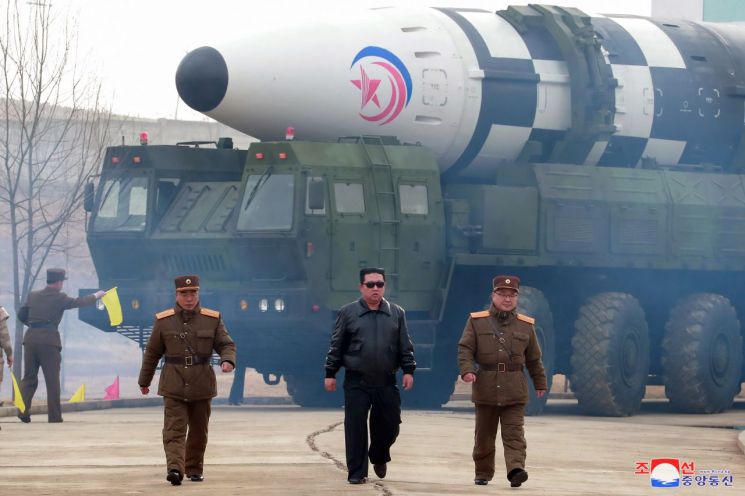
This missile launch occurred just one day after the North Korean Foreign Ministry spokesperson's statement condemning the UN Security Council meeting and the South Korea-U.S. joint military exercises, suggesting a possible connection.
In a statement released at 12:03 p.m. the previous day, the Foreign Ministry warned, "If the Security Council continues to be dragged around as the U.S. desires (omitted)... we cannot rule out reconsidering additional measures beyond the scope of normal military activities." This came after the Security Council held a closed meeting on North Korea at the U.S.'s request on the 30th of last month, followed by another closed meeting on the 16th (local time) focused on North Korea's denuclearization, which North Korea opposed.
Furthermore, the Foreign Ministry threatened that if the South Korea-U.S. joint military exercises scheduled for February to March proceed, North Korea would face an "unprecedented strong response." By blaming South Korea and the U.S. again for the deterioration of the Korean Peninsula situation, North Korea built justification for provocation. Indeed, about 29 hours after this statement was made public, North Korea launched the missile presumed to be an ICBM, proving that the warning was not empty talk.
North Korea, angered by 'doubts about technical capability'...Next step: normal angle launch?
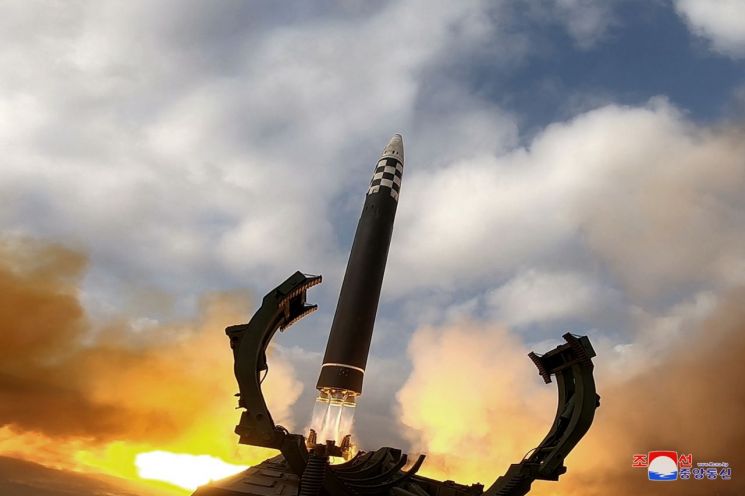 Test launch scene of North Korea's intercontinental ballistic missile (ICBM) 'Hwasong-17' [Image source=Yonhap News]
Most notably, this provocation is the first ICBM launch since Kim Yo-jong, sister of Chairman Kim Jong-un and vice department director of the Workers' Party, announced in a statement last December that North Korea had secured "ICBM atmospheric re-entry technology." At that time, Kim Yo-jong reacted angrily to external criticism questioning whether North Korea possessed ICBM atmospheric re-entry technology, saying, "It is something that will be tested soon and something that will be known soon." This implied a launch of the ICBM at a normal angle (30?45 degrees).
Experts express concern that North Korea has entered an experimental phase before launching an ICBM at a normal angle, as Kim Yo-jong predicted.
Yang Moo-jin, president of the University of North Korean Studies, analyzed, "As warned in the Foreign Ministry statement, this is a retaliatory military demonstration against the UN Security Council meeting and the start of the South Korea-U.S. joint military exercises. At the same time, it appears to have a technical inspection nature for a normal-angle ICBM launch."
Jung Sung-jang, head of the Unification Strategy Research Office at the Sejong Institute, expressed concern, saying, "If an ICBM is launched at a normal angle, it can reach as far as New York in the U.S. As North Korea's ICBM technology advances, the U.S. will face the dilemma of extended deterrence, questioning whether it must risk nuclear war with North Korea to protect South Korea."
North Korea's provocation level likely to escalate...Possibility of 'reconnaissance satellite' launch
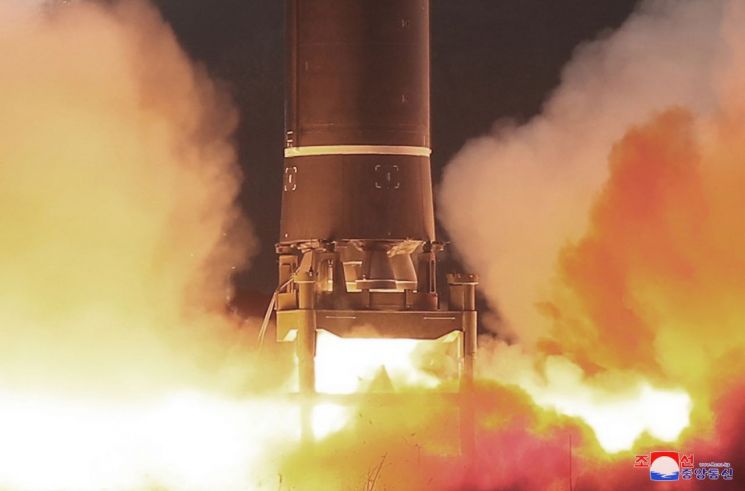 Test launch scene of North Korea's intercontinental ballistic missile (ICBM) 'Hwasong-17' [Image source=Yonhap News]
The military and experts anticipate that the level of North Korea's future provocations will gradually escalate. Especially with the Extended Deterrence Strategy and Consultation Tabletop Exercise (DSC TTX) starting on the 22nd (U.S. local time), which assumes a North Korean nuclear attack scenario, and a large-scale South Korea-U.S. joint military exercise scheduled for mid-next month, North Korea is expected to use these as pretexts for additional provocations.
In fact, recent civilian satellite images have detected new construction sites daily at the Dongchang-ri West Sea Satellite Launching Station in Cholsan County, North Pyongan Province, indicating unusual activity. Last December, North Korea launched two medium-range ballistic missiles (MRBMs) claimed to be "reconnaissance satellite test vehicle carriers" from this site and announced that it had completed the final important tests for reconnaissance satellite development. At that time, the National Aerospace Development Administration of North Korea announced, "We will complete preparations for the first military reconnaissance satellite by April 2023." This signals a provocation involving a reconnaissance satellite launch before April.
Additionally, there are concerns about provocations similar to the infiltration of unmanned aerial vehicles over Seoul at the end of last year or localized provocations using conventional weapons in frontline areas. Yang Moo-jin predicted, "Since the Party plenary meeting scheduled for late this month will focus solely on agricultural issues, North Korea will separate domestic affairs and military responses, pursuing a two-track approach. Starting with this ballistic missile launch, they may escalate provocations including solid-fuel ICBM combustion tests, liquid-fuel ICBM normal-angle launches, rocket launches for reconnaissance satellites, and unmanned aerial vehicle provocations."
Meanwhile, South Korean military authorities foresee an escalation in North Korea's provocation level and have ordered the establishment of a surveillance posture against North Korea in frontline contact units.
© The Asia Business Daily(www.asiae.co.kr). All rights reserved.



















