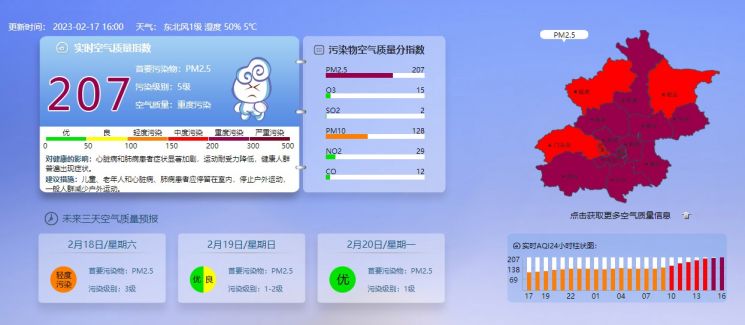
 Beijing Environmental Protection Monitoring Center announcement materials. Photo by Beijing Environmental Protection Monitoring Center website capture
[Asia Economy Reporter Jeong Dong-hoon] A smog exceeding 40 times the World Health Organization (WHO) recommended fine dust standard hit Beijing, the capital of China. Smog refers to a state where car exhaust or factory smoke mixes with fog.
The Beijing Environmental Protection Monitoring Center announced that as of 4 p.m. that day, the Air Quality Index (AQI) across Beijing recorded a level 5 "severe pollution" status. China's AQI is divided into six levels: Excellent (0?50), Good (51?100), Light Pollution (101?150), Moderate Pollution (151?200), Severe Pollution (201?300), and Critical Pollution (301?500).
The main pollutant was fine particulate matter (PM 2.5). The PM 2.5 concentration at 35 air pollution monitoring points installed throughout Beijing averaged 207 μg/m³.
Considering that the WHO's recommended fine dust standard is 5 μg/m³, the air quality deteriorated to more than 41 times the standard. There were 12 locations where the PM 2.5 concentration exceeded 220 μg/m³, and some areas in southeastern Beijing even soared to 254 μg/m³, more than 50 times the WHO recommended standard.
The Environmental Protection Monitoring Center urged, "Children and the elderly should stop outdoor exercise and stay indoors, and the general public should also reduce outdoor activities."
© The Asia Business Daily(www.asiae.co.kr). All rights reserved.

















