Wearing Watches with AR... Contactless Ordering Possible
Select Size via Fitting Room Mirror... Check Stock Directly
IT Wave in Fashion Industry... "Endless Possibilities for Utilization"
I wore the Patek Philippe Nautilus 5980 model, a hallmark of high-end watch brands, on my wrist. Feeling a bit bold, I then tried on the Rolex Submariner Steel Black Dial model. Although it had a safe design, it didn’t suit my slender wrist. Wanting a classic design, I next placed a Breguet watch on my wrist.
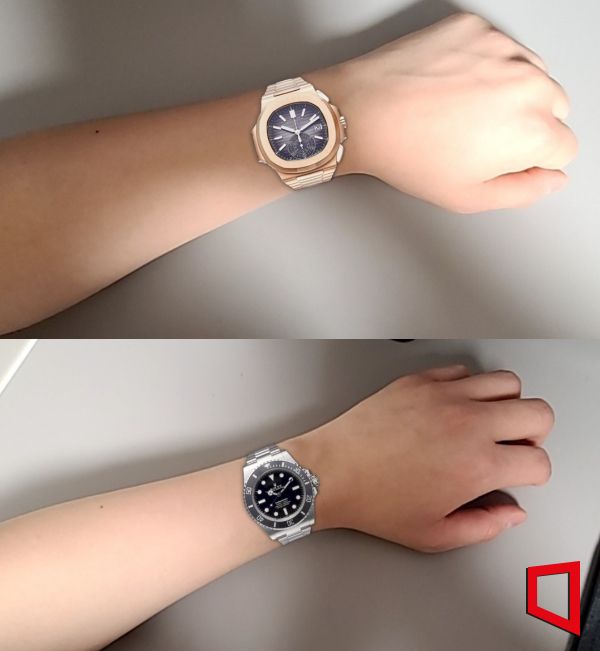 On the 19th, a reporter personally experienced LF's 'Raum Watch AR' service. Through AR technology, they tried on the Patek Philippe Nautilus 5980 model (above) and the Rolex Submariner Steel Black Dial model.
 [Photo by Song Seung-yoon]
In less than 10 minutes, I had tried on 5 to 6 watches worth several hundred million won in total, yet no one gave me a hard time. Normally, wearing such expensive watches is out of the question, but here I could freely try them on without being labeled a difficult customer behind my back. This is because I wasn’t actually wearing the watches. It’s LF’s ‘Lium Watch AR’ service, which uses augmented reality (AR) technology to virtually try on luxury watches without visiting department stores or luxury watch boutiques.
As IT technology is integrated into customer services in the fashion industry, the boundaries between online and offline are dissolving. This is a result of keeping pace with the rapidly emerging ‘hyper-personalized’ consumption trend.
On the 16th, LF introduced this service at Raum Watch, a luxury watch O4O (Online for Offline) multi-edit shop. Even without visiting an offline store, customers can try on watches through the online mall. By pressing the camera button on the product detail page and aligning their arm with the dotted outline of an arm displayed on the smartphone screen, an image of the watch automatically appears on their wrist. While the weight and feel of the product cannot be experienced, customers can check the actual product size and see if it suits them well. After virtually trying on the watch, if they purchase it online, a perfect non-face-to-face consumption experience from trying to buying is achieved.
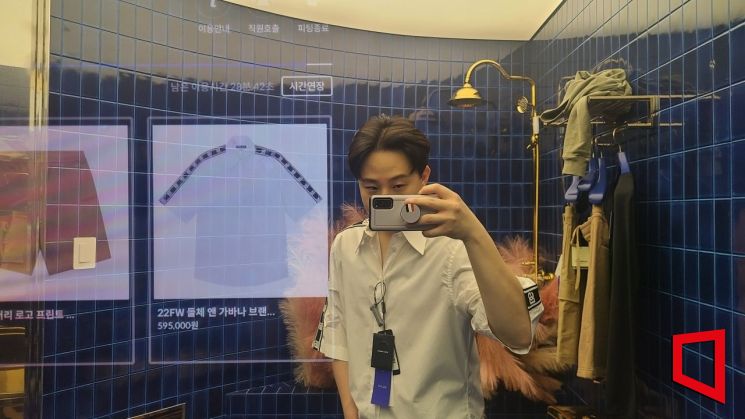 On the 19th, a reporter is trying on a product ordered via smartphone in the smart mirror fitting room of Balann's 'Connected Store.'
 [Photo by Seungyoon Song]
Balanco also introduced retail tech in its ‘Connected Store’ opened last July at Yeouido IFC Mall. Through QR codes, customers can check product information such as price and store inventory, and by using a smartphone app, they can add desired clothes to a ‘fitting list’ and order them to be delivered to a smart mirror fitting room. In the smart mirror fitting room, customers can view all the information about the clothes they ordered at a glance through the smart mirror. If the size doesn’t fit after trying them on, it can be changed there. There is also a selfie mode for taking photos. Without directly facing store staff, customers can try on clothes, check information, and make purchases all with a single smartphone.
Kolon Industries FnC division recently released two Zepeto Worlds using the Waki character from the golf wear brand ‘Wak’, following VR content introduced by women’s clothing brands Lucky Chouette and Lucky Marche. These brand contents on the metaverse platform Zepeto are made in the form of casual games and golf games. This is to provide brand experiences online and build fandom communities centered on MZ (Millennial + Generation Z) customers.
In addition, various brands are widely utilizing IT technologies in diverse fields such as metaverse fashion shows held in virtual reality, lookbooks created with AR, and virtual makeup.
An industry insider said, “As the utilization of metaverse and AR technologies increases across various fields, the fashion industry is also competing to introduce content that expands customer experiences. Technologically, it is already possible to try on clothes in virtual spaces, and in the future, services that offer detailed experiences without spatial limitations will continue to emerge.”
© The Asia Business Daily(www.asiae.co.kr). All rights reserved.
![User Who Sold Erroneously Deposited Bitcoins to Repay Debt and Fund Entertainment... What Did the Supreme Court Decide in 2021? [Legal Issue Check]](https://cwcontent.asiae.co.kr/asiaresize/183/2026020910431234020_1770601391.png)

















