Chinese Migrant Workers Return Home for Lunar New Year
Reduced Returnees Disrupt Factory Operations
COVID-19 Factory Closures Cited as Cause
Low Wages and Employment Shortages Also Contribute
On the 9th (local time), the downtown area of Guangzhou, a major southern city in China with the country's largest clothing wholesale market, was bustling with factory owners and hiring staff holding recruitment signs. Factory owners surrounded migrant workers who had returned from their hometowns after celebrating the Chinese Lunar New Year, known as Chunje, and competitively displayed sketchbooks and signs listing job conditions. Some factory owners even loudly proclaimed their factories' welfare benefits while following workers who tried to leave.
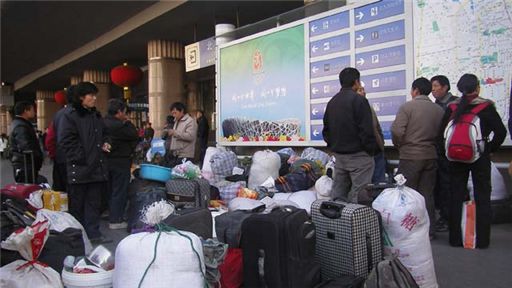 A migrant worker preparing to return home. Photo by Yonhap News
On the 16th, Bloomberg reported this scene, describing how Chinese factories struggling with labor shortages have launched a new recruitment drive.
After three years since the COVID-19 pandemic, as migrant workers who returned home for the ethnic major holiday Chunje (January 21?27) have yet to come back, such a spectacle has unfolded.
Migrant workers refer to those who move from rural areas to cities to work in factories. The number of rural-origin migrant workers in China reaches 296 million. They account for one-third of the total 530 million non-agricultural jobs in China. Bloomberg explained that these workers drive China's manufacturing and export economy.
One might wonder if their return to their hometowns is a big problem. However, considering it is their first homecoming in three years, it is understandable. Due to the Chinese government's strict 'Zero COVID' policy after the pandemic, interregional movement was restricted, and these workers were able to visit their hometowns only after three years.
In particular, they were unable to leave factories because of this policy. However, at the end of last year, as the policy shifted to 'With COVID,' they were able to return home. Typically, they stay in their hometowns for up to a month, including during Chunje, but having endured harsh 'quarantine hardships,' many decided it was better to settle in their hometowns. Meanwhile, facing an aging workforce and labor shortages, Chinese manufacturers began efforts to 'woo migrant workers.'
Tang Ning, an employee responsible for recruiting workers at a medical factory in Haizhu District, Guangzhou, told Bloomberg that they had not hired a single worker in a week. Tang Ning stated, "Over the past 10 years, the factory had more than 30 employees, but this Chunje, 10 workers returned to their hometowns."
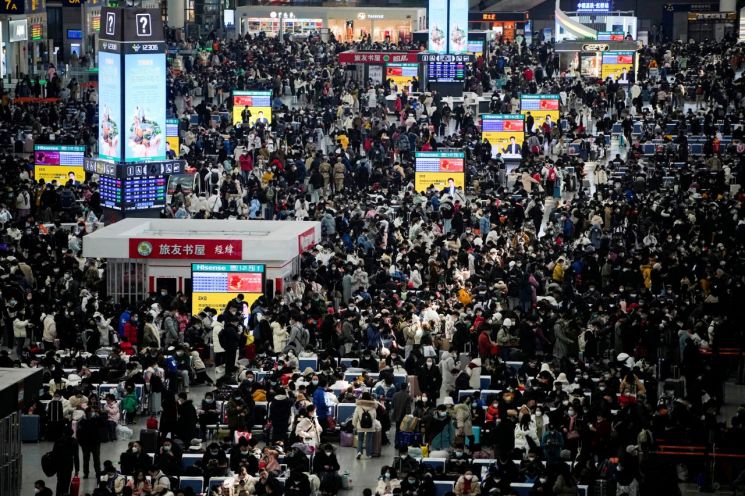 On the 18th of last month, ahead of the Chinese New Year, the largest holiday in China, Shanghai Hongqiao Station was crowded with passengers. Shanghai=Photo by Reuters Yonhap News
What made Chinese migrant workers declare settling in their hometowns was not just the warmth of home. Bloomberg reported that the closure of factories due to 'Zero COVID' increased their anxiety about survival. Previously, in October last year, Zhengzhou city locked down the Foxconn factory, the world's largest iPhone production base, trapping 200,000 workers inside with no outside contact. The factory faced repeated quarantine issues, such as placing COVID-19 positive cases and other employees in the same dormitories.
Bruce Fang, China economic analyst at global real estate services firm Jones Lang LaSalle, explained, "At that time, workers endured unpaid periods or long separations from their families," adding, "It seems migrant workers decided to stay in their hometowns after experiencing the uncertainties caused by the COVID-19 crisis." He also noted that Chinese government rural support policies have increased cases of migrant workers finding jobs locally.
Factories hit by COVID-19 also reduced wages, which is cited as another reason for the difficulty in hiring workers. The Hong Kong media outlet South China Morning Post (SCMP) reported that factories which offered hourly wages of 26 (4,891 KRW) to 30 yuan last year are now offering 22 to 24 yuan. Wage arrears issues, such as delayed bonuses, have also occurred at companies like Foxconn.
On the other hand, some reports suggest that due to a sluggish job market, migrant workers are unable to find employment. SCMP reported that as employers reduce hiring scales, migrant workers are finding it harder to secure jobs compared to previous years. Feng Feng, chairman of the Guangdong Reform Society, a Chinese think tank, stated, "Many companies have suffered significant damage over the past three years and have run out of money," adding, "It will not be easy for Chinese manufacturing companies to recover."
© The Asia Business Daily(www.asiae.co.kr). All rights reserved.

















