Cafe 'Kagongjok' Owners Worry
Need to Seek Compromise with Consideration and Apologies
[Asia Economy Reporter Han Seung-gon] Cafe owners are increasingly frustrated due to the so-called 'Kagongjok'?people who stay for long hours studying in cafes. On the other hand, some Kagongjok argue that this is a legitimate consumer right. As a result, conflicts caused by Kagongjok are deepening, with some owners even posting notices on their doors stating that 'Kagongjok are not welcome.'
Recently, complaints from cafe owners were posted on the self-employed online community 'Apeunikka Sajangida' (Because It Hurts, I'm the Boss). The posts expressed frustration over decreased store turnover and revenue losses caused by Kagongjok customers. A self-employed person, Mr. A, said, "A customer ordered a 3,000 won drink and has been using a laptop for four hours. I want to ask them to leave." Another owner, Mr. B, pointed out, "A customer who comes three to four times a week orders a 3,500 won Americano or a 4,500 won hand-drip coffee each time and sits for at least six hours a day."
On the other hand, consumers studying in cafes have their rebuttals. Kim, in his late 20s, who uses a cafe in Hyehwa-dong, Jongno-gu, Seoul, said, "We are not using the cafe for free. We pay by buying coffee and other items. The problem is with people who sit continuously for hours, not with Kagongjok themselves." Another Kagongjok, Park, explained why he studies in cafes: "I need white noise to concentrate well," and emphasized, "Studying in a cafe for about two hours should be understood by the owners."
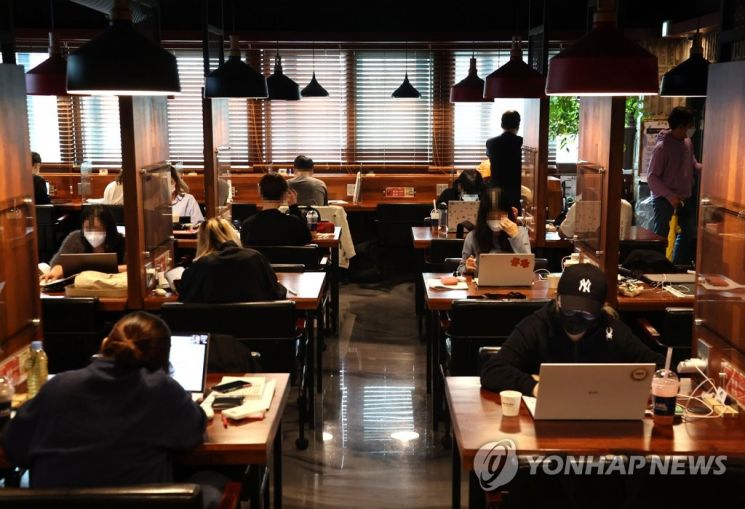
So, what is the appropriate maximum stay time for Kagongjok that owners can tolerate? According to the Korea Foodservice Industry Research Institute in August 2019, the breakeven point for a customer who buys a 4,100 won coffee is 1 hour and 42 minutes. This figure was calculated assuming a non-franchise cafe with an average sales volume, 8 tables, a 29% takeout rate, and 12 hours of daily operation. Considering the complaints posted on 'Apeunikka Sajangida,' it appears that owners can tolerate Kagongjok staying for about two hours on average. Ultimately, the current conflict stems from some Kagongjok using the store for three to four hours, negatively affecting cafe customer turnover.
Moreover, if someone studies in a cafe for 5 to 6 hours to the extent of being considered a freeloading customer, they could potentially be sued for business obstruction. According to a Supreme Court precedent from September 2009 regarding business obstruction, the court recognized that acts making free movement impossible or significantly difficult can be included. Therefore, long-term seat occupancy by Kagongjok could be punishable as an act that significantly hinders cafe operations.
However, owners reportedly avoid legal action because it could lead to being targeted on Instagram, Twitter, and other social media platforms. Instead, they seek understanding through notices such as "Studying in the cafe is limited to 2 hours" posted on the entrance or by not providing Wi-Fi at all. Some cafes are known to directly ask customers to leave if their stay becomes excessively long.
Professor Eunhee Lee of Inha University's Department of Consumer Studies emphasized, "The problem with Kagongjok arises when they sit for long periods and disrupt cafe turnover. Consumer rights are not absolute." She added, "Owners may criticize such Kagongjok, but before blaming them, it is important to find a compromise, such as offering 'a request for understanding regarding Kagongjok,' to prevent conflicts from deepening."
© The Asia Business Daily(www.asiae.co.kr). All rights reserved.

















