Promotion of Direct Referral of the Yellow Envelope Act to the Plenary Session Following the Grain Management Act
Presidential Office: "Inappropriate... Concern Over Unilateral Promotion"
Possibility of Veto on the Broadcasting Act... Presidential Office: "Law and Principle"
[Asia Economy Reporter Baek Kyunghwan] As the Democratic Party of Korea is pushing for the direct submission of the Yellow Envelope Act to the plenary session following the Grain Management Act, the Presidential Office has mentioned the possibility of a 'reconsideration.' This essentially means exercising a veto, expressing concerns that this legislation, which differs from the Yoon administration's governance principles and President Yoon Seok-yeol's principles, could further increase public inconvenience.
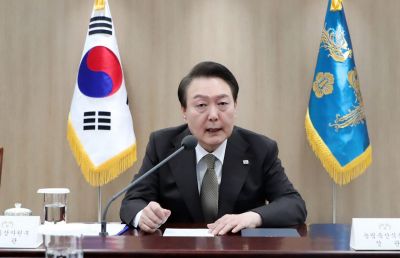
On the 17th, a senior official from the Presidential Office criticized, "It is not appropriate to comment on every bill being promoted in the National Assembly," but added, "The situation where various bills are being pushed unilaterally without a consensus process is worrisome." That afternoon, the National Assembly's Environment and Labor Committee planned to hold a coordination committee meeting to discuss the 'Yellow Envelope Act.'
The Yellow Envelope Act is an amendment to Articles 2 and 3 of the Labor Union and Labor Relations Adjustment Act, expanding the scope of employers and strengthening the protection of workers' strikes. The opposition parties, including the Democratic Party and the Justice Party, plan to discuss the bill in the coordination committee, proceed with a re-vote, and then approve the Yellow Envelope Act at the Environment and Labor Committee's plenary session on the 21st.
A Presidential Office official emphasized regarding the possibility of the President's reconsideration, "Considering that the government and the President have repeatedly stressed principles, it is natural to request reconsideration." This means that the President intends to exercise the veto power stipulated in Article 53 of the Constitution amid the Democratic Party pushing the bill with a majority of seats. If the President requests reconsideration, the National Assembly must reapprove the bill with a majority of the total members present and at least two-thirds approval of those present for it to become law.
The Presidential Office's stance on the Yellow Envelope Act is firm. They argue that it would create conditions where illegal strikes are guaranteed as legal and block employers from receiving compensation for damages caused by strikes. Although passing through the coordination committee and the Environment and Labor Committee plenary session is likely, President Yoon has already expressed concerns, stating, "Significant side effects are anticipated."
Above all, the Act is far from the 'labor reform' that President Yoon prioritizes as the top reform agenda. Another Presidential Office official pointed out, "Transparency in labor-management relations and fair compensation between regular and irregular workers, as well as between primary contractors and subcontractors, are key, but the Yellow Envelope Act undermines both transparency and fairness."
The Grain Management Act and the Broadcasting Act are also expected to face vetoes from President Yoon. The Grain Management Act has already been directly submitted to the plenary session, increasing its chances of passing the National Assembly. The ruling and opposition parties plan to hold a plenary session on the 24th to handle livelihood bills, and the Grain Management Act amendment may be voted on that day. However, President Yoon has repeatedly opposed the Grain Management Act, which mandates government rice purchases if rice production exceeds demand by more than 3% or if harvest prices fall by more than 5% compared to the previous year. He has pointed out that "it does not help farmers." His argument is that it should be left to government discretion, as gradually narrowing the supply-demand gap cannot prevent waste of finances and agricultural products. Ultimately, mandating purchases by law is judged to widen the gap further.
The Broadcasting Act has already been discussed within the Presidential Office regarding whether to exercise veto power. The amendment mainly aims to expand the boards of directors of public broadcasters such as KBS and MBC from the current 9?11 members to 21 members. The ruling party opposes this, claiming that granting certain organizations the right to recommend directors is an attempt by the left to permanently dominate public broadcasting.
The Presidential Office plans to maximize the President's constitutionally guaranteed authority to establish a governance foundation centered on reform until next year's general election. A Presidential Office official stated, "The repeated legislative pushes by the opposition leading to mentions of vetoes ultimately show the public the intensifying political strife between the ruling and opposition parties," adding, "However, the Presidential Office will always maintain a firm stance based on law and principles."
© The Asia Business Daily(www.asiae.co.kr). All rights reserved.

















