Seoul City Gimbap Average Price 3,100 Won
Filling Ingredients Range from 5,000 to 8,000 Won
Main Ingredient Price Increase Causes...Consumers and Store Owners Feel Bitter
 The photo is not related to any specific expression in the article. [Image source=Getty Images Bank]
Jiseungho (37, pseudonym), an office worker living in Seocho-gu, Seoul, was recently surprised when he visited a snack bar near his company for lunch. He intended to save on lunch costs and have a simple meal, but ordering a tuna kimbap roll and ramen cost him 9,000 won. Jiseungho said, "A tuna kimbap roll costs 4,500 won, but just a few years ago, this price could get you a bowl of spicy pork rice bowl. I knew prices had risen, but now it feels like even snack foods have become hard to afford, which worries me."
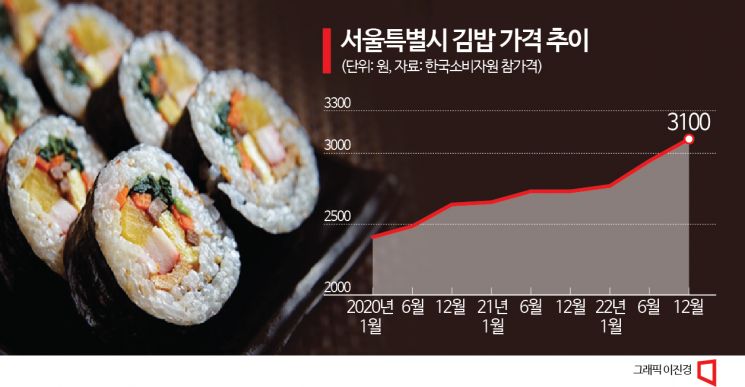
It has become difficult to find kimbap that once could be had for just 1,000 won. As dining-out prices continue to rise, the average price of a kimbap roll has long surpassed 3,000 won. Recently, with the sharp increase in the cost of ingredients, kimbap priced over 5,000 won, exceeding the psychological threshold of 2,500 won, has become common.
According to the Korea Consumer Agency's Price Comparison on the 17th, the average price of a kimbap roll in Seoul last month was 3,100 won, up 11.9% from 2,769 won the previous year. Kimbap prices have been steadily rising for years. The average price of a kimbap roll in Seoul was 2,408 won in January 2020, increased by 10% to 2,654 won in 2021, and surpassed 3,000 won for the first time in August 2022 at 3,046 won. However, in reality, prices are often much higher. The main reason is the recent sharp rise in the cost of kimbap ingredients. It has become common for kimbap rolls at snack bars or kimbap specialty stores to approach 5,000 won. Changing the fillings or adding toppings can easily push the price to 8,000 won.
In fact, most kimbap ingredients continue to rise in price. According to statistics from the Korea Agro-Fisheries & Food Trade Corporation, as of the 16th, the average retail price of unwashed carrots per kilogram was 4,808 won, a 67% increase from 2,873 won a year ago. This is 49% higher than the average price of 3,207 won. Cucumbers (thorn variety) also rose 29% to 18,595 won from 14,379 won the previous year, and radishes increased 22% to 2,076 won each from 1,689 won a year ago. The main ingredient, gim (seaweed), also followed this trend. According to the Korea Price Association's living cost price list, the average price of 100 sheets of improved gim in Seoul was 14,900 won on the 15th, up 15% from 12,900 won a year ago. The surge in vegetable prices was largely influenced by harsh weather conditions such as cold waves and heavy snowfall since the end of last year. In cultivation areas like Jeju, winter vegetables such as radishes, cabbages, and carrots suffered frost damage due to the cold and snow.
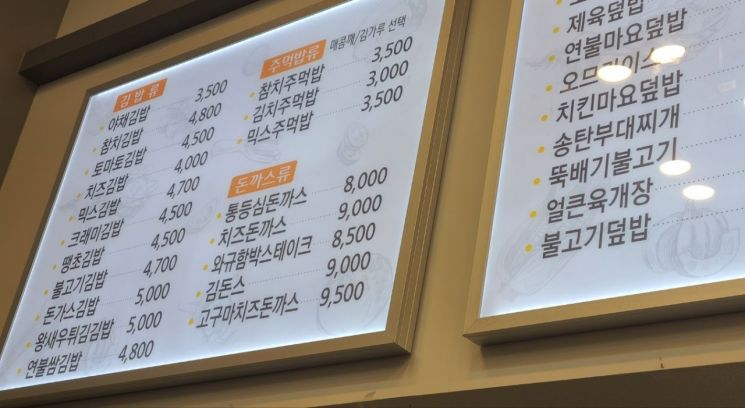 Menu board of a gimbap specialty store in Incheon on the 16th. Gimbap prices are listed from 3,500 won to 5,000 won.
 [Photo by Song Seung-yoon]
Consumers are left with bitter expressions in this situation. Kimbap, once a representative affordable meal that could be had for 5,000 to 6,000 won including ramen, now feels distant as its price approaches that of a full meal just a few years ago.
Small business owners are also struggling. Especially with soaring ingredient costs, they feel compelled to raise prices to maintain profit margins but often hesitate. They worry that raising prices might drive away regular customers. The long-standing image of kimbap as an affordable food also plays a role. For these reasons, premiumization of kimbap is underway, with more specialty stores charging higher prices by either filling kimbap rolls more generously or using expensive ingredients.
Park Jinhee (58, pseudonym), who runs a kimbap shop in Incheon, said, "Many customers are surprised at how expensive kimbap has become, and takeout orders are not what they used to be. Considering ingredient costs, prices should be raised even more, but we can't do that for fear of losing customers," she lamented.
© The Asia Business Daily(www.asiae.co.kr). All rights reserved.



















