Controversy over public utility fee hikes is spreading to the issue of free rides for the elderly. While necessary from the perspective of elderly welfare, there are calls for a national consensus as local governments struggle with budget issues.
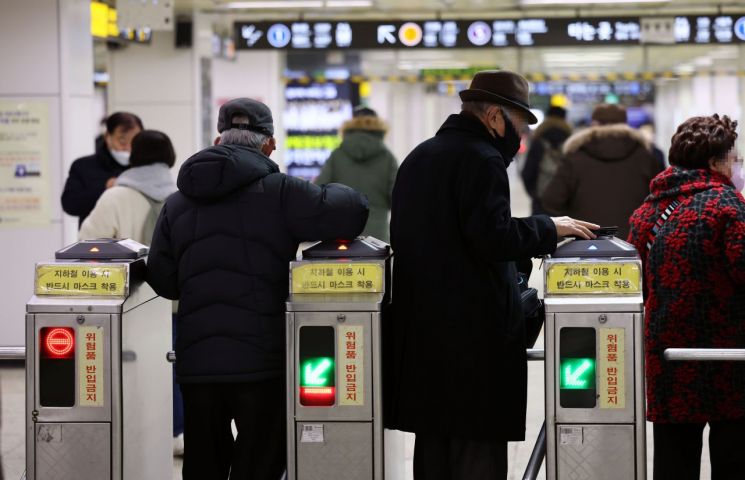 On the 6th, an elderly person is passing through the ticket gate at Jongno 3-ga Station of the Seoul subway.
 [Image source=Yonhap News]
The issue of free rides for the elderly was first raised by local governments. On the 30th of last month, Seoul Mayor Oh Se-hoon stated at a New Year's press conference, "It is appropriate for the central government to partially compensate for losses caused by free rides for the elderly." Later, on the 10th, Mayor Oh reportedly proposed to President Yoon Suk-yeol at the Central-Local Cooperation Meeting that if the Ministry of Economy and Finance supports the free ride program for the elderly, the increase in public transportation fares could be reduced from 400 won to 200 won. Under the leadership of Daegu Mayor Hong Joon-pyo, Daegu City also decided to gradually raise the age eligibility for free rides on urban rail transit to 70 by 2028.
Free Rides for Impoverished Elderly vs. Local Governments Unable to Bear Budget
Free rides for the elderly are provided as a welfare measure. According to the Elderly Welfare Act, the elderly are recognized as contributors to national and social development and are guaranteed a sound and stable life. Although the right to mobility is not explicitly stated in the Constitution, it is indirectly acknowledged through Article 10 on the pursuit of happiness and Article 11 on equality. Given that the elderly poverty rate was 38.97% in 2020, about three times higher than the OECD average of 13.5%, multifaceted elderly welfare is necessary.
There are also claims that free rides for the elderly do not simply reduce their transportation costs. The Korea Transport Institute explains that free rides for the elderly lead to increased economic and leisure activities among seniors, improved elderly health, and reduced elderly welfare support budgets. The social benefits from this were estimated to be between 313.6 billion and 336.1 billion won as of 2012. Professor Heo Jun-su of Soongsil University’s Department of Social Welfare stated, "Social activities of the elderly lead to reduced social costs," adding, "South Korea is the OECD country with the highest elderly poverty rate, and if free rides for the elderly are eliminated immediately, it could result in extreme choices and ultimately large social costs."
However, Seoul is struggling with budget issues. Seoul Metro recorded deficits of 1.1137 trillion won in 2020 and 959.9 billion won in 2021. The accumulated deficit reaches 16 trillion won. The causes of the deficit include a decreasing number of passengers and an increasing number of free riders. This stems from a financial structure that relies heavily on public transportation fares. In 2021, Seoul Metro’s total revenue was 1.6802 trillion won, of which transportation business income accounted for 1.2542 trillion won. Other income sources such as ancillary and entrusted businesses have little impact on Seoul Metro’s financial structure.
Free Rides for the Elderly Set Without Social Consensus... "An Appropriate Time to Reach Agreement"
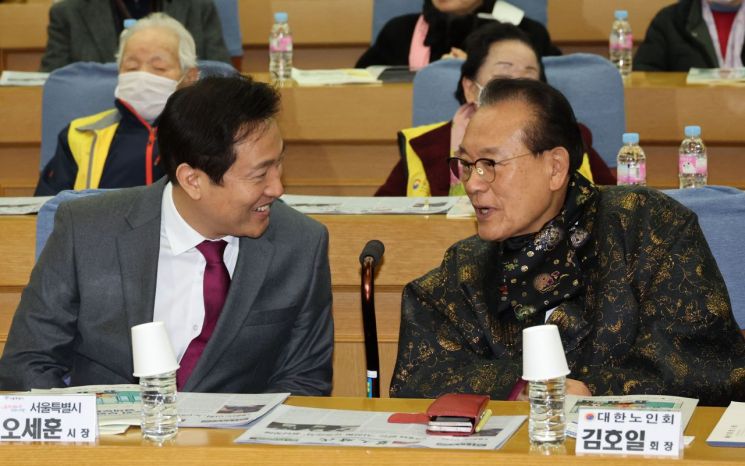 Kim Ho-il, President of the Korea Senior Citizens Association, and Oh Se-hoon, Mayor of Seoul, are conversing at the policy discussion on free transportation for the elderly held on the 16th at the National Assembly Members' Office Building in Yeouido, Seoul.
 [Image source=Yonhap News]
The issue has been tangled since 1984. At that time, under the unilateral directive of former President Chun Doo-hwan, the Enforcement Decree of the Elderly Welfare Act was amended. A presidential decree was established to provide a 100% fare discount for the elderly. In the paper "Analysis for Improving the User-Centered Elderly Subway Free Ride System" by Professor Noh Si-hak of Kyung Hee University’s Department of Geography, it is stated, "It is difficult to see that a rational national consensus process was followed in establishing the elderly subway free ride system," and "Considering that the chairman of the Korean Senior Citizens Association, who actively recommended the system to the government, was the father-in-law of the president and the political situation of that era, it is difficult to judge that the policy decision was made transparently."
Experts point out that social consensus is needed, even if belatedly. Professor Jung Soon-dul of Ewha Womans University’s Department of Social Welfare said, "It is necessary to properly consider the sustainability of finances and the social benefits of free subway rides," adding, "Senior organizations such as the Korean Senior Citizens Association have shown some willingness to compromise. Given the long-standing nature of the discussion, this is an appropriate time to reach a social consensus together." Professor Heo emphasized, "Since the capacities of local governments vary, decisive action is needed from the central government to share the burden jointly."
© The Asia Business Daily(www.asiae.co.kr). All rights reserved.


















