North Korea's New Grain Policy... Strengthened Government Control
Crackdown on Private Transactions → Market Shrinkage and Supply Instability
Unification Ministry "Doubtful if North Korea's Original Plan is Proceeding"
[Asia Economy Reporter Jang Hee-jun] It is observed that North Korea introduced a grain policy strengthening government-level control from October last year. According to authorities, the policy, which controls grain transactions even between individuals, has ironically caused distribution problems, worsening the food shortage.
An official from the Ministry of Unification said on the 16th at the Government Seoul Office, "North Korea has shown a trend of strengthening government control over food since the end of last year." He added, "There are signs that North Korea's food situation has become serious since the end of last year. Since it is still early in the year, it is unlikely that all the grain produced last year has been exhausted. It is a situation where a 'distribution problem' has occurred rather than an absolute quantity problem."
According to recent reports from North Korean state media, the term 'grain supply center' and separately 'grain sales center' frequently appear. The grain supply center is a place where the government sells food to residents at state-set prices, and if a sufficient amount of rice is purchased, it can prevent sudden increases in rice prices. The grain sales center differs in that it sells food somewhat cheaper than the jangmadang (market).
North Korea, Attempting 'Supply Stabilization' but Triggering 'Supply-Demand Instability'
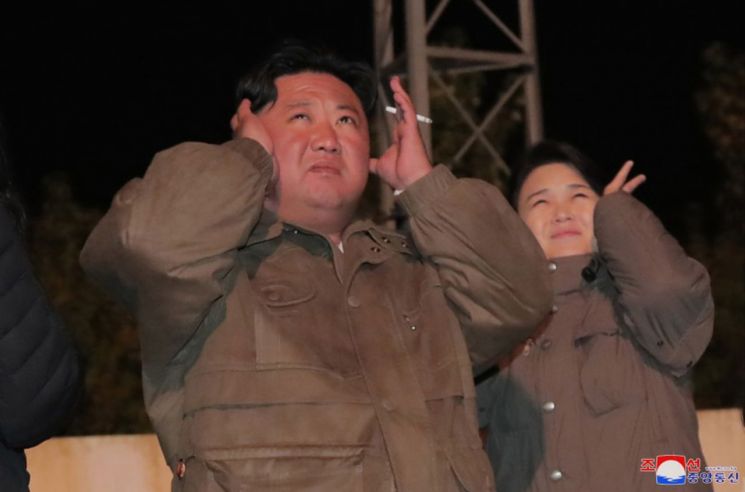
The new mentions of grain sales centers suggest changes in the food supply system. The Ministry of Unification analyzed this as North Korea strengthening control over food at the government level. In fact, North Korea mentioned 'improvement of grain purchase and supply projects' at the 10th Political Bureau meeting of the 8th Party Congress in September last year, and since then, news has emerged that even grain transactions between individuals are being controlled.
North Korea's intention appears to be to regulate grain transactions between individuals through a new grain policy while trying to make purchase prices more realistic. They believed that by selling grain cheaper than market prices through grain sales centers, they could achieve stability in food supply.
However, it is estimated that the new policy caused a contraction in transactions, leading to supply and demand problems. Combined with controls such as shortened operating hours of comprehensive markets due to the impact of COVID-19, residents who sustained their livelihoods through jangmadang saw their incomes decrease, which also affected food procurement.
An official from the Ministry of Unification explained, "I cannot say they tried to completely stop (private transactions), but there are reports here and there that food transactions through jangmadang are not as free as before." He added, "Previously, food was traded through jangmadang and could be purchased relatively conveniently, but there are signs that transactions have contracted due to the new policy."
He particularly noted, "There is an effect of decreased income for people sustaining their livelihoods through jangmadang, and we believe these factors have influenced food procurement in various ways." He questioned, "It is doubtful how smoothly this policy is proceeding according to North Korea's original plan."
Reports of Starvation Affect Even Soldiers' Food Rations... "At a Serious Level"
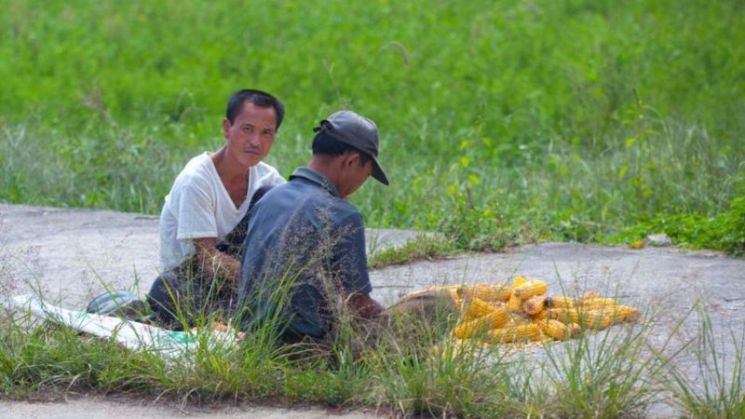 In September 2012, North Korean farmers in Kaesong are sorting harvested corn in the field. [Image source=Getty Images]
According to sources on North Korea, recent reports indicate multiple starvation deaths occurring in various regions including Hamgyong Province. Hamgyong is one of the most underdeveloped border areas in North Korea, and after the COVID-19 outbreak, lockdowns intensified, causing difficulties in procuring food from the outskirts. This is also believed to be influenced by the centrally controlled grain policy.
In particular, it is reported that North Korea recently reduced the daily grain ration per soldier from the previous 620g to 580g. This is the first time since the 2000s that North Korea has cut grain rations for soldiers. Due to the combined effects of COVID-19, spring drought, and summer floods last year, North Korea's food crop production significantly decreased, and this year even if grain is imported externally at usual levels, it is estimated to be short by more than 800,000 tons compared to demand.
However, Minister of Unification Kwon Young-se said at the National Assembly Foreign Affairs and Unification Committee plenary session the day before, regarding North Korea's food shortage, "It seems that the food situation is not good these days, but I do not think starvation deaths are occurring in large numbers." Regarding this, an official from the Ministry of Unification explained,
"It does not mean there are no starvation deaths, but rather that a situation like the 'mass starvation deaths' during the 1990s Arduous March is not expected."
© The Asia Business Daily(www.asiae.co.kr). All rights reserved.
![Clutching a Stolen Dior Bag, Saying "I Hate Being Poor but Real"... The Grotesque Con of a "Human Knockoff" [Slate]](https://cwcontent.asiae.co.kr/asiaresize/183/2026021902243444107_1771435474.jpg)

















