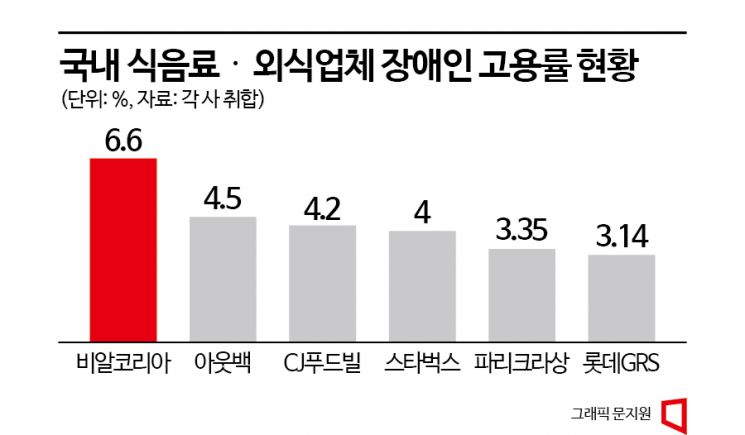
BR Korea, including Baskin-Dunkin, reaches up to 6.6%
Outback, Starbucks, and others exceed mandatory employment rate of 3.1%
Jobs previously limited to back-office support and simple clerical work
Now expanding to face-to-face services directly interacting with customers
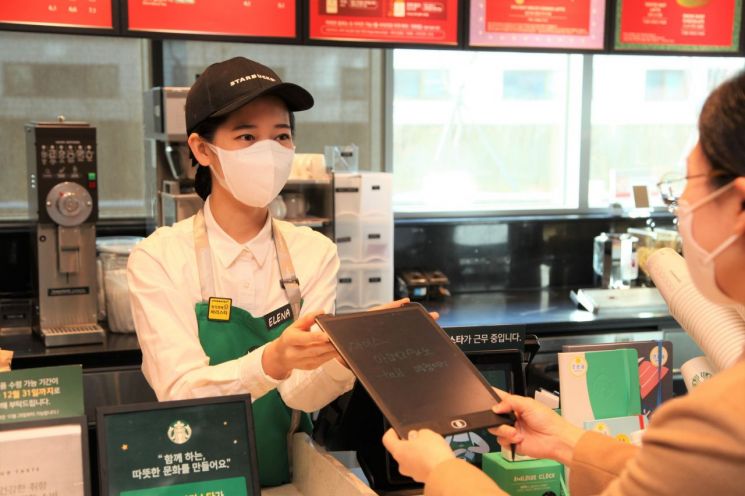 Recently, Yena Choi, a hearing-impaired store manager, has been working at the Starbucks Seoul National University Dental Hospital branch.
 [Photo by Starbucks]
Domestic food and beverage and dining companies are taking the lead in upholding ESG (Environmental, Social, and Governance) management as a core value and fulfilling their obligations to employ people with disabilities. According to the Disabled Employment Act, companies with 50 or more regular employees must hire people with disabilities for at least 3.1% of their total workforce.
According to the industry on the 16th, SPC Group's disability employment rate is 6.6% for BR Korea, which operates Baskin-Robbins and Dunkin, and 3.35% for Paris Croissant, which operates Paris Baguette, Pascucci, and Shake Shack.
To create jobs for people with disabilities, SPC officially launched and operates the social enterprise "Haengbokhan Geobugi" (Happy Turtle) in 2019. Haengbokhan Geobugi is a job-providing social enterprise meaning "a workplace for people with disabilities who are slow but happy." Its main purpose is to provide jobs for vulnerable groups, employing more than 30% of its staff as people with disabilities and vulnerable groups.
The main business of Haengbokhan Geobugi is "Happy Bakery & Cafe." At this store, people with disabilities learn skills such as barista and baking and work there, receiving bread supplied from "Aedeok-ui Jip Soul Bakery," a protected workshop for people with disabilities.
Starbucks Korea has been hiring baristas with disabilities since 2007. In 2012, it became the first in the industry to sign an employment promotion agreement with the Korea Employment Agency for the Disabled, leading the way in non-discriminatory hiring. As of the end of last month, 462 partners with disabilities are working at Starbucks stores nationwide. Among them, 392 have severe disabilities, and 70 have mild disabilities. The legal number of disabled partners, counting severe disabilities as double, is 854, resulting in an employment rate of about 4% compared to the total number of employees.
bhc Group's Outback Steakhouse has a disability employment rate of 4.5%. Outback has stated its intention to continue increasing the employment rate of people with disabilities.
CJ Foodville, which operates Tous Les Jours and VIPS, has a disability employment rate of 4.2%, exceeding the mandatory employment rate of 3.1% and nearly tripling the national average of 1.49% for regular workers with disabilities (as of 2021).
Currently, the longest tenure of a disabled employee at CJ Foodville is 20 years, and the highest number of disabled employees hired at a single VIPS store is five. CJ Foodville is recently focusing on diversifying job roles for people with disabilities. Previously limited to back-office support or simple clerical work, roles have expanded to include face-to-face customer service. Efforts are also being made to create a stable working environment for disabled employees. The HR manager responsible for hiring people with disabilities has obtained a "Disability Vocational Life Counselor" certification to carefully support employees by listening to any difficulties that may arise during job adaptation and performance.
Additionally, Lotte GRS, which operates Lotteria, Angel-in-us, and Krispy Kreme Doughnuts, has a disability employment rate of 3.14%.
Professor Kim Jimi of the Department of Social Welfare at Gyeongnam National University said, "The social security system mandating the employment of people with disabilities has increased the number of people with disabilities participating in social activities, helping improve awareness of disabilities." She advised, "Not only should people with mild disabilities be hired, but people with severe disabilities who want to work should be actively employed. When a person with a severe disability is employed, a personal assistant is necessarily required, which means that one disabled person's employment can create more jobs."
© The Asia Business Daily(www.asiae.co.kr). All rights reserved.
!["The Woman Who Threw Herself into the Water Clutching a Stolen Dior Bag"...A Grotesque Success Story That Shakes the Korean Psyche [Slate]](https://cwcontent.asiae.co.kr/asiaresize/183/2026021902243444107_1771435474.jpg)

















