Recruitment of 5 Vacancy Managers Attracts 9 Applicants '1.8:1'
Far Below Initial Project Competition Rate of 3:1
[Asia Economy Honam Reporting Headquarters Reporter Park Jin-hyung] Nam-gu, Gwangju Metropolitan City, which created the 'Street Food Zone' around Baegun Square, seems to be losing popularity not only among customers but also among business owners hoping to enter.
The opening effect did not last as long as expected, and due to poor sales caused by seasonal factors and the occurrence of store closures, creating a 'startup risk,' Nam-gu's key project is showing signs of stagnation after just half a year.
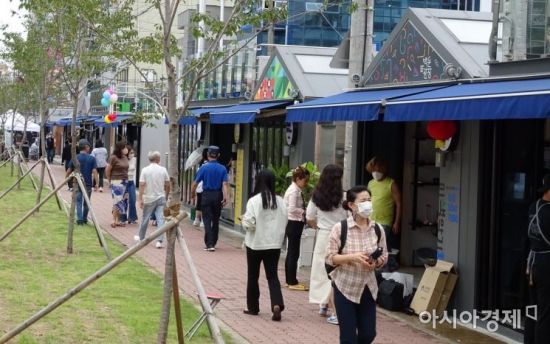 'Street Food Zone' created by Nam-gu, Gwangju Metropolitan City around Baegun Square
 Photo by Jin-Hyung Park
According to Nam-gu on the 17th, the district recruited 5 additional operators in the food service sector from the 2nd to the 6th to fill vacancies caused by closed businesses, receiving 9 applications. The competition rate for entry was only 1.8 to 1.
This is somewhat lower compared to the public recruitment of operators at the end of 2021 before the official opening (August 2022).
At that time, the food service sector attracted 71 applicants for 24 positions, recording a hot competition rate of about 3 to 1. The cultural and arts sector had 14 applicants for 6 positions, showing a competition rate of 2.33 to 1.
However, the reason for the lower competition rate in this additional recruitment is analyzed to be due to the lack of notable success stories within the Food Zone during the approximately six months of operation and the inherent limitation of being a 'C-grade commercial district.'
In the early days of opening, the best-performing store showed signs of a big hit with monthly sales exceeding 40 million KRW, but as it entered the winter off-season (December to February), sales dropped by more than 70%, going through a season of hardship.
According to the Small Enterprise and Market Service's commercial district analysis, data for December last year has not yet been compiled, making direct comparison difficult, but as of December 2021, the average monthly sales of 46 businesses within a 500m radius of the Food Zone was 10.98 million KRW.
Compared to this, it is reported that a considerable number of merchants in the Food Zone around the same period this year have not reached the average.
In fact, two Food Zone stores closed due to operational difficulties caused by declining sales. Given this situation, it seems difficult for prospective entrepreneurs to readily decide to enter.
Especially, Baegun Square lost its function as a 'square' after the Baegun Overpass was installed in 1989, causing urban aesthetic degradation and pedestrian path discontinuity, and the surrounding commercial district also went into decline.
Although Nam-gu is revitalizing Baegun Square through an urban regeneration project worth 87.9 billion KRW, the individual projects such as the Food Zone and the Blue Road Bridge construction are progressing at different paces, making it difficult to expect synergy effects from a short-term perspective.
In a situation where abundant floating population does not support it, the initial startup costs reaching up to tens of millions of KRW and the uncertain future changes of the Food Zone commercial district characteristics are analyzed to act as deterrents to investment (startup).
The monthly rent for the Food Zone is relatively low at 120,000 to 150,000 KRW compared to surrounding market prices, providing small business owners with opportunities to reduce fixed costs and generate stable profits, but some opinions suggest that this advantage cannot be realized unless the commercial district recovers first.
A self-employed person in Nam-gu, Mr. A, said, "Even if the rent is cheap, what merit is there if the business profit is at a loss due to a poor commercial district?" He added, "Baegun Square development might turn it into a hot place in 1 to 2 years, but at this point, it is judged difficult to expect satisfactory profits, so small business owners with weak fundamentals will find it hard to endure."
A Nam-gu official explained the reason for the lower competition rate for entry, saying, "When recruiting operators before the opening, we promoted it across the entire Gwangju area with banners, but this additional recruitment was conducted only within Nam-gu," and "The restriction that menus already sold in the Food Zone cannot be duplicated also seems to have had an impact."
Nam-gu plans to spare no support to help Food Zone merchants settle well through continuous management such as strengthening Food Zone promotion via media walls and conducting secondary consulting in connection with the urban regeneration project.
Meanwhile, the Street Food Zone is a key project of Nam-gu Mayor Kim Byung-nae, with about 2.6 billion KRW invested, and it opened last August. It is a complex cultural space in the city center with various food service and cultural arts stores lined up along a park walkway about 500 meters long across from Nam-gu Office.
© The Asia Business Daily(www.asiae.co.kr). All rights reserved.
![Clutching a Stolen Dior Bag, Saying "I Hate Being Poor but Real"... The Grotesque Con of a "Human Knockoff" [Slate]](https://cwcontent.asiae.co.kr/asiaresize/183/2026021902243444107_1771435474.jpg)











