[Asia Economy Yeongnam Reporting Headquarters Reporter Hwang Doo-yeol] Professor Iboram Lee's research team at Pukyong National University in Busan published a review paper on the cover of the world-renowned scientific journal Joule (IF=46.048).
Joule is the energy field journal with the highest impact factor (IF) among the sister journals of Cell, known as one of the world's top three journals along with Nature and Science.
On the 15th, Professor Lee’s research team adorned the cover of the journal with their review paper titled “Passivation strategies for mitigating defect challenges in halide perovskite light-emitting diodes.”
The research team consisted of distinguished scholars including Professor Iboram Lee of Pukyong National University, Dr. Xinyu Shen, Professor Kihoon Kang of Seoul National University, Professor Richard H. Friend and Professor Samuele D. Stranks of the University of Cambridge, and Professor Henry J. Snaith of the University of Oxford.
Through this paper, the team presented the challenges to be overcome and solutions in current perovskite light-emitting diode (LED) research, leading the development of high-efficiency and high-stability perovskite LEDs.
The paper reviewed and summarized various previously reported defect passivation strategies based on four fundamental principles?ionic bonding, coordination bonding, hydrogen bonding, and core-shell structures?and their synergistic multiple combinations.
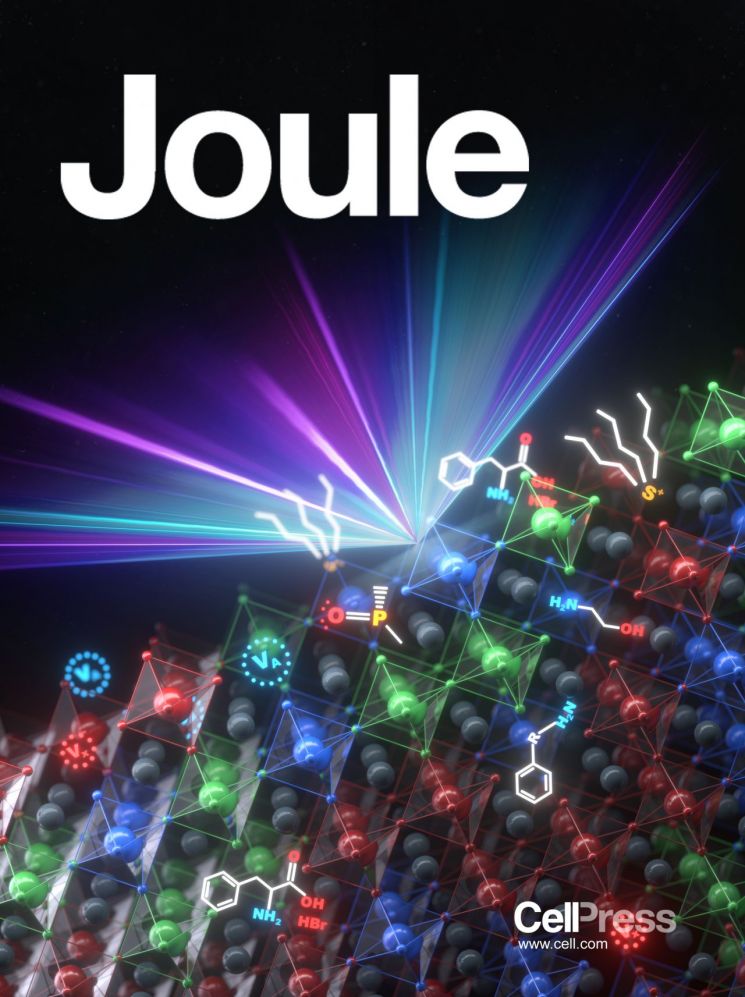 Cover of the July 15 issue of Joule featuring the review article image by Professor Lee Boram's team.
Metal halide perovskites (MHP) are materials recognized for their high color purity and high photoluminescence quantum yield, showing great potential for next-generation display applications.
Although perovskite materials are known to have higher defect tolerance compared to conventional semiconductor materials, various defects occur during the thin-film formation process of perovskite materials, and defects also arise at the heterointerface between the charge transport layer and the perovskite material, limiting the device performance of LEDs.
To prevent device performance degradation, many researchers have continuously improved the performance of perovskite LEDs through various defect passivation strategies, and an external quantum efficiency of up to 28.9%, close to commercialization, has been reported.
Professor Iboram Lee said, “We expect this paper to serve as a reference for industry and academia to discover greater potential of perovskites for optoelectronic devices.”
This research was supported by the Ministry of Science and ICT and the National Research Foundation of Korea through the BrainLink project, Nano-Material Technology Development project, Early Career Researcher program, Mid-career Researcher program, and Priority Research Centers program.
© The Asia Business Daily(www.asiae.co.kr). All rights reserved.

















