Announcement of 'Regional Key Industry Restructuring and Development Plan'
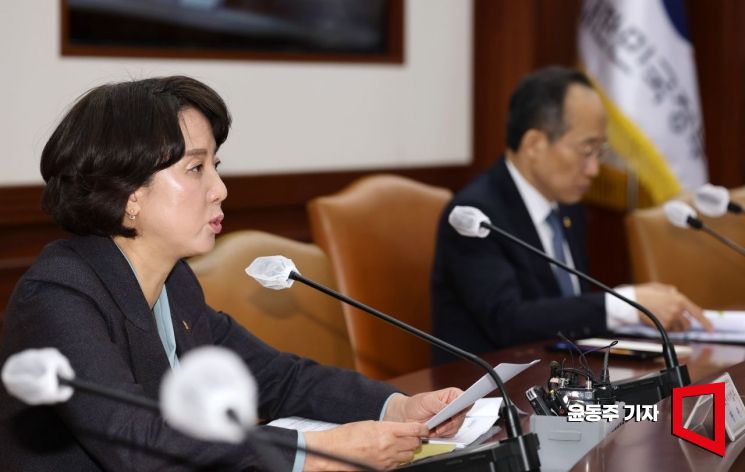 Lee Young, Minister of SMEs and Startups, is delivering a keynote speech at the 'Emergency Economic Ministers' Meeting and Export Investment Countermeasures Meeting' held at the Government Seoul Office on the 16th. Photo by Dongju Yoon doso7@
[Asia Economy Reporter Kim Bo-kyung] The government has prepared a plan to restructure regional key industries to nurture local small and medium-sized enterprises (SMEs) as the main drivers of economic growth and to foster future new industries.
The Ministry of SMEs and Startups announced the "Direction for Restructuring and Fostering Regional Key Industries" at the Emergency Economic Ministers' Meeting chaired by Deputy Prime Minister for Economy Choo Kyung-ho on the 16th.
The regional balanced development policy pursued over the past 20 years has shown limitations in addressing job losses outside the metropolitan area and regional extinction, raising the need for a growth strategy centered on supporting regional SMEs. Accordingly, since last October, the Ministry of SMEs and Startups has been preparing this plan together with 14 non-metropolitan cities and provinces.
First, regional key industries will be restructured into main industries (41 sectors) and future new industries (19 sectors), considering factors such as technology maturity, industrial infrastructure, and the presence of enterprise groups forming supply chains.
Main industries are key industries with high technology maturity and established industrial infrastructure in the region. Industries with low competitiveness will be excluded or replaced, and those contributing economically to the region will be maintained or adjusted in scope, reducing the existing 48 industries to 41.
By analyzing the innovativeness and growth potential of enterprises, enterprise groups will be categorized by growth stage, and regions will be supported to autonomously design support programs. To enhance policy effectiveness through competition among regions, the scale of differentiated incentives based on evaluations will be expanded, transitioning to a performance-based policy.
The restructuring cycle of key industries will be regularized, and a Regional Key Industry Selection Committee (tentative name) involving industry, academia, research, and government will be newly established. Legal measures will be pursued to ensure systematic restructuring and stable fostering of key industries.
Future new industries are newly selected 19 sectors linked to national strategic technologies such as the 12 national strategic technologies and the New Growth 4.0 project, aimed at securing new growth engines for regions.
For future new industry strategic items by region, support will be provided for planning technology tasks and technology development to secure core technologies, and growth into main industries will be promoted through investment and financing linkage.
Minister Lee Young of the Ministry of SMEs and Startups stated, "The Regional Small and Medium Venture Business Offices, 14 non-metropolitan cities and provinces, Technoparks, and regional innovation institutions will form one team and provide swift support so that the fostering achievements of regional key industries can be tangibly felt in the field."
Meanwhile, the Ministry of SMEs and Startups will hold a Regional Economic Committee meeting with 14 cities and provinces on the 27th to finalize the regional key industry restructuring plan. Within the first half of this year, it plans to establish the "Regional SME Fostering Strategy (tentative name)" including detailed tasks for fostering regional key industries.
© The Asia Business Daily(www.asiae.co.kr). All rights reserved.

















