Competition to Integrate AI Chatbots into Search by MS, Google, Naver
Advertising Revenue Outlook Diverges... Subscription-Based Revenue Model Also Possible
[Asia Economy Reporter Yuri Choi] As AI chatbots like ChatGPT are increasingly integrated with search engines, profitability issues for leading search providers are emerging. This is because changes in search methods could significantly reduce advertising revenue, which is their core income source. Some predict that the search advertising market may disappear. On the other hand, some experts believe AI chatbots will attract more users and increase advertising revenue.
According to mobile data and analytics platform data.ai on the 16th, Microsoft's (MS) search engine 'Bing' app ranked second in the productivity category of the US App Store. Just one week after applying the AI chatbot 'Prometheus,' which outperforms ChatGPT, on the 7th, Bing rose 188 ranks vertically.
As MS surged ahead, other portal companies became busy. Google plans to soon apply its AI chatbot 'Bard' to search, and Naver announced it will launch 'SearchGPT' in the first half of this year.
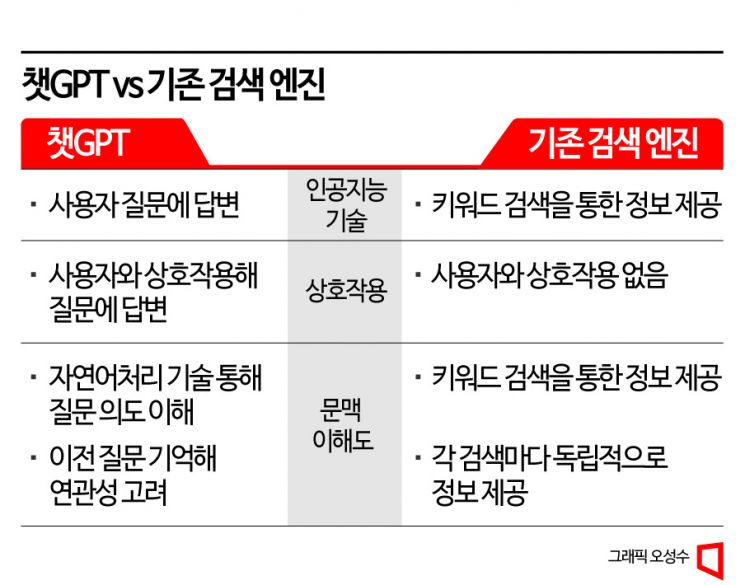
With the ChatGPT craze spreading to search bars, attention is focused on the impact on portal revenue models. Some analyses suggest that conversational search will replace traditional search methods, significantly reducing advertising revenue.
Currently, portals display lists of sites or documents matching search keywords. They charge search advertising fees in exchange for exposing related information at the top. Users find information matching their search intent, sending traffic to other sites and generating advertising revenue. In contrast, chatbot search provides a single answer summarizing multiple pieces of information. Users no longer need to browse multiple sites, but portals lose space to display ads. Google, which earns over 80% of its revenue from advertising, issued a 'red alert' for this reason.
Industry insiders believe it is not easy to immediately attach ads to chatbot searches. Providing advertising content could instantly undermine trust in search results. From the advertiser's perspective, companies are unlikely to advertise on current chatbot searches that reveal limitations such as search errors or ethical issues.
Professor Seongmin Jeon of Gachon University’s Department of Business Administration (Visiting Researcher at Seoul National University AI Institute) said, "The reason Google did not apply chatbot AI technology to search despite acquiring it first is that it anticipated damage to advertising revenue. MS judged that since its advertising proportion is small, it has nothing to lose and can rather expand its cloud business."
Subscription services could also replace advertising revenue. Like the paid version of ChatGPT, chatbot search could be offered as a subscription service with a monthly fee. The paid version of ChatGPT, priced at $20 per month, surpassed 1 million users just three days after its official launch on the 13th. Assuming a 5% paid conversion rate among ChatGPT users, this generates over $100 million (about 127 billion KRW) in monthly revenue.
Conversely, some believe the existing advertising revenue model will remain strong. This is because chatbot search complements existing search engines. Users ask ChatGPT and then reconfirm results on Google, or use different tools depending on the desired information. MS placing Prometheus next to the existing search bar is interpreted as an attempt to maintain the revenue model while gaining additional benefits. Bae Jaekyung, product leader at AI startup Upstage, said, "If existing search ads are keyword matching, chatbot-style search has shifted to semantic matching, but it does not fundamentally depart from the existing advertising method. Rather than the entire industry being reorganized, companies like Google and Naver that have performed well will show stronger dominance."
There is also a possibility that chatbot AI will attract more users and increase advertising revenue. Professor Lee Kyungjeon of Kyung Hee University’s Department of Business Administration and Big Data Applications said, "If natural language interfaces are added to existing services, users may search more. If portals occupy more user time, Netflix or YouTube could be the ones negatively affected."
© The Asia Business Daily(www.asiae.co.kr). All rights reserved.
![Clutching a Stolen Dior Bag, Saying "I Hate Being Poor but Real"... The Grotesque Con of a "Human Knockoff" [Slate]](https://cwcontent.asiae.co.kr/asiaresize/183/2026021902243444107_1771435474.jpg)











