Promoting Competition Among Financial Firms and Lowering Financial·IT Barriers for Effective Competition
Emphasizing Fare Segmentation and Service Quality Improvement in Telecommunications
Public Fees for Highways and Railways Frozen in the First Half
Energy Fees Gradually Increased with Support for Vulnerable Groups
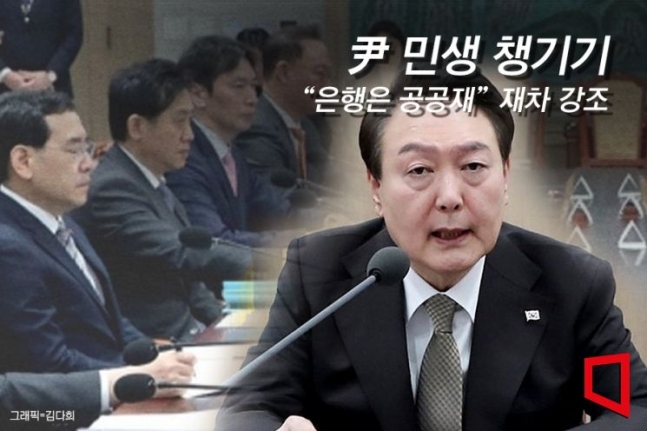
[Asia Economy Reporter Ki-min Lee] On the 15th, President Yoon Suk-yeol instructed, "Prepare extraordinary measures to strengthen the practical competition system in the oligopolistic banking and telecommunications industries and report the results separately." This reflects the intention that the financial and telecommunications sectors, which have strong public goods characteristics, should actively participate in sharing the burden for price stabilization. He also requested a freeze in the first half of the year and a gradual increase in sensitive areas for low-income and vulnerable groups, such as public utility fees and energy charges.
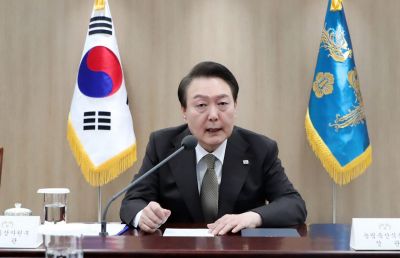
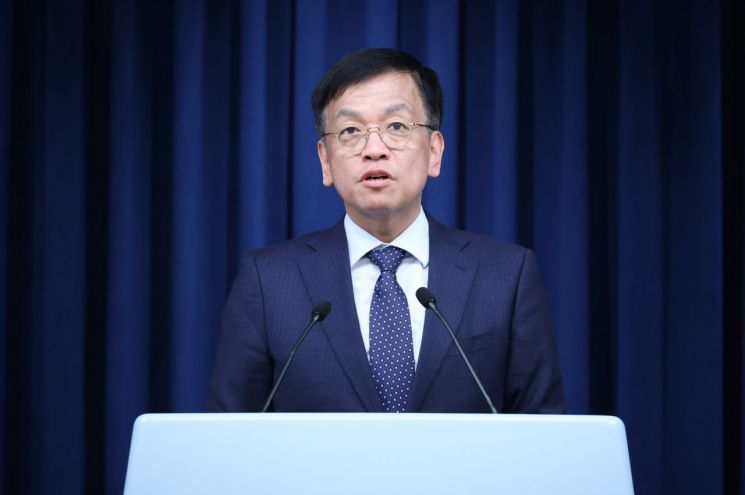
President Yoon gave these instructions during the 13th Emergency Economic and Livelihood Meeting held at the Yongsan Presidential Office in the morning, as briefed by Chief Secretary for Economic Affairs Choi Sang-mok.
The emergency meeting focused on urgent livelihood stabilization measures centered on four major areas: public utility fees, energy charges, telecommunications costs, and financial costs. Attendees included Deputy Prime Minister and Minister of Economy and Finance Choo Kyung-ho, Minister of Trade, Industry and Energy Lee Chang-yang, Minister of Science and ICT Lee Jong-ho, Financial Services Commission Chairman Kim Joo-hyun, and Financial Supervisory Service Governor Lee Bok-hyun.
Regarding the financial sector, President Yoon pointed out the need to reduce the burden by shrinking the interest rate margin between deposits and loans and protecting vulnerable borrowers. He instructed Chairman Kim and Governor Lee, noting the significant harm caused by the oligopoly in the banking industry, to devise practical measures to strengthen the competition system.
Chief Secretary Choi explained the background, stating, "Currently, the top five commercial banks hold market shares of 74.2% and 63.4% in deposits and loans respectively as of the end of last year. It is pointed out that banks have leveraged this oligopolistic position to easily achieve record-high interest income when setting deposit and loan interest rates."
He added, "Measures to strengthen competition among banks may include disclosing the interest rate spread between deposits and loans, establishing refinancing loan platforms, and deposit comparison and recommendation platforms to enhance competition among existing financial companies. Lowering operational barriers between finance and IT to promote effective competition is also under consideration."
President Yoon also emphasized the protection of vulnerable groups, stating, "Banks should accumulate sufficient reserves during profitable periods and use them to provide more support to citizens and businesses during difficult times. For sustainable banking operations and profit generation, the banking sector must play a role such as co-prosperity finance when the public faces hardships."
Chairman Kim reported that he agreed to participate in efforts to ease interest burdens on vulnerable borrowers and strengthen social responsibilities. On January 27, a 500 billion KRW co-prosperity project was announced for the next three years, promising about 3 trillion KRW in financial support to vulnerable borrowers. Accordingly, using funds contributed by banks, an emergency livelihood loan will be launched in March. This loan will support borrowers who find it difficult to use loan companies due to delinquencies and other reasons and who resort to illegal private loans with interest rates around 400%. The loan interest rate will be significantly reduced from the original 15.9% to a minimum of 9.4% for those who repay faithfully for one year.
Furthermore, the banking sector plans to prepare a co-prosperity finance program worth 10 trillion KRW over the next three years to share the difficulties of livelihood. This includes about 3 trillion KRW for low-income, low-credit, debt adjustment faithful repayment borrowers, and medium-sized low-interest loan support; 3 trillion KRW for financial exclusion medium-sized special supply; and about 4 trillion KRW for expanding supply of livelihood finance, Chief Secretary Choi conveyed.
Regarding the telecommunications sector, the need to reduce consumers' cost burdens was also emphasized. Chief Secretary Choi said, "For 5G, there are plans with low data usage or unlimited data, but there is no plan for the 40 to 100GB range, which is mainly used by the public." He mentioned, "President Yoon recognized this issue and instructed to expand the choice of telecommunications plans and strengthen competition in the telecommunications market."
He continued, "There are 55 million mobile subscribers, 23 million high-speed internet subscribers, and 14 million OTT subscribers, meaning most citizens use telecommunications as an essential good. However, since 2001, the domestic market has maintained an oligopoly centered on three telecommunications companies, and recent investments for network innovation have stagnated. Mobile phone plans show little difference among companies, limiting the actual choice for citizens."
He particularly added, "(President Yoon) said that the telecommunications fee brackets should be subdivided to reduce the burden on citizens. Above all, considering the importance of telecommunications as an essential good, healthy competition to improve quality, fees, and services in the market must be promoted."
In response, the government plans to diversify fees by bracket, class, and period to reduce the burden of plans and expand fee choices, while periodically evaluating and disclosing telecommunications service quality and supporting the expansion of budget phone services.
Minister Lee also reported that measures to promote competition in the telecommunications market, including support for domestic and foreign investment attraction, easing frequency usage burdens, supporting network construction, and lowering barriers to entry for new businesses, will be prepared within the first half of the year.
Additionally, regarding public utility fees, a freeze is planned for public utility fees managed by the central government, such as highways, railways, postal services, and metropolitan water supply. President Yoon stated, "Local governments are also a pillar of livelihood stabilization," and urged efforts to minimize increases through cost reduction and productivity improvement so that the burden on citizens does not increase during difficult times.
Incentives such as additional special grants will be expanded to ensure that local governments' cooperation and burden-sharing for livelihood stabilization are appropriately rewarded.
Regarding the energy sector, Chief Secretary Choi said, "Although price increases are inevitable due to global energy price rises and deteriorating profits of Korea Electric Power Corporation and Korea Gas Corporation, the increase speed will be slowed to minimize the burden on low-income households. At the same time, strong efforts will be made to improve the financial structure of energy public enterprises." He added, "In this process, we will provide substantial support to low-income and vulnerable groups."
He continued, "Energy voucher payments and discounts on city gas and district heating have already been significantly expanded. Additionally, for vulnerable groups using kerosene and LPG this winter, government support will be expanded up to 592,000 KRW during the winter season, matching the discount levels for city gas and district heating, ensuring no blind spots."
For citizens facing large energy cost burdens concentrated in specific periods, including small business owners, the system and operational framework will be improved to allow installment payments, with implementation planned as soon as possible.
To fundamentally reduce energy costs in society, "the 'Green Home Initiative' to support energy efficiency improvements tailored to residential spaces will be actively promoted. Support for energy efficiency improvement projects for low-income households replacing cooling and heating facilities will be expanded. Energy diagnosis and efficiency improvement consulting for aging residential facilities will be conducted, and feasible cooling and heating efficiency improvements will be implemented immediately," he concluded.
© The Asia Business Daily(www.asiae.co.kr). All rights reserved.
![Clutching a Stolen Dior Bag, Saying "I Hate Being Poor but Real"... The Grotesque Con of a "Human Knockoff" [Slate]](https://cwcontent.asiae.co.kr/asiaresize/183/2026021902243444107_1771435474.jpg)


















