Yellow Envelope Act Passes Employment and Labor Law Subcommittee on 15th
Expansion of Scope Including Employers and Labor Disputes
Significant Adjustments to Compensation Scope and More
[Asia Economy Reporters Naju-seok and Park Joon-yi] The 'Yellow Envelope Act (Amendment to Articles 2 and 3 of the Labor Union and Labor Relations Adjustment Act)' was passed by a vote amid opposition from the ruling party at the Employment and Labor Law Review Subcommittee of the National Assembly's Environment and Labor Committee. Although procedures such as the full Environment and Labor Committee meeting, the Legislation and Judiciary Committee's systematic and technical review, and the National Assembly plenary session remain, there is a high possibility that the basic framework of domestic labor relations law will undergo significant changes.
The basic outline of the Yellow Envelope Act, which passed the subcommittee on the 15th, is a unified version adjusted from the proposals submitted by the Democratic Party of Korea lawmakers, with the consent of Lee Eun-ju, the floor leader of the Justice Party. The Yellow Envelope Act is fundamentally concerned with issues such as the problem of damages amounting to hundreds of billions of won and guaranteeing collective bargaining with the employer who can determine the actual working conditions within a multi-layered contractual relationship network including primary and subcontractors.
Despite strong demands from labor groups, the bill had been stalled due to concerns about the overall burden on the labor market and differences in opinions on the level of legal amendments. The amendment passed the subcommittee with five votes in favor (four from the Democratic Party of Korea and one from the Justice Party) and three against (all three from the People Power Party).
Looking at the contents of the alternative bill passed by the subcommittee, it mainly expands the scope of employers and broadens the conditions for labor disputes. It also differentiates liability in damage claims by setting responsibility ranges according to contribution levels and removes liability for guarantors.
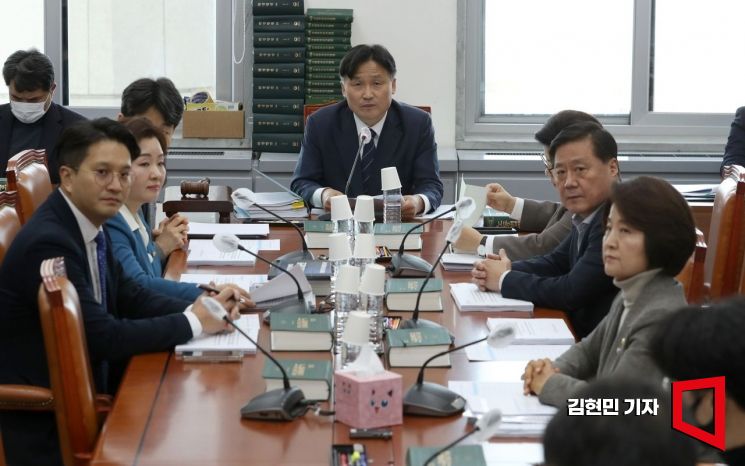 On the 15th, a meeting of the Subcommittee on Employment and Labor Law under the Environment and Labor Committee was held in the small conference room of the National Assembly's Environment and Labor Committee. During the meeting, partial amendments to the Labor Union and Labor Relations Adjustment Act, including revisions to Articles 2 and 3 of the Trade Union Act, were reviewed. Photo by Hyunmin Kim kimhyun81@
First, the scope of employers is significantly expanded. Previously, only those who were employers under the employment contract were considered employers, but the amendment broadens this to "persons who, even if not a party to the labor contract, have a position to substantially and specifically control or determine the working conditions of workers." This codifies precedents from the Supreme Court and other judiciary bodies into law. As a result, if it is judged that the primary contractor effectively determines working conditions, that employer can be subject to collective bargaining. Kim Young-jin, chairman of the Employment and Labor Law Review Subcommittee and a Democratic Party lawmaker, said, "It was necessary for the National Assembly to organize numerous labor-related precedents from the Supreme Court and administrative courts," adding, "This is a real employer bargaining law that clearly defines rights such as the constitutional right to collective bargaining and action." Legal circles had previously pointed out that "if only the primary employer is burdened with collective bargaining obligations, the three fundamental labor rights cannot be guaranteed."
The scope of labor disputes involving workers' strikes is also expanded. Currently, labor disputes are defined as conflicts between labor unions and employers over the "determination of working conditions." Accordingly, labor disputes have been limited to interest disputes surrounding the conclusion and renewal of collective agreements related to working conditions. The alternative passed by the subcommittee expands the scope of labor disputes to include working conditions. Consequently, the legal scope of labor disputes is greatly increased by extending to the area of rights disputes. Kim said, "Regarding labor disputes, the amendment clarifies the legal scope of legitimate labor disputes, reflecting the actual forms of disputes occurring in the field," explaining, "Previously, disputes were limited to wage issues, and violations of collective agreements or related matters were considered illegal acts leading to legal disputes. This amendment defines the scope of labor disputes under the comprehensive term 'working conditions.'" He also added, "In fact, this law is a provision that was suddenly changed during the 1996 rushed union law amendment."
The amendment also limits the scope of damages claims. Currently, there is only a provision that damages claims cannot be made for parts arising from collective bargaining or disputes, but the amendment includes provisions that even if liability for damages is recognized, the scope of responsibility is limited by the liable party's fault or contribution for each damage. This aims to improve the issue of joint liability in damages claims. Kim said, "According to the amendment, when claiming damages for illegal acts, the claimant must clearly specify which illegal act the liable party committed and what damage is being claimed," adding, "This was established to prevent excessive damage claims from destroying unions or being abused to eliminate the constitutionally guaranteed three fundamental labor rights."
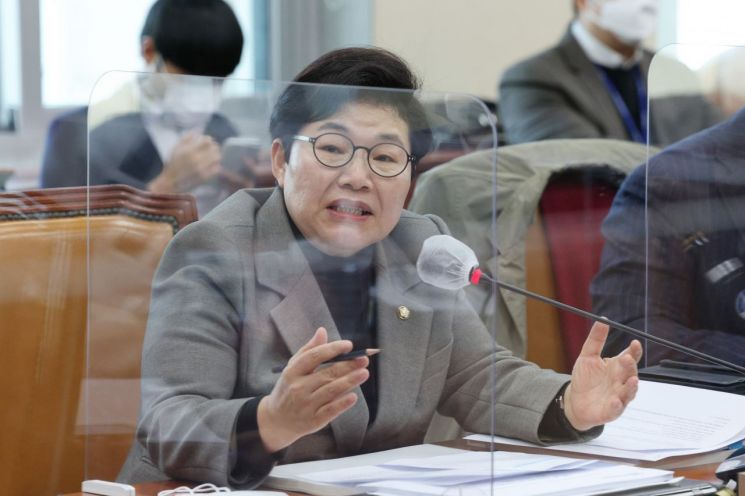
The amendment includes a provision exempting labor guarantors from liability for damages. Kim said, "Claiming damages from guarantors is a feudal system," adding, "Imposing liability for all aspects of dispute actions on guarantors has been largely avoided in recent legal systems, and it is time to change this."
The Employment and Labor Law Review Subcommittee of the Environment and Labor Committee held four meetings including this day. However, progress was slow due to significant differences between the ruling and opposition parties. The atmosphere changed from last month. The turning point was the first trial ruling by the Seoul Administrative Court on CJ Logistics on the 12th of last month. In that case, the court ruled that CJ Logistics' refusal to engage in collective bargaining with delivery workers was an 'unfair labor practice.' After the ruling, momentum for legislative promotion grew within the Democratic Party. Democratic Party lawmakers in the Environment and Labor Committee held a forum titled 'The Direction of Labor Union Law Amendments Signified by the CJ Delivery Workers First Trial Ruling' and accelerated efforts to create a unified party proposal. A Justice Party official explained, "Within the Democratic Party, except for some lawmakers, there was strong opposition to the 'employer scope provision (Article 2 of the Labor Union Act),' and this CJ ruling became a basis and turning point." Voices within the Democratic Party also called for "at least the National Assembly to prepare laws that follow precedents, even if it cannot go beyond the courts."
Academia and labor circles have expressed concerns that if the bill's passage is delayed while court precedents are already established, social confusion may only worsen. Park Soo-geun, former chairman of the Central Labor Relations Commission and professor at Hanyang University Law School, warned at a forum, "If there is no legislation on the Yellow Envelope Act, conflicts between companies and unions will occur, and labor-management relations could intensify." Legal circles also expressed concerns that without legislation, both labor and management would repeatedly turn to the courts, potentially waiting five to six years for a Supreme Court ruling despite existing precedents.
There is still a long way to go before the amendment becomes effective. People Power Party members of the Environment and Labor Committee held a press conference immediately after the bill's passage, stating, "This law is clearly nothing more than a commissioned legislation by the massive political union, the Korean Confederation of Trade Unions," and "The Democratic Party is pushing through a law that encourages illegal strikes and shields the Korean Confederation of Trade Unions while only looking at them." They criticized that the employer definition is ambiguous, predicting "conflicts and confusion between labor and management in the field, legitimizing illegal strikes, and denying joint responsibility for illegal acts."
Since the ruling party requested a coordination committee, the bill will first go through the coordination committee process. The committee is expected to be composed of three Democratic Party members, two People Power Party members, and one Justice Party member, making it likely that the bill will be submitted to the full Environment and Labor Committee meeting on the 21st. Democratic Party lawmaker Lee Su-jin, a member of the Environment and Labor Committee, explained, "Once the coordination committee is requested, it must be held, and the conclusion from the coordination committee will be brought to the full committee on the 21st for a vote."
Although the Environment and Labor Committee has a majority of opposition members, making passage possible, the bill still faces the hurdle of the Legislation and Judiciary Committee, chaired by the ruling party. It will not be easy to pass the systematic and technical review in the Legislation and Judiciary Committee. Options such as direct referral from the Environment and Labor Committee to the plenary session after 60 days, as with the Grain Management Act, remain, but the possibility of a presidential veto also exists, leaving the outlook for actual legal amendment uncertain.
© The Asia Business Daily(www.asiae.co.kr). All rights reserved.


















